Guidelines for Enhancing Student-Centered Learning Management in the Digital Era of the Phop Phra-Wale-RuamThai School group under Tak Primary Educational Service Area Office 2
Keywords:
Student-Centered Learning, Learning Management, Digital EraAbstract
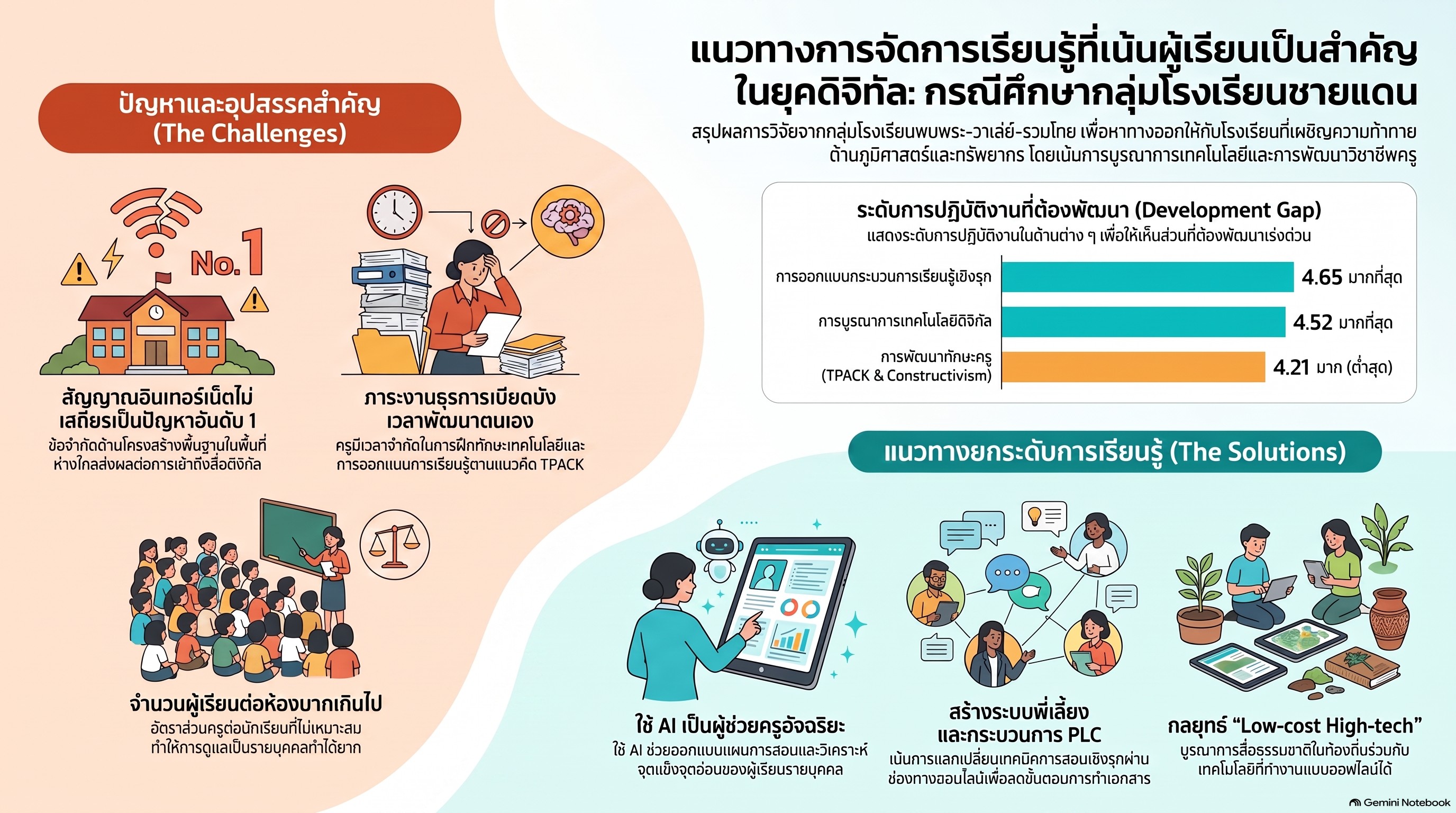
This research aimed to investigate the current conditions and problems and to develop guidelines for promoting learner-centered learning management in the digital era within the Phop Phra–Wale–Ruam Thai School Group under Tak Primary Educational Service Area Office 2. A mixed methods research design was employed in two phases. The participants comprised 347 school administrators and teachers from schools in the Phop Phra–Wale–Ruam Thai School Group and 9 experts. Data were collected using questionnaires and structured interviews. The data were analyzed using frequency, percentage, mean, standard deviation, and content analysis. The findings indicated that the overall level of promoting learner-centered learning management in the digital era was high (μ = 4.43, σ = 0.52). The highest-rated aspect was the promotion of active learning design, whereas the lowest-rated aspect was teachers’ development in technology integration and instructional design based on the TPACK and Constructivism frameworks. The major problems included unstable internet connectivity, large class sizes that limited effective learning activities, and excessive administrative workloads that reduced teachers’ opportunities for professional development. The proposed guidelines emphasized the use of artificial intelligence (AI) as a teaching assistant to support instructional management and analyze individual students’ strengths and weaknesses. In addition, school administrators should establish mentoring systems and professional learning communities (PLCs) to facilitate knowledge sharing and the exchange of effective active learning practices.
References
กระทรวงศึกษาธิการ. (2553). พระราชบัญญัติการศึกษาแห่งชาติ พ.ศ. 2542 และที่แก้ไขเพิ่มเติม (ฉบับที่ 2) พ.ศ. 2545. คุรุสภาลาดพร้าว.
จุฑามาศ กลิ่นขจร. (2564). การพัฒนาทักษะการคิดของผู้เรียนโดยใช้การเรียนรู้แบบโครงงาน โรงเรียนบ้านแม่ตะละ อำเภอท่าสองยาง จังหวัดตาก. โรงเรียนบ้านแม่ตะละ.
ธัชพนธ์ สรภูมิ. (2568). TPACK: กรอบแนวคิดสำหรับครูยุคใหม่. วารสารเทคโนโลยีและสื่อสารการศึกษา คณะศึกษาศาสตร์ มหาวิทยาลัยมหาสารคาม, 8(27), 7–18.
บุญชม ศรีสะอาด. (2560). การวิจัยเบื้องต้น (พิมพ์ครั้งที่ 10). สุวีริยาสาส์น.
ผุดผาด หงส์ชุมแพ. (2568). บทบาทของเทคโนโลยีดิจิทัลในระบบการศึกษาไทย: ความท้าทายและโอกาสของการนำเทคโนโลยีมาใช้ในโรงเรียน มหาวิทยาลัย และการเรียนรู้ตลอดชีวิต. วารสารสังคมศาสตร์ไทย, 2(1), 27–37. https://www.tci-thaijo.org/articles/social18-1089
พวงทอง ศรีวิลัย. (2568). การพัฒนารูปแบบการส่งเสริมการจัดการเรียนรู้ของครูโดยใช้เทคโนโลยีดิจิทัลเป็นฐานรองรับการเรียนรู้ทุกที่ทุกเวลา สังกัดสำนักงานคณะกรรมการการศึกษาขั้นพื้นฐาน. วารสารการวิจัยการบริหารการพัฒนา, 15(3–4), 4507–4521.
วิมลรัตน์ สุนทรโรจน์. (2563). การจัดการเรียนรู้เชิงรุก (Active Learning). คณะศึกษาศาสตร์ มหาวิทยาลัยมหาสารคาม.
วัชรินทร์ กองสุข. (2569). กรอบแนวคิด TPACK-AI: แนวทางการพัฒนาทักษะครูไทยในยุคปัญญาประดิษฐ์. วารสารการบริหารและความเป็นผู้นำทางการศึกษา มหาวิทยาลัยรามคำแหง, 3(1), 1–28.
วัฒนาพร ระงับทุกข์. (2542). การจัดการเรียนการสอนที่เน้นผู้เรียนเป็นศูนย์กลาง. เลิฟแอนด์เลิฟเพรส.
สถาบันคุรุพัฒนา. (2565). แนวทางการพัฒนาครูและบุคลากรทางการศึกษาตามระบบการพัฒนาวิชาชีพอย่างต่อเนื่อง. สถาบันคุรุพัฒนา.
สำนักงานเขตพื้นที่การศึกษาประถมศึกษาตาก เขต 2. (2568). แผนปฏิบัติการประจำปีงบประมาณ 2568. สำนักงานเขตพื้นที่การศึกษาประถมศึกษาตาก เขต 2.
สำนักงานเขตพื้นที่การศึกษาประถมศึกษาตาก เขต 2. (2568). แผนพัฒนาการศึกษา พ.ศ. 2566–2570. สำนักงานเขตพื้นที่การศึกษาประถมศึกษาตาก เขต 2.
สำนักงานเลขาธิการสภาการศึกษา. (2562). รายงานแนวทางการพัฒนาสมรรถนะผู้เรียนในระดับการศึกษาขั้นพื้นฐาน. บริษัท 21 เซ็นจูรี่ จำกัด.
สำนักงานเลขาธิการสภาการศึกษา. (2564). รายงานการศึกษา: รูปแบบการจัดการเรียนรู้สำหรับนักเรียนระดับการศึกษาขั้นพื้นฐานที่ได้รับผลกระทบจากสถานการณ์โควิด–19. กระทรวงศึกษาธิการ.
สุกัญญา แช่มช้อย. (2562). การบริหารสถานศึกษาในยุคดิจิทัล. โรงพิมพ์แห่งจุฬาลงกรณ์มหาวิทยาลัย.
อาภรณ์ ใจเที่ยง. (2553). หลักการสอน (พิมพ์ครั้งที่ 5). โอเดียนสโตร์.
เอกพงษ์ พิเศษจาตุรงศ์. (2569). การพัฒนารูปแบบการบริหารสมรรถนะของครูโดยใช้หลักชุมชนการเรียนรู้ทางวิชาชีพ (PLC) โรงเรียนวัดท่าข้าม จังหวัดเชียงใหม่. วารสาร มจร หริภุญชัยปริทรรศน์, 10(2), 234–243. https://www.tci-thaijo.org/articles/social04-282662
Trilling, B., & Fadel, C. (2009). 21st century skills: Learning for life in our times. Jossey-Bass.
Vygotsky, L. S. (1978). Mind in society: The development of higher psychological processes. Harvard University Press.
Downloads
Published
How to Cite
Issue
Section
Categories
License
Copyright (c) 2026 Journal of Buddhist Education and Research (JBER)

This work is licensed under a Creative Commons Attribution-NonCommercial-NoDerivatives 4.0 International License.