The Development Model of 21st-Century Instructional Management for Thai Language Teachers in Schools under the Khon Kaen Provincial Administrative Organization
Keywords:
Learning Management, 21st-Century Thai Language Teacher, Khon Kaen Provincial Administrative OrganizationAbstract
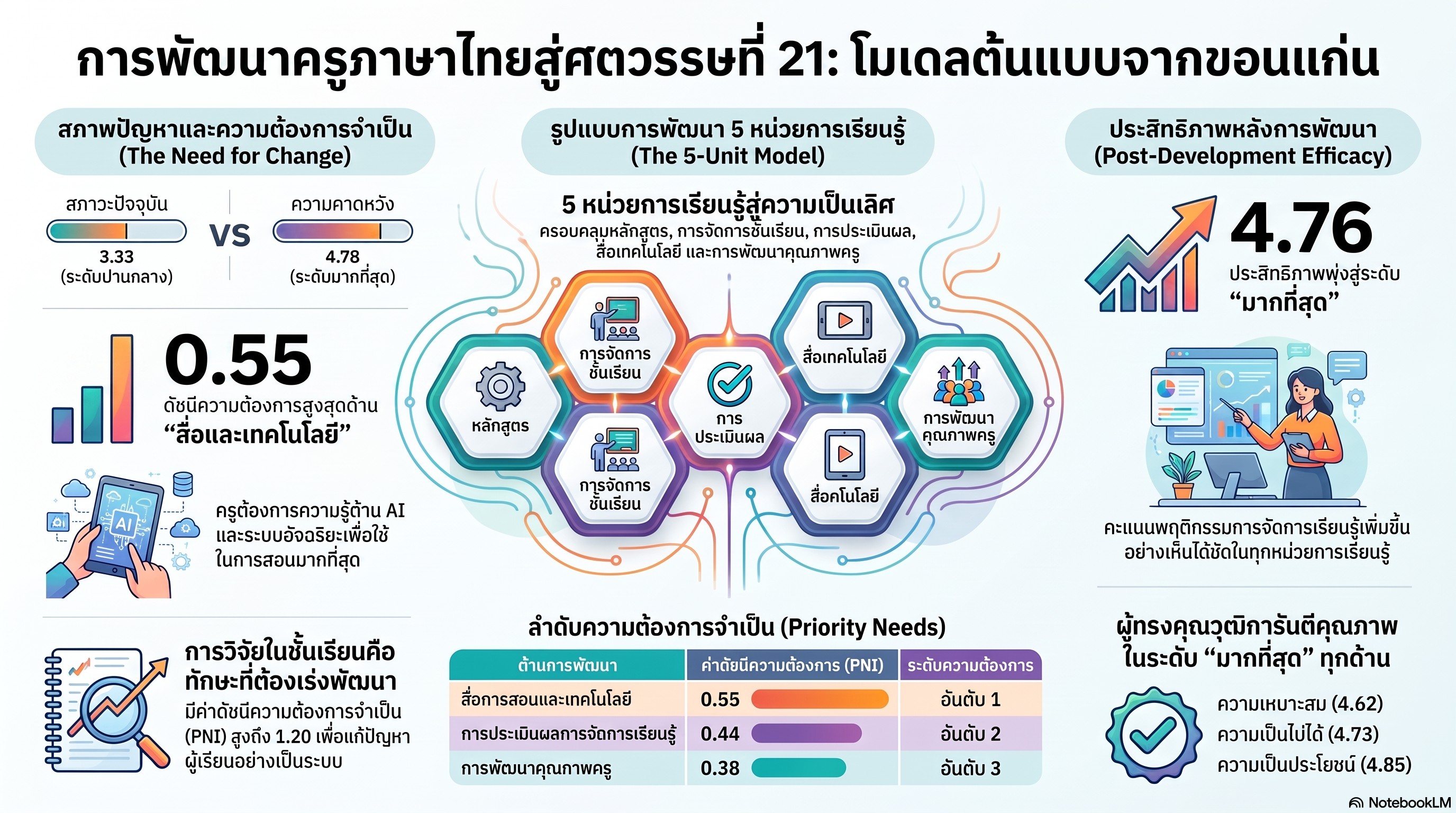
This research and development study aimed to 1) examine the current states, desirable states, and priority needs, 2) develop a model, 3) implement the model, and 4) evaluate a learning management development model for 21st-century Thai language teachers under the Khon Kaen Provincial Administrative Organization. The research was conducted in four phases: Phase 1 surveyed the current and desirable states from 116 school administrators, heads of Thai language departments, and Thai language teachers using a questionnaire with a reliability of 1.00; Phase 2 involved model development verified and evaluated by 9 experts; and Phases 3 and 4 focused on model implementation and evaluation with 30 Thai language teachers. Data were analyzed using percentage, mean, standard deviation, and the Modified Priority Needs Index (PNI _modified). The results indicated that: 1) The overall current state of practice was at a moderate level (M=3.33,SD=0.36), while the desirable state was at the highest level (M=4.78,SD=0.26). The overall priority need index was 0.43, with the highest need found in instructional media and technology (0.55), followed by learning assessment (0.44), teacher quality development (0.38), classroom management (0.35), and curriculum development (0.34). 2) The developed model comprises five components: principles, objectives, content, development process, and measurement and evaluation, spanning five learning units. 3) The implementation results showed that teachers' learning management capabilities significantly increased from a moderate level (M=3.38,SD=0.42) before development to the highest level (M=4.76,SD=0.45) after development. 4) Expert evaluation of the model's efficiency demonstrated that appropriateness (M=4.62,SD=0.34), feasibility (M=4.73,SD=0.37), and utility (M=4.85,SD=0.38) were all at the highest levels, and the overall satisfaction of teachers toward the model was also at the highest level (M=4.72,SD=0.44).
References
กระทรวงศึกษาธิการ. (2568). การพัฒนาคุณภาพการเรียนการสอนภาษาไทย. http://academic.obec.go.th/images/document/1635915031_d_1.pdf
กิตติยา ชื่นอารมณ์. (2565). ผลของการใช้เทคโนโลยีความเป็นจริงเสริมร่วมกับแบบฝึกที่มีต่อผลสัมฤทธิ์ทางการเรียนของนักเรียนประถมศึกษา. วารสารวิจัยทางการศึกษา, 18(2), 91–104.
จอมพงศ์ มงคลวนิช. (2555). การบริหารองค์การและบุคลากรทางการศึกษา. สำนักพิมพ์จุฬาลงกรณ์มหาวิทยาลัย.
จิราภรณ์ คำจริง. (2563). ผลของการส่งเสริมครูในการวิจัยในชั้นเรียนต่อการพัฒนาการเรียนรู้ของนักเรียนระดับประถมศึกษา. วารสารวิชาการมหาวิทยาลัยราชภัฏนครปฐม, 9(2), 45–59.
จิระพันธ์ แก้วกำเนิด. (2562). ผลของการพัฒนาครูในการสร้างและวิเคราะห์เครื่องมือประเมินผลการเรียนรู้. วารสารศึกษาศาสตร์ มหาวิทยาลัยนเรศวร, 21(3), 45–58.
ฐิตารีย์ ปาปะใน. (2563). การพัฒนาโปรแกรมการจัดการเรียนรู้ของครูสอนภาษาไทยเพื่อการอ่านออกเขียนได้ของนักเรียนชั้นก่อนประถมศึกษา สังกัดสำนักงานเขตพื้นที่การศึกษาประถมศึกษามหาสารคาม เขต 2 [วิทยานิพนธ์การศึกษามหาบัณฑิต, มหาวิทยาลัยมหาสารคาม].
นิตยา ผิวผ่อง. (2563). การพัฒนาสื่อมัลติมีเดียเพื่อส่งเสริมความเข้าใจในวิชาวิทยาศาสตร์ระดับมัธยมศึกษาตอนต้น. วารสารเทคโนโลยีการศึกษา, 13(1), 65–78.
นุชนาถ พรหมการี. (2563). การพัฒนารูปแบบการเรียนรู้แบบผสมผสานเพื่อส่งเสริมทักษะการคิดวิเคราะห์ของนักเรียนระดับชั้นมัธยมศึกษา. วารสารวิจัยทางการศึกษา, 15(2), 45–60.
ปิยนาถ วิชัยรัมย์. (2565). การส่งเสริมครูในการวิจัยในชั้นเรียนเพื่อพัฒนาพฤติกรรมและผลสัมฤทธิ์ของนักเรียนระดับมัธยมศึกษา. วารสารวิจัยและพัฒนาระบบสุขภาพ, 15(1), 22–31.
ภูมิภัทร พันธ์ทองหลาง. (2562). การพัฒนารูปแบบหลักสูตรฝึกอบรมเพื่อเสริมสร้างความสามารถในการใช้ภาษาไทยสำหรับนักศึกษาวิชาชีพครู สถาบันการพลศึกษา [วิทยานิพนธ์ปรัชญาดุษฎีบัณฑิต, มหาวิทยาลัยราชภัฏวไลยอลงกรณ์ ในพระบรมราชูปถัมภ์].
เพชรจันทร์ ภูทะวัง, & สุวัฒน์ จุลสุวรรณ์. (2566). การพัฒนาโปรแกรมเสริมสร้างสมรรถนะการจัดการเรียนรู้เชิงรุกของครูโรงเรียนประถมศึกษา สังกัดสำนักงานคณะกรรมการการศึกษาขั้นพื้นฐาน. วารสาร มจร สังคมศาสตร์ปริทรรศน์, 12(4), 282–296.
เยาวดี วิบูลย์ศรี. (2562). การวิจัยในชั้นเรียน: แนวคิดและแนวปฏิบัติ. สำนักพิมพ์มหาวิทยาลัยศรีนครินทรวิโรฒ.
วิชัย วงษ์ใหญ่, & มารุต พัฒผล. (2563). New normal ทางการเรียนรู้. มหาวิทยาลัยศรีนครินทรวิโรฒ.
สุดธิดา พ่วงเฟื่อง, & ทองเหลือ แย้มศิริ. (2562). รูปแบบการพัฒนาคุณลักษณะความเป็นครูของครูภาษาไทยในศตวรรษที่ 21. บัณฑิตศึกษาปริทรรศน์ วิทยาลัยสงฆ์นครสวรรค์, 7(3), 137–150.
สงกรานต์ พรไชยา. (2567). แนวทางการพัฒนาการจัดการเรียนรู้ที่เน้นทักษะการคิดวิเคราะห์สำหรับครูภาษาไทย สังกัดสำนักงานเขตพื้นที่การศึกษามัธยมศึกษาสุรินทร์. วารสารมหาวิทยาลัยมหามกุฏราชวิทยาลัย วิทยาเขตร้อยเอ็ด, 13(1), 459–470.
สำนักงานเขตพื้นที่การศึกษาประถมศึกษานครราชสีมา เขต 3. (2568). ทักษะการเรียนรู้ในศตวรรษที่ 21 (3R8C). https://korat3.go.th/supervisor/
สำนักงานคณะกรรมการการศึกษาแห่งชาติ. (2545). พระราชบัญญัติการศึกษาแห่งชาติ พ.ศ. 2542 และที่แก้ไขเพิ่มเติม (ฉบับที่ 2) พ.ศ. 2545. สำนักงานคณะกรรมการการศึกษาแห่งชาติ.
สำนักงานคณะกรรมการการศึกษาขั้นพื้นฐาน. (2553). คู่มือการประเมินสมรรถนะครู. สำนักงานคณะกรรมการการศึกษาขั้นพื้นฐาน.
สำนักงานเลขาธิการสภาการศึกษา. (2560). แผนการศึกษาแห่งชาติ พ.ศ. 2560–2579. บริษัท พริกหวานกราฟฟิค จำกัด.
สำนักงานรับรองมาตรฐานและประเมินคุณภาพการศึกษา. (2554). คู่มือการประเมินคุณภาพภายนอกรอบสาม (พ.ศ. 2554–2558) ระดับการศึกษาขั้นพื้นฐาน ฉบับสถานศึกษา พ.ศ. 2554 [เอกสารอัดสำเนา]. สำนักงานรับรองมาตรฐานและประเมินคุณภาพการศึกษา.
ศิริเดช สุชีวะ. (2561). การวัดและประเมินผลการเรียนรู้. สำนักพิมพ์มหาวิทยาลัยเกษตรศาสตร์.
อาภาพร บุญสุข. (2564). ผลของการพัฒนาทักษะการวิจัยในชั้นเรียนที่มีต่อความสามารถในการจัดการเรียนรู้ของครู. วารสารศึกษาศาสตร์ มหาวิทยาลัยขอนแก่น, 44(2), 35–48.
อารีย์รัตน์ โนนสุวรรณ. (2563). การพัฒนารูปแบบการเรียนการสอนด้วยแนวทางการเรียนรู้เชิงรุกและการกำกับตนเองเพื่อส่งเสริมสมรรถนะการวิจัยในชั้นเรียนสำหรับนักศึกษาครู สาขาวิชาภาษาไทย [วิทยานิพนธ์ปรัชญาดุษฎีบัณฑิต, มหาวิทยาลัยขอนแก่น].
อุทุมพร จามรมาน. (2560). การพัฒนาวิชาชีพครู (พิมพ์ครั้งที่ 4). สำนักพิมพ์แห่งจุฬาลงกรณ์มหาวิทยาลัย.
Bardo, J. W., & Hartman, D. R. (1992). Improving teaching through classroom research. Kendall/Hunt Publishing.
Doolittle, P. E., & Camp, W. G. (1999). Constructivism: The career and technical education perspective. Journal of Vocational and Technical Education, 16(1), 23–46.
Hobbs, R. (2010). Digital and media literacy: A plan of action. The Aspen Institute.
Oppong-Gyebi, E., Bonyah, E., & Clark, L. J. (2023). Constructive instructional teaching and learning approaches and their mathematical classroom teaching practices: A junior high school perspective. Contemporary Mathematics and Science Education, 4(1), Article ep23002. https://doi.org/10.30935/conmaths/12541
Nitko, A. J., & Brookhart, S. M. (2014). Educational assessment of students (7th ed.). Pearson.
Zawacki-Richter, O., Marín, V. I., Bond, M., & Gouverneur, F. (2019). Systematic review of research on artificial intelligence applications in higher education: Where are the educators? International Journal of Educational Technology in Higher Education, 16(1), 1–27. https://doi.org/10.1186/s41239-019-0171-0
Downloads
Published
How to Cite
Issue
Section
License
Copyright (c) 2026 Author(s)

This work is licensed under a Creative Commons Attribution-NonCommercial-NoDerivatives 4.0 International License.