
Vocational Education Innovation and Research Journal is an educational journal published by the Institute of Vocational Education: Northeastern Region 1. The journal distributed on the purpose of:
- Promote and distribute the Knowledge and concept of the Bachelor of Technology and related field.
- Disclose the output of a study, explore, and research of Innovation and Research on vocational education.
- Use as the medium on the discussion and opinion exchange among members and person concerned.
Focus and Scope
A Vocational Education Innovation and Research Journal aims to be functioned as the medium on the discussion and opinion exchange among members and person concerned. Moreover, it is hoped to enable the development of vocational education and research, the workplace, economic, society and environment. It comprises of the content scope on the industrial technology, information technology, business administration and vocational education related area.
Peer Review Process
A Vocational Education Innovation and Research Journal (Ve-irj) is grateful to everyone who kindly submit the academic work productivities approval. Consequently, these journal will be supposed to be both in printed and online publishing (via www.tci-thaijo.org). In order to make it completed, the editors would like to inform the discipline in peer review process as follows:
- The research article must have not been previously published elsewhere or on a waiting list of another journal.
- The approved research article must be approved by at least 2 Peer Review Experts. In case of the different mean of approval, this article will finally submit to the third expert. Furthermore, the approval process intends to be a Double-Blind Peer Review and will be qualified by the editors. After an approval, the article author will be informed upon the approval time. Actually, the editors’ approval result is regarded as a final stage.
- The author should follow the requirements of the editors and admit the proofreading and editing for a complete publishing.
The author’s suggestion
The author should report the research work honestly without the fabrication, falsification or data manipulation, and be responsible for opinion and viewpoint appeared in the journal. The Editors will not bear any responsibilities on the above mentioned. In addition, the author should hold accountable for the copyright of the original article in all cases. The CopyCat application will be applied for any plagiarism of other works via ThaiJo (the minimum level of acceptance will be at 20%). The plagiarism approval will be commenced in September 2022 onward.
Announcement
Those who involved can edit the personal information in both Thai and English versions such as: name (with no title); last name; and full name along with job position (if any) via https://drive.google.com/.../tmses7-Rf-iviCXqyESpLgcxd-9.../view in order to solve the following problems:
- To avoid the wrong name reference because ‘name’ will be employed as a reference. In case of putting the title with name will lead to the misunderstanding about the amount of the author.
- To prevent the Google website from misunderstanding. Some people host a wrong name and when it is searched by google, the wrong name will be recorded. In case of name change requirement, it will take long time for Google to change as desired.
- As for no. 1, it is advantageous on the score calculation for a correct reference and personal information.
Publication Frequency
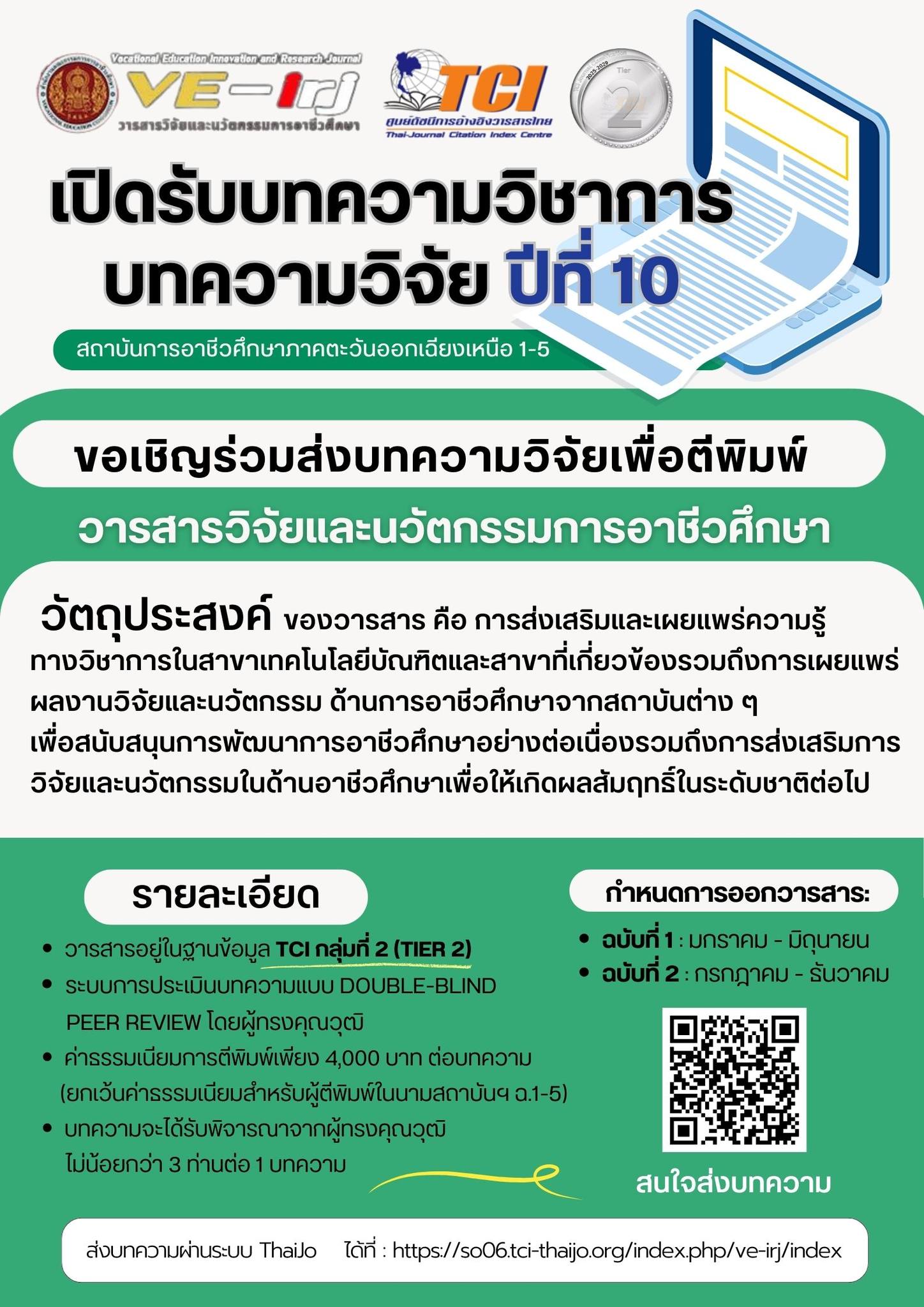
A journal will be published two regular issues a year. (January – June and July – December)
E-mail: ivene1journal@gmail.com
ISSN: 3027-6861 (Print)
ISSN: 3027-687X (Online)
Current Issue
Vol. 10 No. 2 (2569): July - December
วารสารวิจัยและนวัตกรรมการอาชีวศึกษา มีนโยบายเพื่อเป็นสื่อกลางในการเผยแพร่ผลงานวิจัยและนวัตกรรม ที่นำไปสู่การพัฒนาการอาชีวศึกษา หรือการนำองค์ความรู้ด้านการอาชีวศึกษาที่ผ่านกระบวนการวิจัย และนวัตกรรมเพื่อนำไปสู่การพัฒนาสถานประกอบการชุมชน เศรษฐกิจ สังคม สิ่งแวดล้อม ประกอบไปด้วยขอบเขตเนื้อหา ด้านเทคโนโลยีอุตสาหกรรม เทคโนโลยีสารสนเทศ บริหารธุรกิจ และอื่นๆ ที่เกี่ยวข้องกับการอาชีวศึกษา
Published: 2026-10-27