Creative Leadership of School Administrators Affecting the Effectiveness of Schools under the Khon Kaen Primary Educational Service Area Office 3
Keywords:
Creative Leadership, School Administrators, School Effectiveness, Primary Educational Service Area, Khon Kaen 3Abstract
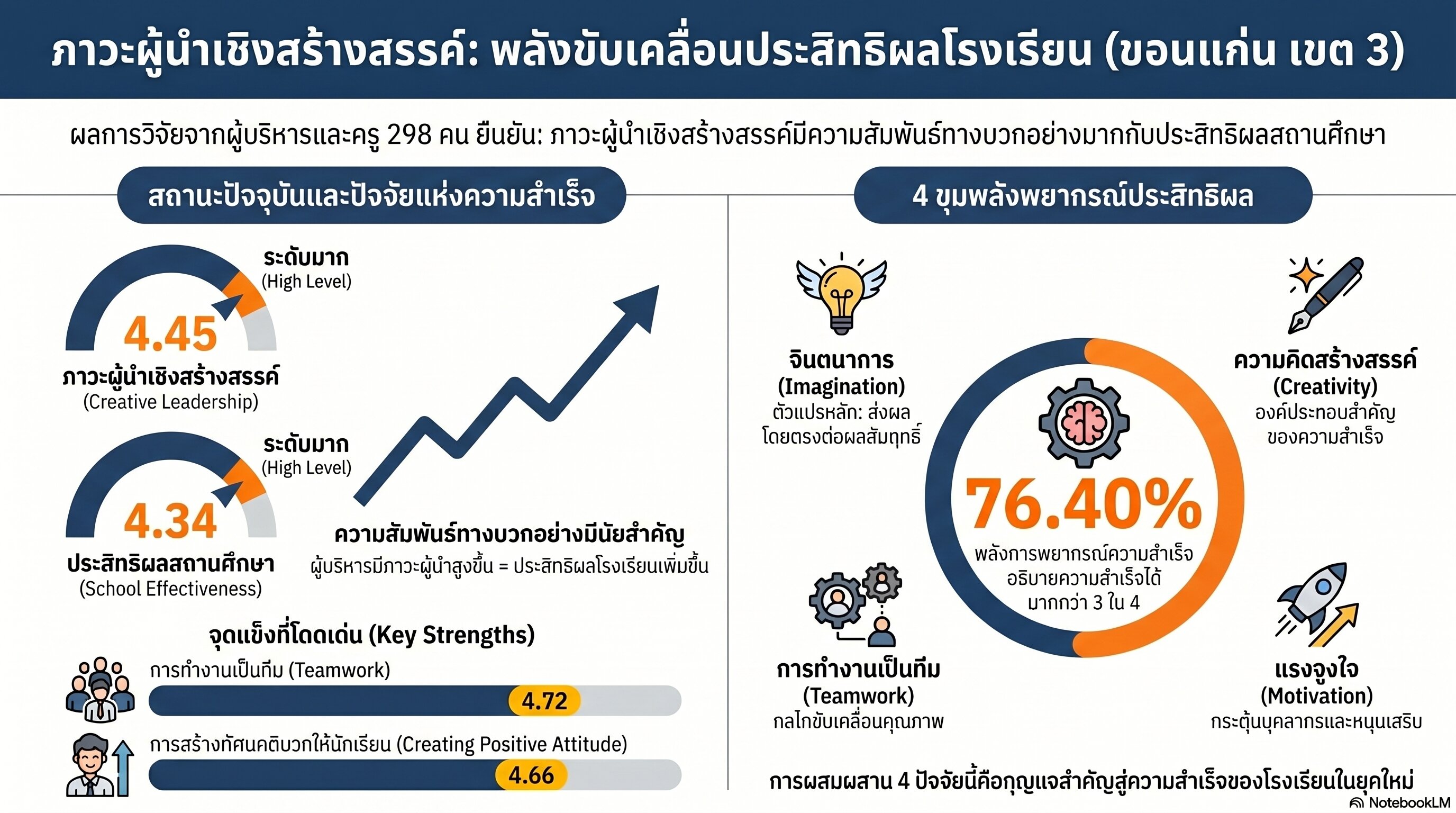
The objectives of this research were: (1) to study the level of creative leadership of school administrators under the Office of Khon Kaen Primary Educational Service Area 3 (2) to study the level of school effectiveness under the same office (3) to examine the relationship between creative leadership of school administrators and school effectiveness; and (4) to investigate the influence of creative leadership on the effectiveness of schools under the Office of Khon Kaen Primary Educational Service Area 3. This study employed a quantitative research methodology. The sample consisted of 298 participants, comprising 100 school administrators and 198 teachers, determined using Krejcie and Morgan’s sample size table and selected through stratified random sampling. The research instrument was a questionnaire with item discrimination indices ranging from 0.415 to 0.965 and an overall reliability coefficient of 0.976. Data were analyzed using a statistical software package to calculate percentage, mean, standard deviation, Pearson’s product-moment correlation coefficient, and stepwise multiple regression analysis. The findings revealed that: 1) The study found that the overall level of creative leadership among school administrators under the Khon Kaen Primary Educational Service Area Office 3 was high (=4.45, S.D.=0.18) When ranked by dimension, teamwork was the highest ( =4.72, S.D. 0.54), followed by motivation (=4.68, S.D.=0.03), flexibility (= 4.51, S.D.=0.14), creativity (=4.33, S.D.=0.16), vision (= 4.30, S.D.=0.16), and imagination (=4.13, S.D.=0.10). These results indicate that administrators demonstrate strong teamwork and motivational abilities, which are key factors contributing to their overall creative leadership. 2) The study revealed that the overall school effectiveness under the Khon Kaen Primary Educational Service Area Office 3 was high (=4.34, S.D.=0.19). Ranked by dimension, the highest score was for the ability to develop students with positive attitudes (=4.66, S.D.=0.04), followed by academic achievement (=4.57, S.D.=0.09), quality assurance (=4.49, S.D.=0.79), teacher job satisfaction (=4.32, S.D.=0.16), school development capacity (=4.15, S.D.=0.77), participation (=4.13, S.D.=0.10), and resource management (=4.09, S.D.=0.07). These findings suggest that schools maintain high effectiveness across multiple dimensions, particularly in fostering positive student attitudes and academic performance.3) There was a statistically significant positive correlation at the .01 level between the creative leadership of school administrators and school effectiveness. 4) Four aspects of creative leadership imagination (X3), creativity (X4), teamwork (X5), and motivation (X6)were found to significantly predict school effectiveness, with an explanatory power of 76.40% (R² = 0.764). The prediction equations were as follows: The prediction equations of Unstandardized score = 0.863 + 0.299(X3) + 0.183(X4) + 0.292(X5) + 0.253(X6) The prediction equations of Standardized score = 0.154Z(X3) + 0.279(X4) + 0.379(X5) + 0.336(X6)
References
รัษฎากรณ์ อัครจันทร์. (2560). รูปแบบการพัฒนาภาวะผู้นำเชิงสร้างสรรค์ของครูในโรงเรียนประถมศึกษา สังกัดสำนักงานคณะกรรมการการศึกษาขั้นพื้นฐานในภาคตะวันออกเฉียงเหนือตอนบน [ดุษฎีนิพนธ์ปริญญาดุษฎีบัณฑิต, มหาวิทยาลัยราชภัฏสกลนคร].
พรชัย เจดามาน. (2560). ความสำคัญของการศึกษาในยุคปฏิรูป. สำนักพิมพ์มหาวิทยาลัยรามคำแหง.
ธีระ รุญเจริญ. (2554). สุดยอดภาวะผู้นำ: Super leadership. โรงพิมพ์ข้าวฟ่าง.
นัยนา ชนาฤทธิ์. (2556). ภาวะผู้นำเชิงสร้างสรรค์ของผู้บริหารสถานศึกษา สังกัดสำนักงานเขตพื้นที่การศึกษาประถมศึกษาขอนแก่น เขต 5 [วิทยานิพนธ์ปริญญาการศึกษามหาบัณฑิต, มหาวิทยาลัยมหาสารคาม].
บุญชม ศรีสะอาด. (2560). การวิจัยเบื้องต้น (พิมพ์ครั้งที่ 10). สุวีริยาสาส์น.
พวงเพ็ชร์ พรหมมณี. (2560). ประสิทธิผลของสถานศึกษาในเขตพื้นที่การศึกษาประถมศึกษา [วิทยานิพนธ์ปริญญามหาบัณฑิต].
พิมลพรรณ เพชรสมบัติ. (2560). ทักษะการบริหารของผู้บริหารมหาวิทยาลัยเทคโนโลยีราชมงคลธัญบุรี จังหวัดปทุมธานี [ดุษฎีนิพนธ์ปริญญาดุษฎีบัณฑิต, มหาวิทยาลัยเทคโนโลยีราชมงคลธัญบุรี].
สุจิตรา บุญมา. (2559). ความพึงพอใจของครูกับประสิทธิผลของสถานศึกษา [วิทยานิพนธ์ปริญญาครุศาสตรมหาบัณฑิต, จุฬาลงกรณ์มหาวิทยาลัย].
Amabile, T. M. (1996). Creativity in context. Westview Press.
Bass, B. M. (1990). Bass & Stogdill’s handbook of leadership: Theory, research, and managerial applications (3rd ed.). Free Press.
Likert, R. (1932). A technique for the measurement of attitudes. Archives of Psychology.
Mumford, M. D., Scott, G. M., Gaddis, B., & Strange, J. M. (2002). Leading creative people: Orchestrating expertise and relationships. The Leadership Quarterly, 13(6), 705–750. https://doi.org/10.1016/S1048-9843(02)00158-3
Robinson, K. (2011). Out of our minds: Learning to be creative (2nd ed.). Capstone.
Sternberg, R. J. (2003). Wisdom, intelligence, and creativity synthesized. Cambridge University Press.
Torrance, E. P. (1988). The nature of creativity as manifest in its testing. Cambridge University Press.
Downloads
Published
How to Cite
Issue
Section
License
Copyright (c) 2026 Journal of Buddhist Education and Research (JBER)

This work is licensed under a Creative Commons Attribution-NonCommercial-NoDerivatives 4.0 International License.