Thai Laws and the Support for the Transition Process of Children with Disabilities
Keywords:
Special Education, Transition, Children with Disabilities, Thai Laws, Educational RightsAbstract
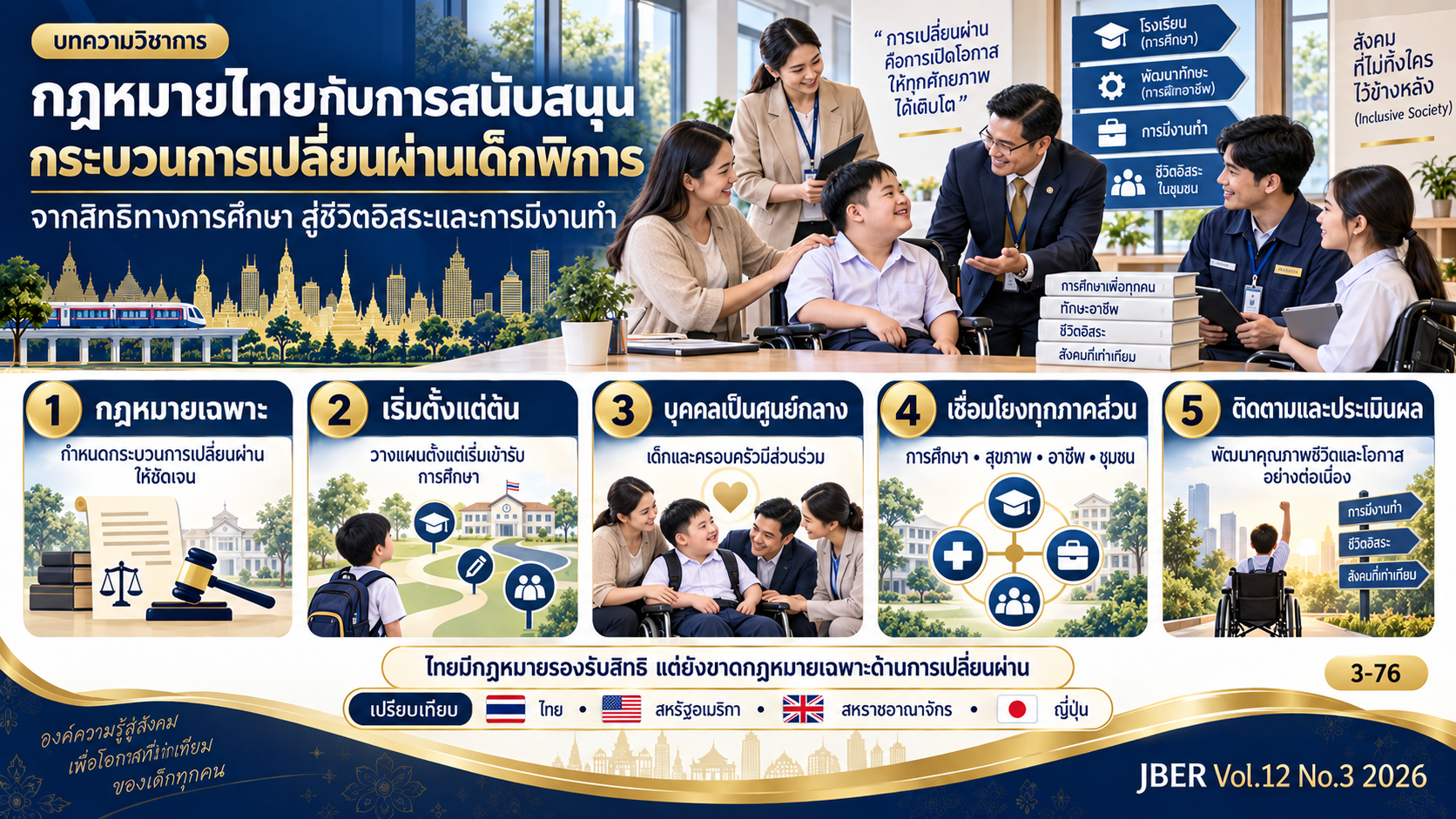
This article examines the development of laws and policies related to the transition process for children with disabilities in Thailand, from past to present, and compares these with international practices. The study finds that Thailand has several relevant laws, including the Constitution of the Kingdom of Thailand B.E. 2560 (2017), the National Education Act B.E. 2542 (1999), the Education for Persons with Disabilities Act B.E. 2551 (2008), and the Empowerment of Persons with Disabilities Act B.E. 2550 (2007), which have established important foundations for supporting educational rights and improving the quality of life for people with disabilities. However, Thailand still lacks specific legislation that clearly defines the transition process for children with disabilities. Compared with the United States, the United Kingdom, and Japan, significant differences were found in five areas: policies and legislation, process initiation, participation, collaboration integration, and monitoring and evaluation. This article proposes recommendations for developing laws and transition processes in Thailand, including developing specific transition legislation, initiating the transition process from the beginning of education, utilizing person-centered approaches, integrating collaboration between agencies, and developing monitoring and evaluation systems to enhance the quality of life and opportunities for children with disabilities in Thailand.
Keywords: Transition / Children with Disabilities / Thai Laws / Educational Rights / Special Education
References
กรมส่งเสริมและพัฒนาคุณภาพชีวิตคนพิการ. (2568). รายงานสถานการณ์ด้านคนพิการในประเทศไทย. https://dep.go.th/images/uploads/files/Dashboard122568.pdf
กรรวิภาร์ หงษ์งาม. (2557). การพัฒนารูปแบบการบริหารการเปลี่ยนผ่านสำหรับเด็กที่มีความต้องการพิเศษระดับมัธยมศึกษาในสถานศึกษาเฉพาะความพิการ [ดุษฎีนิพนธ์ศึกษาศาสตรดุษฎีบัณฑิต, มหาวิทยาลัยราชภัฏสวนดุสิต].
จิตประภา ศรีอ่อน, & ดารณี ศักดิ์ศิริผล. (2556). แนวทางการพัฒนาโปรแกรมการเปลี่ยนผ่านสำหรับนักเรียนพิการในประเทศไทย. วารสารวิจัยและพัฒนาการศึกษาพิเศษ, 12(1), 15–29.
สาวิตรี วงศ์กิติรุ่งเรือง, & ทวี เชื้อสุวรรณทวี. (2565). การเปลี่ยนผ่านสำหรับนักเรียนออทิสติกมีความสำคัญเพียงใด. วารสารการจัดการทางการศึกษาปฐมวัย มหาวิทยาลัยมหิดล, 4(1), 35–52.
สำนักบริหารงานการศึกษาพิเศษ. (2561). แนวทางการดำเนินงานการเปลี่ยนผ่านให้แก่บุคคลพิการสำหรับสถานศึกษา. https://drive.google.com/file/d/1_4sHZels3_izTayrrhs20aztbFw9MJL7/view
สมพร หวานเสร็จ. (2563). ประวัติการศึกษาพิเศษไทย: อดีต ปัจจุบัน และอนาคต. วารสารศึกษาศาสตร์ มหาวิทยาลัยขอนแก่น, 43(4), 1–17.
สุวิมล อุดมพิริยะศักย์. (2564). การพัฒนารูปแบบการเตรียมความพร้อมสำหรับการเปลี่ยนผ่านสู่อาชีพของนักเรียนที่มีความบกพร่องทางสติปัญญา. วารสารศึกษาศาสตร์ มหาวิทยาลัยนเรศวร, 23(4), 123–138.
Collins, G., Donohoe, C., & O'Reilly, G. (2021). Systematic review of transition planning for young people with intellectual disabilities in the United Kingdom. Journal of Policy and Practice in Intellectual Disabilities, 18(2), 132–142.
Committee on the Rights of Persons with Disabilities. (2022, August 23). Experts of the Committee on the Rights of Persons with Disabilities commend Japan on providing compensation to victims of eugenic surgery and raise concerns on institutionalisation and inclusive education [Press release]. Office of the United Nations High Commissioner for Human Rights. https://www.ohchr.org/en/press-releases/2022/08/experts-committee-rights-persons-disabilities-commend-japan-providing
Committee on the Rights of Persons with Disabilities. (2022, October 7). Concluding observations on the initial report of Japan (CRPD/C/JPN/CO/1). Office of the United Nations High Commissioner for Human Rights. https://uhri.ohchr.org/en/document/8ebab7ca-08d9-4952-a4b5-522eb75ed270
Japanese Law Translation. (2013). Act for Eliminating Discrimination Against Persons with Disabilities (Act No. 65 of June 26, 2013). https://www.japaneselawtranslation.go.jp/en/laws/view/3052/en
Maebara, K., Yamaguchi, K., Ikeda, K., & Takahashi, H. (2025). Current status and issues of the employment of persons with disabilities in small- and medium-sized enterprises in rural areas of Japan: A survey from business owners’ perspectives. Disabilities, 5(3), Article 62. https://doi.org/10.3390/disabilities5030062
Mazzotti, V. L., & Rowe, D. A. (2023a). Economic benefits of transition programming for students with disabilities: A systematic review of cost-benefit analyses. Exceptional Children, 89(3), 265–283. https://doi.org/10.1177/00144029221123456
Mazzotti, V. L., & Rowe, D. A. (2023b). Evidence-based transition practices for students with disabilities: Current status and future directions. Exceptional Children, 89(4), 389–407.
Wehman, P., Schall, C., McDonough, J., & Sima, A. (2022). Transition to adulthood for youth with autism spectrum disorder: A longitudinal study of employment outcomes. Journal of Autism and Developmental Disorders, 52(4), 1739–1754. https://doi.org/10.1007/s10803-021-05235-x
Wehman, P., Taylor, J., Brooke, V., Avellone, L., Whittenburg, H. N., Ham, W., & Carr, S. (2022). Toward competitive employment for persons with intellectual and developmental disabilities: A systematic review of employment interventions. Journal of Disability Policy Studies, 32(4), 231–247.
Downloads
Additional Files
Published
How to Cite
Issue
Section
Categories
License
Copyright (c) 2026 Journal of Buddhist Education and Research (JBER)

This work is licensed under a Creative Commons Attribution-NonCommercial-NoDerivatives 4.0 International License.