Reasons and Factors Influencing Cinema Attendance: A Comparative Study of Chinese and Thai Moviegoers
Keywords:
Cinema Going Behavior, 4P Marketing, Audience PreferenceAbstract
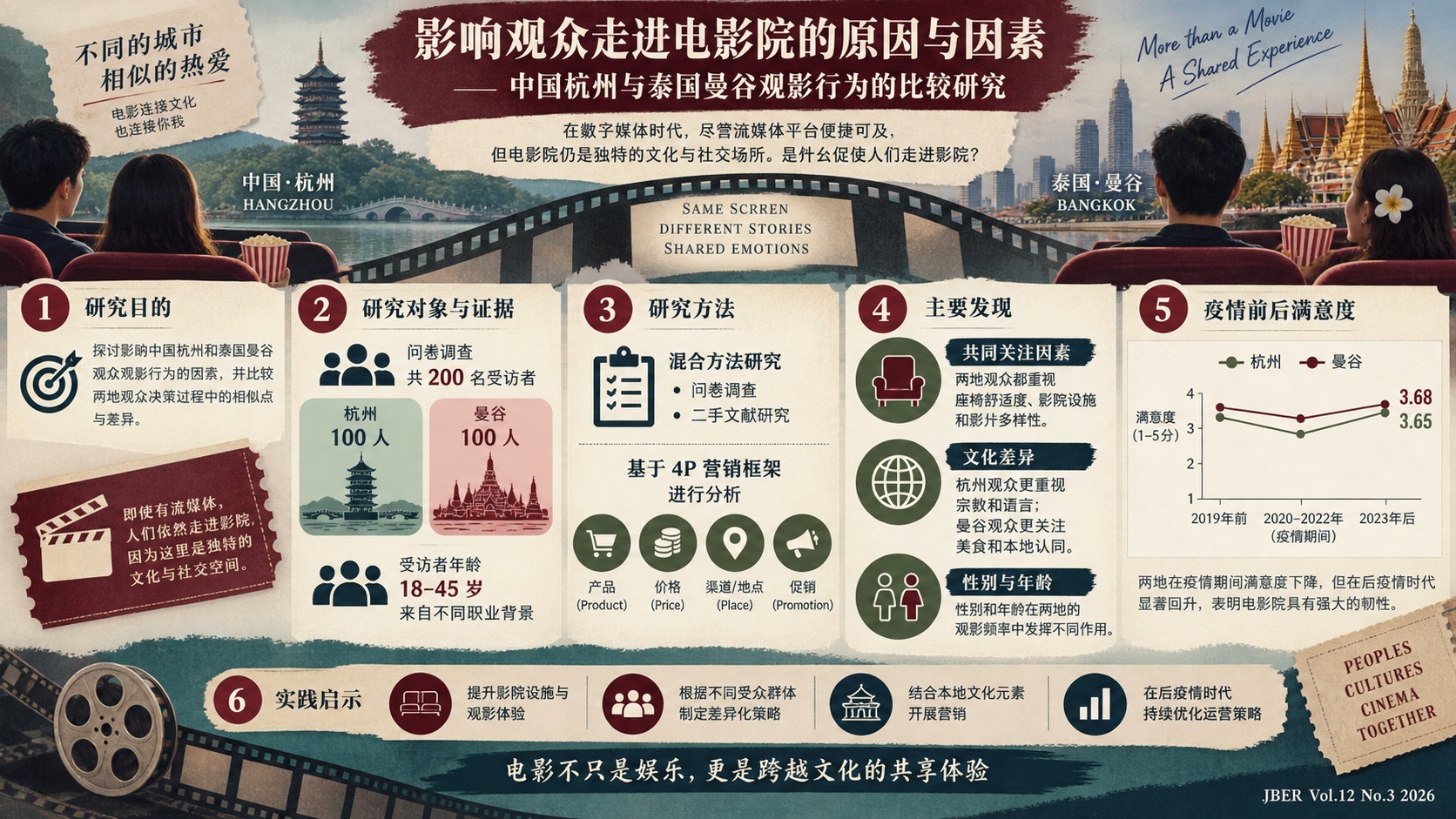
In the era of digital media, cinema remains a unique cultural and social venue despite the convenience of streaming platforms. This study investigates the factors influencing cinema-going behavior in Hangzhou, China, and Bangkok, Thailand, with a focus on price, location, facilities, service quality, film genres, and scheduling. Drawing on the 4P marketing framework, a mixed-method approach was adopted. Questionnaires were distributed to 200 respondents, equally divided between the two cities, and supported by secondary literature. The findings reveal both shared patterns and culturally specific differences in cinema-going behavior. Audiences in both cities value seat comfort, cinema facilities, and film variety, yet cultural dimensions shape preferences differently: Hangzhou audiences emphasize religion and language, while Bangkok audiences highlight cuisine and local identity. Gender and age also play distinct roles in cinema-going frequency. Post-pandemic evidence indicates a clear recovery in audience satisfaction, reaffirming cinema’s resilience as a shared social and cultural space. This research contributes to comparative media consumption studies by highlighting cross-cultural variations and provides practical recommendations for cinema operators.
Keywords: Cinema Going Behavior; 4P Marketing; Audience Preference
References
Alamdari, F. (2000). Evaluation of the causes and factors of attracting audiences in performing arts (Unpublished master’s thesis). Tarbiat Modarres University, Tehran.
Armstrong, G., & Kotler, P. (2000). Marketing: An introduction (5th ed.). Prentice-Hall.
Buccheri, A. (2022). The impact of the shortening and the non-exclusivity of the theatrical window on moviegoing behaviour: A comparison between Italy and Denmark (Master’s thesis).
Chaney, D., Lunardo, R., & Mencarelli, R. (2018). Consumption experience: Past, present and future. Qualitative Market Research, 21(4), 402–420. https://doi.org/10.1108/QMR-04-2018-0042
De Mooij, M., & Hofstede, G. (2011). Cross-cultural consumer behavior: A review of research findings. Journal of International Consumer Marketing, 23(3), 181–192.
Eliashberg, J., & Shugan, S. M. (1997). Film patronage: Choices and consequences. Marketing Science, 16(2), 119–139.
Engel, J. F., Kollat, D. T., & Blackwell, R. D. (1978). Consumer behavior. Holt, Rinehart & Winston.
Finney, J. (2010). The impact of geographic location on cinema attendance. Journal of Urban Culture Studies, 5(2), 98–112.
Hennig-Thurau, T., Houston, M. B., & Walsh, G. (2007). Electronic word-of-mouth via consumer-opinion platforms: What motivates consumers to articulate themselves on the internet? Journal of Interactive Marketing, 21(1), 38–52.
Holbrook, M. B., & Hirschman, E. C. (1982). The experiential aspects of consumption: Consumer fantasies, feelings, and fun. Journal of Consumer Research, 9(2), 132–140.
Howard, J. A., & Sheth, J. N. (1969). The theory of buyer behavior. Wiley.
Karimzadeh, M. (2006). Cinema technology innovation and audience preferences. Iranian Journal of Culture and Cinema, 12(3), 145–161.
Kotler, P., & Armstrong, G. (2008). Principles of marketing (12th ed.). Pearson Prentice Hall.
Lamb, C. W., Hair, J. F., & McDaniel, C. (1998). Marketing. South-Western College Publishing.
Leon-Castro, E., et al. (2015). Empirical evidence on the determination of the level of education and income of consumers in the preferential purchase criterion based on product differentiation. International Journal of Business and Social Science, 6(7), 59–65.
Lilien, G. L., Kotler, P., & Sridhar, M. (1992). Marketing models. Prentice-Hall.
Lovell, G., & Gianluca, P. (2009). Urban cinemas: Location as a competitive advantage. Cinema Economics Review, 14(1), 45–59.
Palmer, A. (2005). Principles of service marketing (4th ed.). McGraw-Hill Education.
Pauli, J. (2002). Film marketing and the importance of screening times. In Marketing and Broadcasting Film (pp. 89–99). Farabi Cinema Foundation.
Shoja’Nouri, R. (2011). Physical aspects of film screening and audience satisfaction. Management Science Letters, 2(4), 1349–1358.
Downloads
Published
How to Cite
Issue
Section
Categories
License
Copyright (c) 2026 Journal of Buddhist Education and Research (JBER)

This work is licensed under a Creative Commons Attribution-NonCommercial-NoDerivatives 4.0 International License.