Academic Administration Based on the Saṅgahavatthu 4 Principles of School Administrators under Maha Sarakham Primary Educational Service Area Office 3
Keywords:
Academic administration, Saṅgahavatthu 4, primary educationAbstract
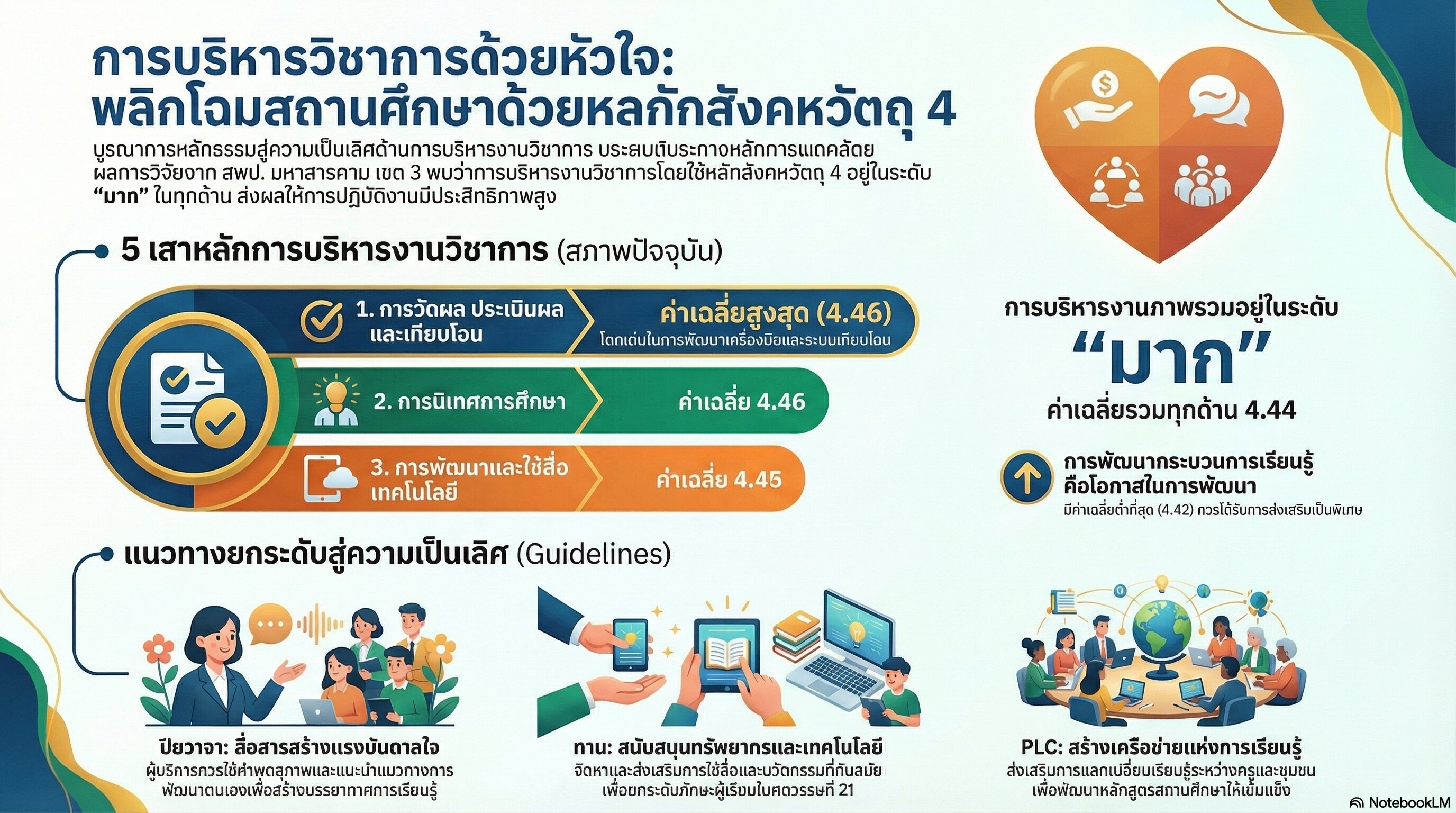
The objectives of this research were to study the current conditions of academic administration of school administrators and to propose guidelines for academic administration based on the Saṅgahavatthu 4 principles of school administrators under Maha Sarakham Primary Educational Service Area Office 3. This research employed a mixed-methods design integrating quantitative and qualitative approaches. The quantitative research instrument was a questionnaire with a reliability coefficient of 0.877. The sample group consisted of 302 school administrators and teachers. Statistical tools used included frequency, percentage, mean, and standard deviation. For qualitative research, data were collected through interviews with 9 key informants who were experts in the field. The research results were as follows: 1. The current conditions of academic administration based on the Saṅgahavatthu 4 principles of school administrators under Maha Sarakham Primary Educational Service Area Office 3 showed that the highest performance level was found in the aspect of assessment, evaluation, and academic credit transfer according to the Saṅgahavatthu 4. This was followed by educational supervision, development and use of educational media and technology, and school curriculum development, respectively. The lowest performance level was found in the aspect of learning process development based on the Saṅgahavatthu 4. 2. The proposed guidelines for academic administration based on the Saṅgahavatthu 4 principles of school administrators under Maha Sarakham Primary Educational Service Area Office 3 indicated that the Office should provide recommendations for improving measurement and evaluation tools to align with current conditions. School administrators should provide guidance for developing measurement and evaluation instruments, and should encourage teachers to continuously improve the creation of effective assessment tools.
References
กมล ภู่ประเสริฐ. (2545). การบริหารงานวิชาการในสถานศึกษา (พิมพ์ครั้งที่ 2). เมธีทิปส์.
พระครูวินัยธรวรวุฒิ เตชธมฺโม, และคณะ. (2566). การวิจัยแบบผสมผสานวิธีทางพุทธบริหารการศึกษา. วารสารครุศาสตร์ปัญญา, 2(2).
รวิวรรณ พลทะกลาง. (2564). การบริหารงานวิชาการแบบมีส่วนร่วมตามหลักสังคหวัตถุ 4 ของโรงเรียนในสังกัดสำนักงานเขตพื้นที่การศึกษาประถมศึกษาร้อยเอ็ด เขต 2 (ศึกษาศาสตรมหาบัณฑิต, สาขาวิชาการบริหารการศึกษา, มหาวิทยาลัยมหามกุฏราชวิทยาลัย).
สำนักงานคณะกรรมการการศึกษาแห่งชาติ. (2553). พระราชบัญญัติการศึกษาแห่งชาติ พ.ศ. 2542 และที่แก้ไขเพิ่มเติม (ฉบับที่ 2 พ.ศ. 2545 และฉบับที่ 3 พ.ศ. 2553). เดอะบุคส์.
สำนักงานเขตพื้นที่การศึกษาประถมศึกษามหาสารคาม เขต 3. (2566). แผนปฏิบัติการประจำปีงบประมาณ. ฝ่ายบริหารงานทั่วไป.
สุวนันท์ สารคำ. (2565). การบริหารงานวิชาการตามหลักสังคหวัตถุ 4 ของผู้บริหารสถานศึกษา สังกัดสำนักงานเขตพื้นที่การศึกษาประถมศึกษาเลย เขต 2 (ครุศาสตรมหาบัณฑิต, สาขาวิชาพุทธบริหารการศึกษา, มหาวิทยาลัยมหาจุฬาลงกรณราชวิทยาลัย).
สัมฤทธิ์ กางเพ็ง, และคณะ. (2567). แนวทางการบริหารงานวิชาการตามหลักอิทธิบาท 4 ของผู้บริหารสถานศึกษา สังกัดองค์การบริหารส่วนจังหวัดขอนแก่น. Journal of Buddhist Education and Research (JBER), 10(2), 16–33.
สารินทร์ เอี่ยมครอง. (2561). แนวทางการบริหารงานวิชาการของสถานศึกษาในจังหวัดชัยนาท สังกัดสำนักงานเขตพื้นที่การศึกษามัธยมศึกษา เขต 5 (ครุศาสตรมหาบัณฑิต, สาขาวิชาการบริหารการศึกษา, มหาวิทยาลัยราชภัฏนครสวรรค์).
อุทัย บุญประเสริฐ. (2538). การวางแผนและจัดระบบแผนงานในโรงเรียน (พิมพ์ครั้งที่ 2). โรงพิมพ์ เอส ดีเพรส.
Krejcie, R. V., & Morgan, D. W. (1970). Determining sample size for research activities. Educational and Psychological Measurement, 30(3), 607–610.
Downloads
Published
How to Cite
Issue
Section
License
Copyright (c) 2026 Authors

This work is licensed under a Creative Commons Attribution-NonCommercial-NoDerivatives 4.0 International License.