Guidelines for Improving the English Reading Skills of Matthayom Suksa 1 Students at Tessaban 1 Kabinratsadornamroong School, Prachinburi Province
Keywords:
Guidelines, Improving, English Reading SkillAbstract
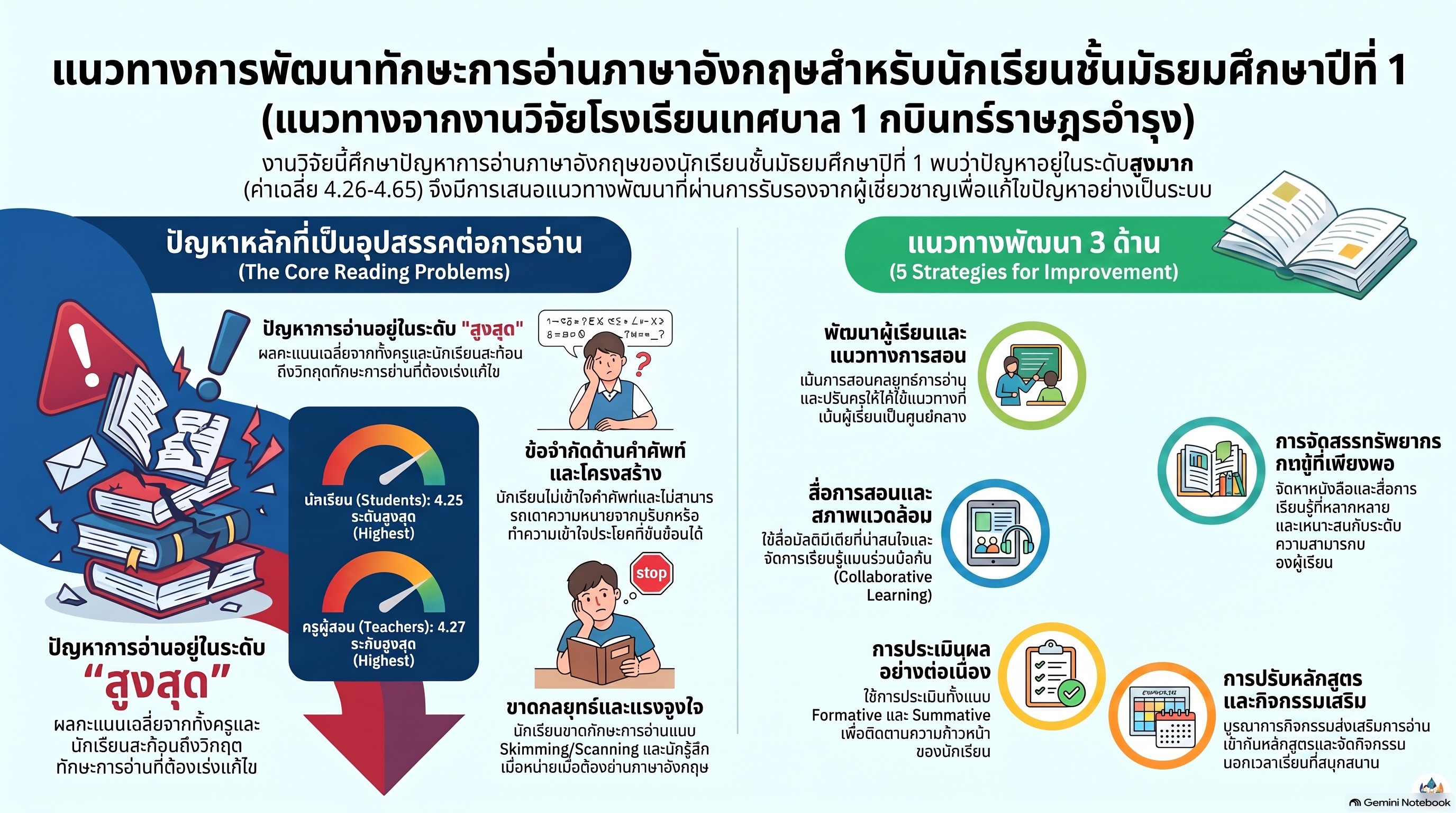
The objectives of this research were: 1) to investigate the problems of English reading skill of students in Mattayom Suksa 1 and 2) to construct proposed guidelines for improving English reading skill. This research was conducted using a mixed-method research design. The research was conducted at Tessaban 1 Kabinratsadornamroong School in Prachinburi Province. The respondents in this research were divided into two groups; namely, 1) 25 students at Mattayom Suksa 1, 2) 10 English teachers. In this study, two research instruments were employed for the collection of data and information; namely, 1) a questionnaire for investigating problems of English reading skill and 2) a set of interview questions for gathering additional information and validating the proposed strategies. The information and data collected were analyzed through statistical analysis and content analysis methods and then presented in terms of frequency count, percentage, mean, and standard deviation. The findings indicated that: 1) the problems of English reading skill of students were found at a high level, particularly in vocabulary knowledge, reading comprehension, and lack of motivation; and 2) the proposed strategies for the enhancement of English reading skill were categorized into five chapters; namely, strategies for learners, strategies for instructors, strategies for classroom management, strategies for teaching-learning materials, and strategies for evaluation of teaching-learning English reading skill.
References
Wongwanich, S. (2005). Need Assessment Research is Necessary.Bangkok: Publishing House Alvermann, D. E., & Moje, E. B. (2019). Adolescent literacy instruction and reading engagement. Journal of Adolescent & Adult Literacy, 62(3), 271–280.
Anderson, N. J. (1999). Exploring second language reading: Issues and strategies. Heinle & Heinle.
Crystal, D. (2003). English as a global language (2nd ed.). Cambridge University Press.
Dörnyei, Z. (2001). Motivational strategies in the language classroom. Cambridge University Press.
Grabe, W. (2009). Reading in a second language: Moving from theory to practice. Cambridge University Press.
Grabe, W., & Stoller, F. L. (2011). Teaching and researching reading (2nd ed.). Routledge.
Graddol, D. (2006). English next: Why global English may mean the end of English as a foreign language. British Council.
Grellet, F. (1981). Developing reading skills: A practical guide to reading comprehension exercises. Cambridge University Press.
Halliday, M. A. K., & Hasan, R. (1976). Cohesion in English. Longman.
Harmer, J. (2007). How to teach English (2nd ed.). Pearson Longman.
Huang, S. (2021). The role of vocabulary knowledge in reading comprehension. Language Teaching Research, 25(4), 567–585.
Johnson, A. P. (2008). Teaching reading and writing: A guidebook for tutoring and remediating students. Rowman & Littlefield.
Krashen, S. D. (1985). The input hypothesis: Issues and implications. Longman.
Nation, I. S. P. (2001). Learning vocabulary in another language. Cambridge University Press.
Nunan, D. (2003). Practical English language teaching. McGraw-Hill.
Pressley, M. (2006). Reading instruction that works. Guilford Press.
Richards, J. C. (2006). Communicative language teaching today. Cambridge University Press.
Rumelhart, D. E. (1980). Schemata: The building blocks of cognition. In R. J. Spiro et al. (Eds.), Theoretical issues in reading comprehension (pp. 33–58). Lawrence Erlbaum.
Snow, C. E. (2002). Reading for understanding: Toward an R&D program in reading comprehension. RAND Corporation.
Wongwanich, S. (2005). Need assessment research. Chulalongkorn University Press.
Downloads
Published
How to Cite
Issue
Section
License

This work is licensed under a Creative Commons Attribution-NonCommercial-NoDerivatives 4.0 International License.