A Learning Management Model for the Course "His Majesty the King’s Philosophy for Local Development" to Enhance Undergraduate Students’ Competency in Learning Management, Faculty of Education, Rajabhat Mahasarakham University
Keywords:
Learning Management Model, His Majesty the King’s Philosophy for Local Development, Undergraduate Students’ Competency in Learning ManagementAbstract
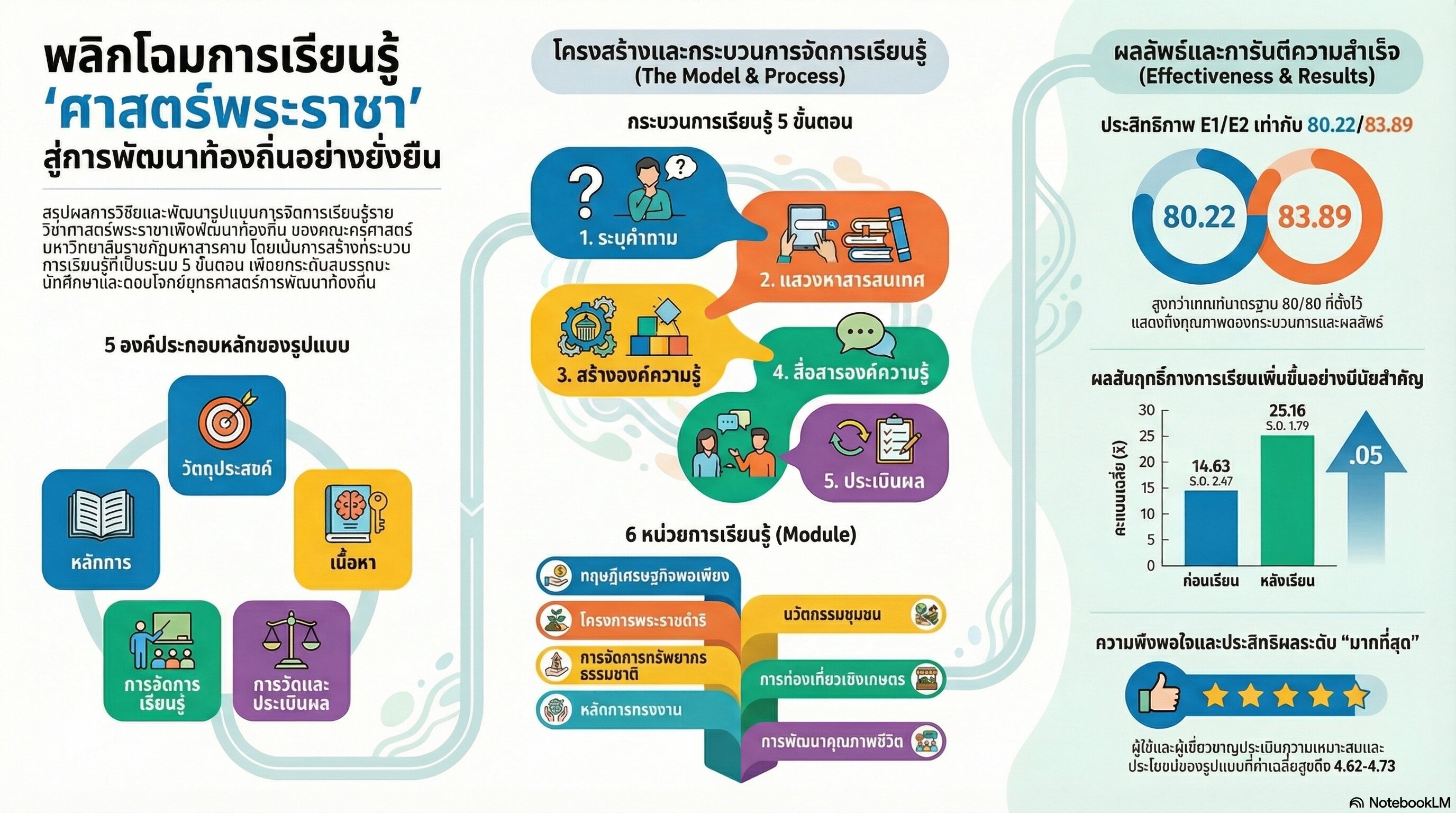
This research aimed to: 1) study the current conditions, needs, and necessities; 2) develop the model; 3) implement the model; and 4) evaluate the learning management model for the course "His Majesty the King’s Philosophy for Local Development" to enhance undergraduate students’ competency in learning management, Faculty of Education, Rajabhat Mahasarakham University. This was a Research and Development (R&D) study conducted in four phases: Phase 1 studied the current conditions, needs, and necessities. The sample group consisted of 135 undergraduate students from the Faculty of Education, academic year 2/2024, determined using Krejcie and Morgan’s sample size formula. Key informants were nine instructors teaching the course "His Majesty the King’s Philosophy" in the Faculty of Education, selected by purposive sampling. Research tools included: 1) a questionnaire on current conditions, needs, and necessities (with an overall reliability of 1.00), and 2) an interview form. Phase 2 focused on developing the model, which comprised five components: 1) principles, 2) objectives, 3) content, 4) learning management, and 5) assessment and evaluation. Tools used in this phase were: 1) the developed learning management model, and 2) the model user manual. Phase 3 involved the trial of the model. Research tools included: 1) the model, 2) the user manual, and 3) a satisfaction evaluation form. Phase 4 assessed the implementation of the model. The tool used was the model effectiveness evaluation form. Data were analyzed using mean, standard deviation, PNI Modified, efficiency values (E₁/E₂), and academic achievement scores. The findings of the research are as follows: 1. The necessity needs showed that, overall, the PNImodified was 0.25. When considered by aspect, the highest need was for media/learning resources and equipment (PNImodified = 0.32), followed by content (PNImodified = 0.28), learning environment and atmosphere (PNImodified = 0.26), and learners (PNImodified = 0.18). 2. The model comprised principles, objectives, content, learning management, and assessment and evaluation. The learning process consisted of: 1) identifying questions, 2) searching for information, 3) constructing knowledge, 4) communicating knowledge, and 5) evaluating knowledge. 3. The learning management model showed an efficiency (E₁/E₂) of 80.22/83.89, which exceeds the predetermined criterion of 80/80. Comparing pre- and post-instruction, students' learning achievement after instruction was significantly higher than before at the .05 level. Overall satisfaction with the model was at the highest level (x̄ = 4.66, S.D. = 0.30).4. The model's effectiveness was found to be at the highest level in terms of appropriateness (x̄ = 4.62, S.D. = 0.34) and usefulness (x̄ = 4.73, S.D. = 0.37).
References
กมลฉัตร กล่อมอิ่ม. (2565). การพัฒนารูปแบบการจัดการเรียนรู้ฐานสมรรถนะประยุกต์ใช้ศาสตร์พระราชาบนพื้นฐานอัตลักษณ์พื้นถิ่นเพื่อเสริมสร้างสมรรถนะวิทยาการจัดการเรียนรู้สำหรับนักศึกษาวิชาชีพครู. วารสารพัฒนาการเรียนการสอน มหาวิทยาลัยรังสิต, 15(1), 118–137.
กรรณิกา สุขงาม. (2562). การพัฒนาหลักสูตรฝึกอบรมสิ่งแวดล้อมศึกษาตามศาสตร์พระราชาในการอนุรักษ์ดิน น้ำ และป่าไม้ (ปรัชญาดุษฎีบัณฑิต, สาขาวิชาสิ่งแวดล้อมศึกษา, มหาวิทยาลัยมหาสารคาม).
จารุวรรณ ตาลสุกเรือง. (2565). รูปแบบการบริหารตามศาสตร์พระราชาเพื่อพัฒนาคุณภาพผู้เรียนในสถานศึกษาสังกัดสำนักงานเขตพื้นที่การศึกษาประถมศึกษา (การศึกษาดุษฎีบัณฑิต, สาขาวิชาการบริหารการศึกษา, มหาวิทยาลัยนเรศวร).
จุฬาพร ศรีรังสรรค์. (2565). การพัฒนารูปแบบการจัดการเรียนรู้สังคมศึกษาตามแนวทางศาสตร์พระราชาเพื่อวิถีชีวิตเศรษฐกิจพอเพียง. มนุษยสังคมปริทัศน์, 24(1), 44–56.
ชัชพล รวมธรรม. (2564). รูปแบบการน้อมนำศาสตร์พระราชาสู่การบริหารโรงเรียนมัธยมศึกษาเพื่อพัฒนาคุณภาพชีวิตที่ดีของผู้เรียน. วารสารสันติศึกษาปริทรรศน์ มจร, 9(6), 2541–2553.
พระมหาอุทัย พลเทโว (พลเทพ). (2561). บูรณาการพุทธธรรมและศาสตร์พระราชาเพื่อเสริมสร้างประสิทธิภาพการบริหารจัดการศูนย์ปฏิบัติธรรมมหาวิทยาลัยมหาจุฬาลงกรณราชวิทยาลัย (พุทธศาสตรดุษฎีบัณฑิต, สาขาวิชาพระพุทธศาสนา, มหาวิทยาลัยมหาจุฬาลงกรณราชวิทยาลัย).
รุ่งอรุณ พรเจริญ, และทรงสิริ วิชิรานนท์. (2563). การพัฒนาผลสัมฤทธิ์ทางการเรียน เรื่องศาสตร์พระราชาสู่การพัฒนาที่ยั่งยืนโดยใช้สื่อสังคมออนไลน์. วารสารอิเล็กทรอนิกส์การเรียนรู้ทางไกลเชิงนวัตกรรม, 10(2), 62–72. https://so01.tci-thaijo.org/index.php/e-jodil/article/view/235915
สมใจ กงเติม. (2564). การพัฒนารูปแบบการเรียนรู้ที่บูรณาการศาสตร์พระราชาเพื่อพัฒนาความสามารถในการคิดวิเคราะห์สำหรับนักเรียนชั้นประถมศึกษาปีที่ 6. วารสารราชภัฏเพชรบูรณ์สาร, 23(2), 37.
สำนักงานเลขาธิการสภาการศึกษา. (2560). แผนการศึกษาแห่งชาติ พ.ศ. 2560–2579. พริกหวานกราฟฟิค.
สำนักงานที่ประชุมอธิการบดีมหาวิทยาลัยราชภัฏ. (2561). ยุทธศาสตร์มหาวิทยาลัยราชภัฏเพื่อการพัฒนาท้องถิ่นระยะ 20 ปี (พ.ศ. 2560–2579).
Downloads
Published
How to Cite
Issue
Section
License
Copyright (c) 2026 Authors

This work is licensed under a Creative Commons Attribution-NonCommercial-NoDerivatives 4.0 International License.