The Development of a Model for Enhancing Teachers’ Competency in Active Learning Management in the Digital Era to Improve Student Quality at Bansiyaeksomdet School under the Kalasin Primary Educational Service Area Office 3
Keywords:
Active Learning, Teacher Competency, Digital Era, Development Model, Student QualityAbstract
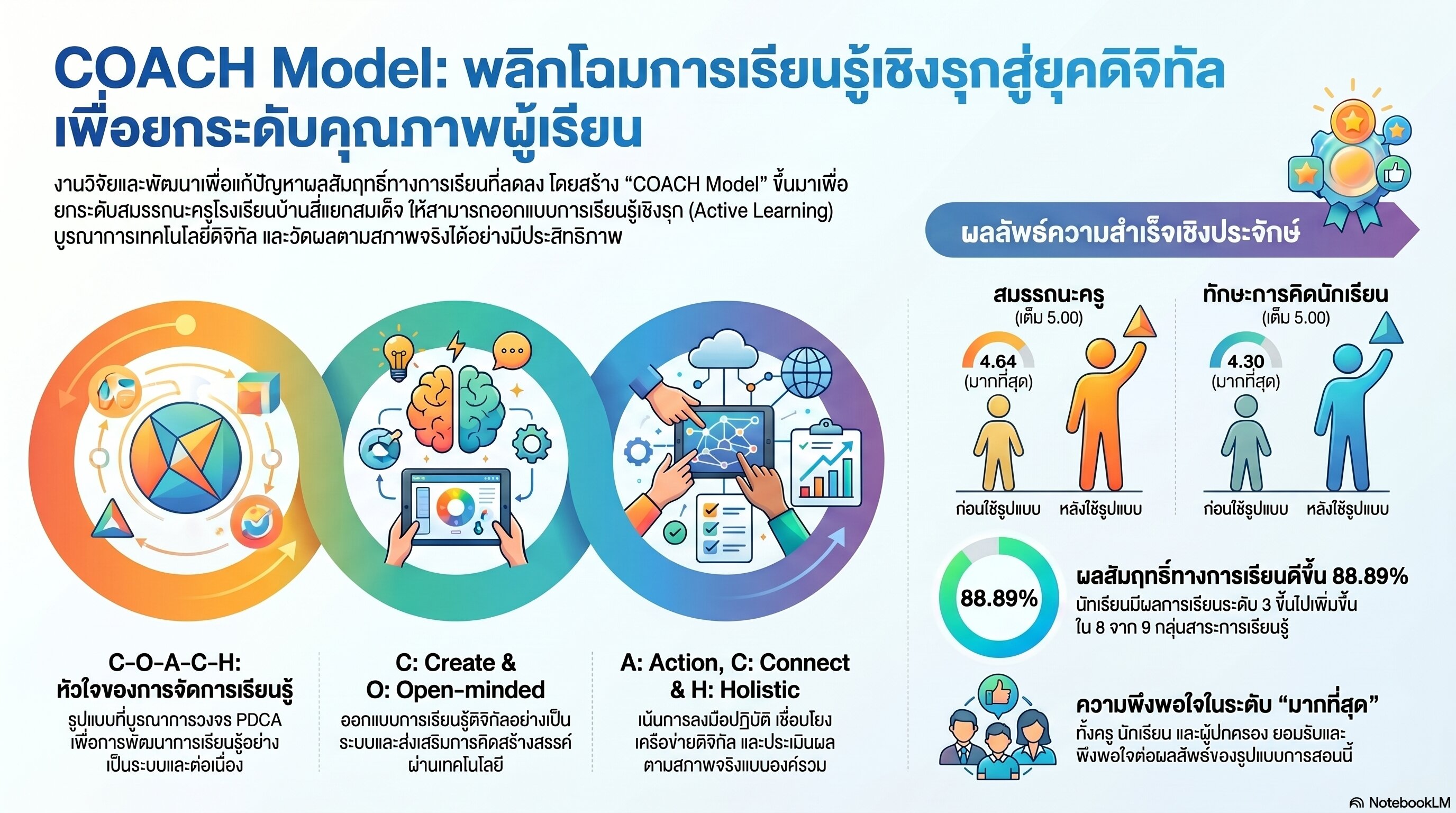
This research and development (R&D) project aimed to: 1) investigate the current status, expected conditions, and essential needs for enhancing proactive learning management competencies of teachers in the digital era to improve student quality at Bansiyaeksomdet School; 2) design and develop a model to enhance these competencies; 3) examine the effects of implementing the model; and 4) evaluate the model’s effectiveness. The study was conducted systematically in four phases: Phase 1 involved assessing the current status and needs of 72 target teachers using questionnaires, with data analyzed by mean (𝜇), standard deviation (σ), and the Modified Priority Needs Index (PNI). Phase 2 focused on model development by five selected experts through documentation and evaluation forms, analyzed using mean and standard deviation. Phase 3 involved piloting the model with 72 teachers and 1,318 students, using pre- and post-assessments of teacher competencies analyzed by mean and standard deviation. Phase 4 evaluated the model's effectiveness with 10 teachers, 306 students, and 306 parents through satisfaction questionnaires, analyzed by frequency, percentage, mean (X̅), and standard deviation (S.D.). The results indicated that teachers’ current competencies were at a moderate level, while the expected competencies were at the highest level, with the greatest need identified in systematic digital learning design and management. The developed model, named the "COACH Model," comprised five components: principles, objectives, processes, evaluation, and success conditions. After implementation, teachers’ learner-centered learning management competency scores significantly increased, positively impacting students who demonstrated improved learning behaviors and higher analytical thinking skills. Additionally, evaluations of the model showed high levels of appropriateness, feasibility, and usefulness. Stakeholder satisfaction was also high, and students’ academic achievement scores increased substantially.
References
จรูญ จารุสาร. (2563). รูปแบบการพัฒนาสมรรถนะการจัดการเรียนรู้เชิงรุกของครู โรงเรียนวัดเขมาภิรตาราม. สำนักงานเขตพื้นที่การศึกษาประถมศึกษานนทบุรี เขต 1.
ชัยวัฒน์ สุทธิรัตน์. (2565). การจัดการเรียนรู้เชิงรุก: แนวคิดและการประยุกต์ใช้. จุฬาลงกรณ์มหาวิทยาลัย.
พิมพันธ์ เดชะคุปต์ และคณะ. (2566). การจัดการเรียนรู้เชิงรุกในศตวรรษที่ 21. สำนักพิมพ์แห่งจุฬาลงกรณ์มหาวิทยาลัย.
ยุภาลัย มะลิซ้อน และ กาญจน์ เรืองมนตรี. (2563). การพัฒนาสมรรถนะครูด้านการจัดการเรียนรู้เชิงรุกในสถานศึกษา. สำนักงานเขตพื้นที่การศึกษาประถมศึกษามหาสารคาม เขต 2.
ศรัญญา หงษ์ทอง. (2565). รูปแบบการพัฒนาสมรรถนะครูด้านการจัดการเรียนรู้เชิงรุกโดยใช้การนิเทศแบบร่วมพัฒนา. สำนักงานเขตพื้นที่การศึกษาประถมศึกษาขอนแก่น เขต 4.
ศรีกาวรรณ ใสใสสกาล. (2565). รูปแบบการพัฒนาสมรรถนะครูด้านการจัดการเรียนรู้เชิงรุกด้วยชุมชนแห่งการเรียนรู้ทางวิชาชีพ. สำนักงานเขตพื้นที่การศึกษามัธยมศึกษานครสวรรค์.
สถาบันส่งเสริมการสอนวิทยาศาสตร์และเทคโนโลยี. (2565). รายงานการจัดการเรียนรู้วิทยาศาสตร์ในยุคดิจิทัล. สถาบันส่งเสริมการสอนวิทยาศาสตร์และเทคโนโลยี.
สำนักงานคณะกรรมการการศึกษาขั้นพื้นฐาน. (2566). รายงานการประเมินตนเองของสถานศึกษา (SAR). กระทรวงศึกษาธิการ.
สำนักงานเลขาธิการสภาการศึกษา. (2564). รายงานการพัฒนาครูในยุคดิจิทัล. กระทรวงศึกษาธิการ.
สุวิทย์ มูลคำ. (2563). กลยุทธ์การจัดการเรียนรู้เพื่อพัฒนาทักษะการคิด. ภาพพิมพ์.
อโรชา แสงลุน. (2564). การพัฒนารูปแบบการส่งเสริมความสามารถในการจัดการเรียนรู้เชิงรุกของครูโดยใช้การศึกษาชั้นเรียนผ่านชุมชนแห่งการเรียนรู้เชิงวิชาชีพ. สำนักงานเขตพื้นที่การศึกษาประถมศึกษานครพนม เขต 1.
Bond, M. (2020). Facilitating student engagement through educational technology: Current research, practices and perspectives [Doctoral dissertation, Carl von Ossietzky University of Oldenburg].
Bond, M., Bedenlier, S., Marín, V. I., & Händel, M. (2021). Emergency remote teaching in higher education. International Journal of Educational Technology in Higher Education, 18(1), 50.
Branch, R. M. (2021). Instructional design: The ADDIE approach. Springer.
Darling-Hammond, L., Hyler, M. E., & Gardner, M. (2020). Effective teacher professional development. Learning Policy Institute.
Fiorella, L., & Mayer, R. E. (2021). The science of learning and instruction: Cognitive strategies for improving education (2nd ed.). Routledge.
Freeman, S., Eddy, S. L., McDonough, M., Smith, M. K., Okoroafor, N., Jordt, H., & Wenderoth, M. P. (2021). Active learning increases student performance. Proceedings of the National Academy of Sciences, 111(23), 8410–8415.
Hattie, J. (2023). Visible learning: The sequel. Routledge.
Koehler, M. J., & Mishra, P. (2013). What is technological pedagogical content knowledge (TPACK)? Journal of Education, 193(3), 13–19.
OECD. (2021). OECD digital education outlook 2021. OECD Publishing.
OECD. (2023). Education at a glance 2023. OECD Publishing.
Redecker, C. (2020). European framework for the digital competence of educators. European Commission.
Ryan, R. M., & Deci, E. L. (2020). Intrinsic motivation and self-determination in human behavior. Springer.
Schleicher, A. (2022). Building back better: Education lessons from COVID-19. OECD Publishing.
Theobald, E. J., Hill, M. J., Tran, E., Agrawal, S., et al. (2020). Active learning narrows achievement gaps. Proceedings of the National Academy of Sciences, 117(12), 6476–6483.
Trust, T., & Whalen, J. (2020). Should teachers be trained in emergency remote teaching? Journal of Technology and Teacher Education, 28(2), 189–199.
Voogt, J., & Roblin, N. P. (2022). A comparative analysis of international frameworks. Journal of Curriculum Studies, 54(3), 345–362.
Zimmerman, B. J., & Schunk, D. H. (2021). Self-regulated learning and academic achievement. Routledge.
Downloads
Published
How to Cite
Issue
Section
License
Copyright (c) 2026 Authors

This work is licensed under a Creative Commons Attribution-NonCommercial-NoDerivatives 4.0 International License.