Mechanisms of Change Management for Driving the Integration of Artificial Intelligence (AI) in Private Vocational Education Institutions: A Qualitative Study from the Perspective of Administrators
Keywords:
Change Management, Artificial Intelligence, Private Vocational EducationAbstract
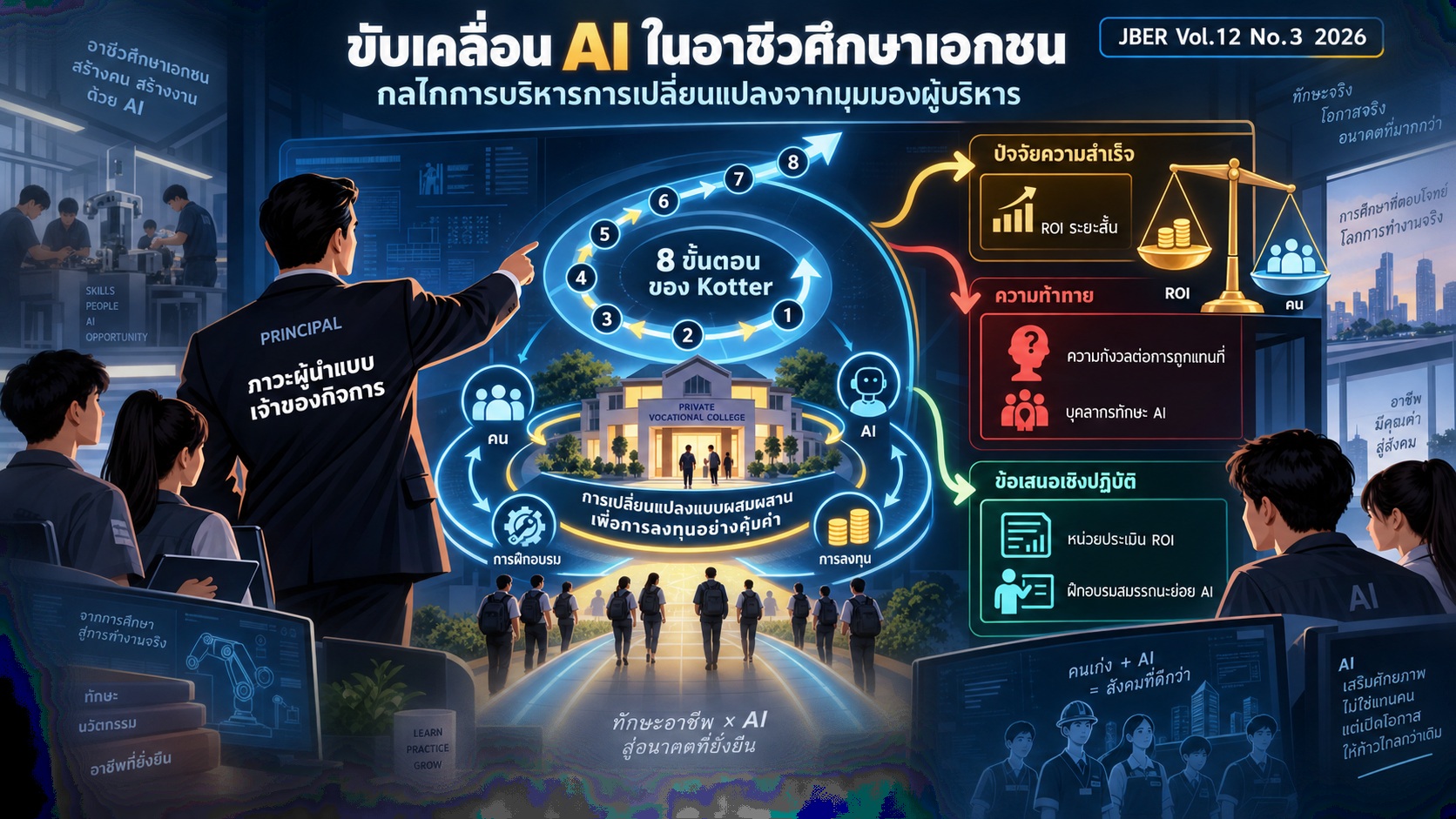
This Qualitative Document Analysis (QDA) primarily aimed to analyze change management mechanisms for integrating Artificial Intelligence (AI) in private vocational education institutions. The study had three main objectives: 1) To analyze strategic mechanisms based on established change management steps; 2) To identify context-specific success factors and challenges; and 3) To synthesize actionable recommendations for AI innovation management. The research proceeded in three phases, utilizing Kotter's 8-Step Model for deductive analysis to extract evidence emphasizing market urgency and establishing an AI-Embedded Vision. Findings revealed the successful mechanism is the “Cost-Benefit Driven Hybrid Change Mechanism.” This model modifies Kotter's steps by using Entrepreneurial Leadership to consolidate implementation phases for rapid deployment. The key success factor identified was Cost-Effectiveness Management, focusing on achieving Return on Investment (ROI) in the short term. Conversely, critical challenges include staff anxiety about being replaced in practical skills streams and the high fluctuation of AI-skilled personnel due to competition from industry. Actionable recommendations synthesized from the study include establishing an “Innovation ROI Evaluation Unit” and continuously investing in “AI Micro-Credentialing Programs” for existing personnel to build sustainability and mitigate resistance. The results confirm and expand the understanding of change management theory within resource-constrained, market-driven organizations.
References
ธนโชติ ธนโชติกุล. (2565). การบริหารการเปลี่ยนแปลงดิจิทัลในสถาบันอุดมศึกษา: กลยุทธ์และปัจจัย ความสําเร็จ.วารสารบริหารการศึกษา มหาวิทยาลัยขอนแก่น, 18(2), 1–17.
สํานักงานคณะกรรมการการอุดมศึกษา. (2564). รายงานผลการสํารวจความพร้อมด้านดิจิทัลของ สถาบันอุดมศึกษา พ.ศ. 2564.สํานักงานคณะกรรมการการอุดมศึกษา.
สํานักงานคณะกรรมการการอาชีวศึกษา. (2566). รายงานสถานการณ์และแนวโน้มการพัฒนาบุคลากร อาชีวศึกษา พ.ศ. 2566.สํานักงานคณะกรรมการการอาชีวศึกษา.
สํานักงานคณะกรรมการดิจิทัลเพื่อเศรษฐกิจและสังคมแห่งชาติ. (2564). แผนปฏิบัติการด้านปัญญาประดิษฐ์ แห่งชาติเพื่อการพัฒนาประเทศไทย ระยะที่ 1 (พ.ศ. 2564–2570).สํานักงานคณะกรรมการดิจิทัล เพื่อเศรษฐกิจและสังคมแห่งชาติ.
Fullan, M. (2016). The essential guide to implementation. Educational Leadership, 73(5), 18– 24.
Hsu, M. H., Chen, C. M., & Chen, Y. T. (2023). The role of AI in vocational education: A conceptual framework and research agenda. Interactive Learning Environments, 31(1), 1–18. https://doi.org/10.1080/10494820.2023.2185523
Jao, M. C. (2023). Exploring factors influencing AI adoption in higher education: A mixed- methods approach. Computers & Education: Artificial Intelligence, 4, 100125. https://doi.org/10.1016/j.ceai.2023.100125
Kotter, J. P. (2012). Leading change.Harvard Business Review Press.
Kowch, E., & Ironstone-Catterall, P. (2020). Leading change in private post-secondary education: The role of entrepreneurial spirit and institutional mission. Journal of Higher Education Policy and Management, 42(3), 324–338. https://doi.org/10.1080/1360080X.2020.1748259
Organisation for Economic Co-operation and Development. (2021). The state of AI in education: Challenges and opportunities.OECD Publishing.
Downloads
Published
How to Cite
Issue
Section
Categories
License
Copyright (c) 2026 Journal of Buddhist Education and Research (JBER)

This work is licensed under a Creative Commons Attribution-NonCommercial-NoDerivatives 4.0 International License.