ประสบการณ์การประยุกต์ใช้ปัญญาประดิษฐ์ในการออกแบบการจัดการเรียนรู้ของนักศึกษาฝึกประสบการณ์วิชาชีพครู : กรณีศึกษามหาวิทยาลัยราชภัฏมหาวิทยาลัยราชภัฏวไลยอลงกรณ์ ในพระบรมราชูปถัมภ์
คำสำคัญ:
ปัญญาประดิษฐ์, นักศึกษาฝึกประสบการณ์วิชาชีพครู, การออกแบบการจัดการเรียนรู้บทคัดย่อ
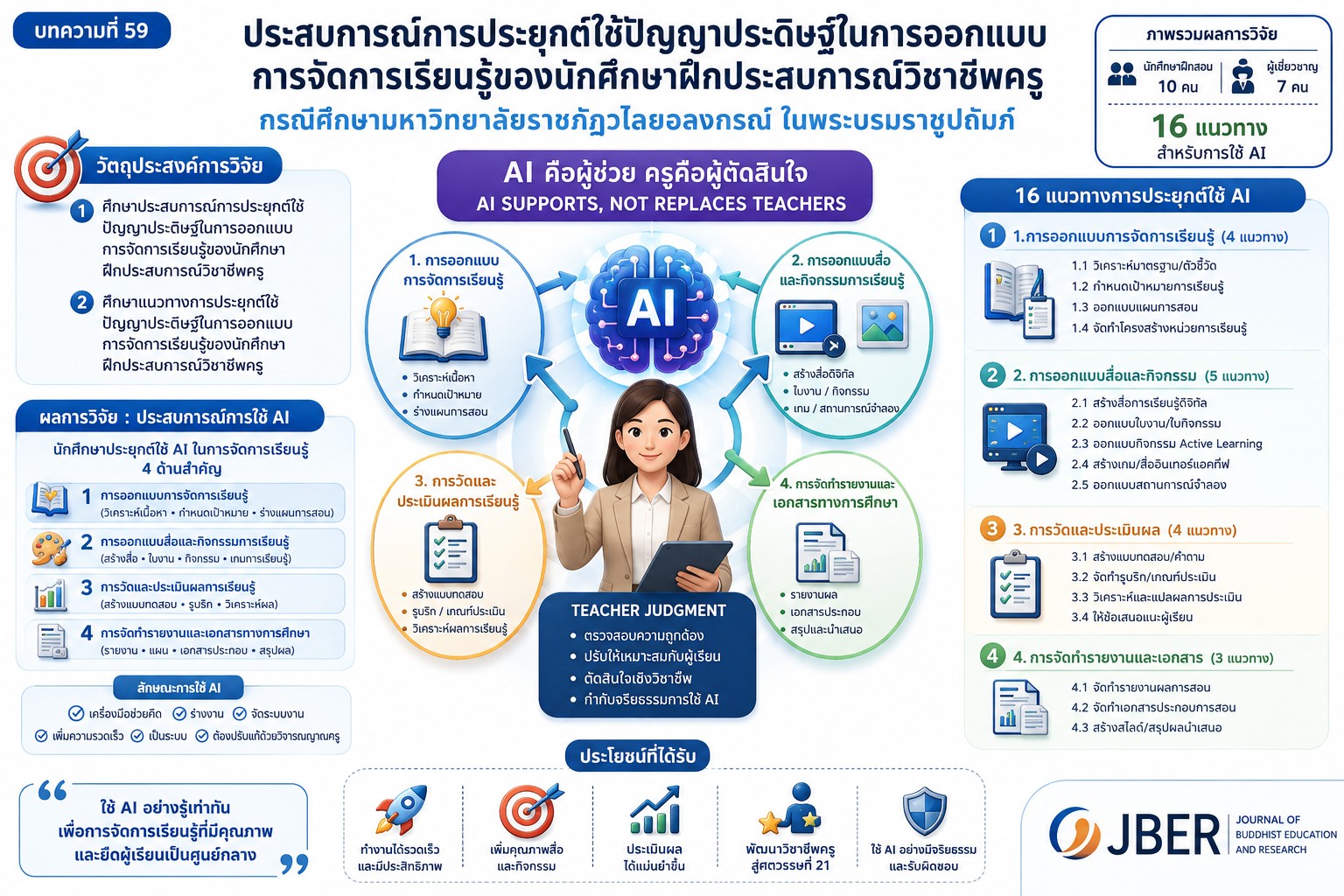
การวิจัยครั้งนี้มีวัตถุประสงค์เพื่อ 1) ศึกษาประสบการณ์การประยุกต์ใช้ปัญญาประดิษฐ์ในการออกแบบการจัดการเรียนรู้ของนักศึกษาฝึกประสบการณ์วิชาชีพครู และ 2) ศึกษาแนวทางการประยุกต์ใช้ปัญญาประดิษฐ์ในการออกแบบการจัดการเรียนรู้ของนักศึกษาฝึกประสบการณ์วิชาชีพครู กลุ่มผู้ให้ข้อมูลสำคัญ ได้แก่ นักศึกษาฝึกประสบการณ์วิชาชีพครู จำนวน 10 คน และผู้เชี่ยวชาญด้านการศึกษา จำนวน 7 คน เครื่องมือที่ใช้ในการวิจัย ได้แก่ แนวทางการสนทนากลุ่มสำหรับนักศึกษา และแบบสัมภาษณ์กึ่งโครงสร้างสำหรับผู้เชี่ยวชาญด้านการศึกษา วิเคราะห์ข้อมูลเชิงคุณภาพด้วยการวิเคราะห์เนื้อหา ผลการวิจัย พบว่า 1) นักศึกษามีประสบการณ์มีการประยุกต์ใช้ปัญญาประดิษฐ์ในการจัดการเรียนรู้ใน 4 ด้าน ได้แก่ การออกแบบการจัดการเรียนรู้ การออกแบบสื่อและกิจกรรมการเรียนรู้ การวัดและประเมินผลการเรียนรู้ และการจัดทำรายงาน และเอกสารทางการศึกษา โดยมีลักษณะการใช้ AI ในฐานะเครื่องมือช่วยสนับสนุนการคิดการร่างงาน และการจัดระบบงาน ช่วยเพิ่มความรวดเร็วและความเป็นระบบในการทำงาน แต่ยังคงต้องอาศัยการปรับแก้และการตัดสินเชิงวิชาชีพของครูเป็นสำคัญ และ 2) แนวทางการประยุกต์ใช้ปัญญาประดิษฐ์ในการจัดการเรียนรู้สังเคราะห์ได้จำนวน 16 แนวทาง โดย AI มีบทบาทเป็นเครื่องมือสนับสนุนการออกแบบการเรียนรู้ การสร้างสื่อ การพัฒนากิจกรรม การวัดและประเมินผล และการจัดทำเอกสารทางการศึกษา ทั้งนี้ การใช้ AI จำเป็นต้องคำนึงถึงความถูกต้องของข้อมูล ความเหมาะสมกับผู้เรียน และประเด็นด้านจริยธรรมทางการศึกษาอย่างรอบด้าน
เอกสารอ้างอิง
สำนักงานคณะกรรมการการศึกษาขั้นพื้นฐาน. (2568). คู่มือการใช้ AI สำหรับครู นักเรียน โรงเรียน และผู้ปกครองในประเทศไทย พ.ศ. 2568. กรุงเทพฯ: สำนักงานคณะกรรมการการศึกษาขั้นพื้นฐาน กระทรวงศึกษาธิการ
Holmes, W., Bialik, M., & Fadel, C. (2019). Artificial intelligence in education: Promises and implications for teaching and learning. Center for Curriculum Redesign. Retrieved from https://curriculumredesign.org/our-work/artificial-intelligence-in-education/
Long, D., & Magerko, B. (2020). What is AI literacy? Competencies and design considerations. Retrieved from https://dl.acm.org/doi/epdf/10.1145/3313831.3376727
Luckin, R., Holmes, W., Griffiths, M., & Forcier, L. B. (2022). Intelligence unleashed: An argument for AI in education. Pearson.
Mishra, P., & Koehler, M. J. (2006). Technological pedagogical content knowledge: A framework for teacher knowledge. Teachers College Record, 108(6), 1017–1054.
Ng, D. T. K., Leung, J. K. L., Chu, S. K. W., & Qiao, M. S. (2021). AI literacy: Definition, teaching, evaluation and ethical issues. Computers and Education: Artificial Intelligence, 2(100041), 1-11.
OECD. (2023). AI in education: Challenges and opportunities for sustainable development. Paris: OECD Publishing.
Polit, D. F., & Beck, C. T. (2006). The content validity index: Are you sure you know what’s being reported? Critique and recommendations. Research in Nursing & Health, 29(5), 489–497.
Shneiderman, B. (2022). Human-centered AI. Oxford University Press.
Shulman, L. S. (1986). Those who understand: Knowledge growth in teaching. Educational Researcher, 15(2), 4–14.
UNESCO. (2021). AI and education: Guidance for policy-makers. UNESCO. Retrieved February 3, 2026, from https://unesdoc.unesco.org/ark:/48223/pf0000376709
Vygotsky, L. S. (1978). Mind in society: The development of higher psychological processes. Massachusetts: Harvard University Press.
Zawacki-Richter, O., Marín, V. I., Bond, M., & Gouverneur, F. (2019). Systematic review of research on artificial intelligence applications in higher education. International Journal of Educational Technology in Higher Education, 16(39), 1-27.
ดาวน์โหลด
เผยแพร่แล้ว
รูปแบบการอ้างอิง
ฉบับ
ประเภทบทความ
หมวดหมู่
สัญญาอนุญาต
ลิขสิทธิ์ (c) 2026 Journal of Buddhist Education and Research (JBER)

อนุญาตภายใต้เงื่อนไข Creative Commons Attribution-NonCommercial-NoDerivatives 4.0 International License.