Developing the Academic Performance by Using Social Media for Students in Southwest Jiaotong University Hope College, China
Keywords:
Academic Performance; Social Media; Higher Education; Student Learning; Educational TechnologyAbstract
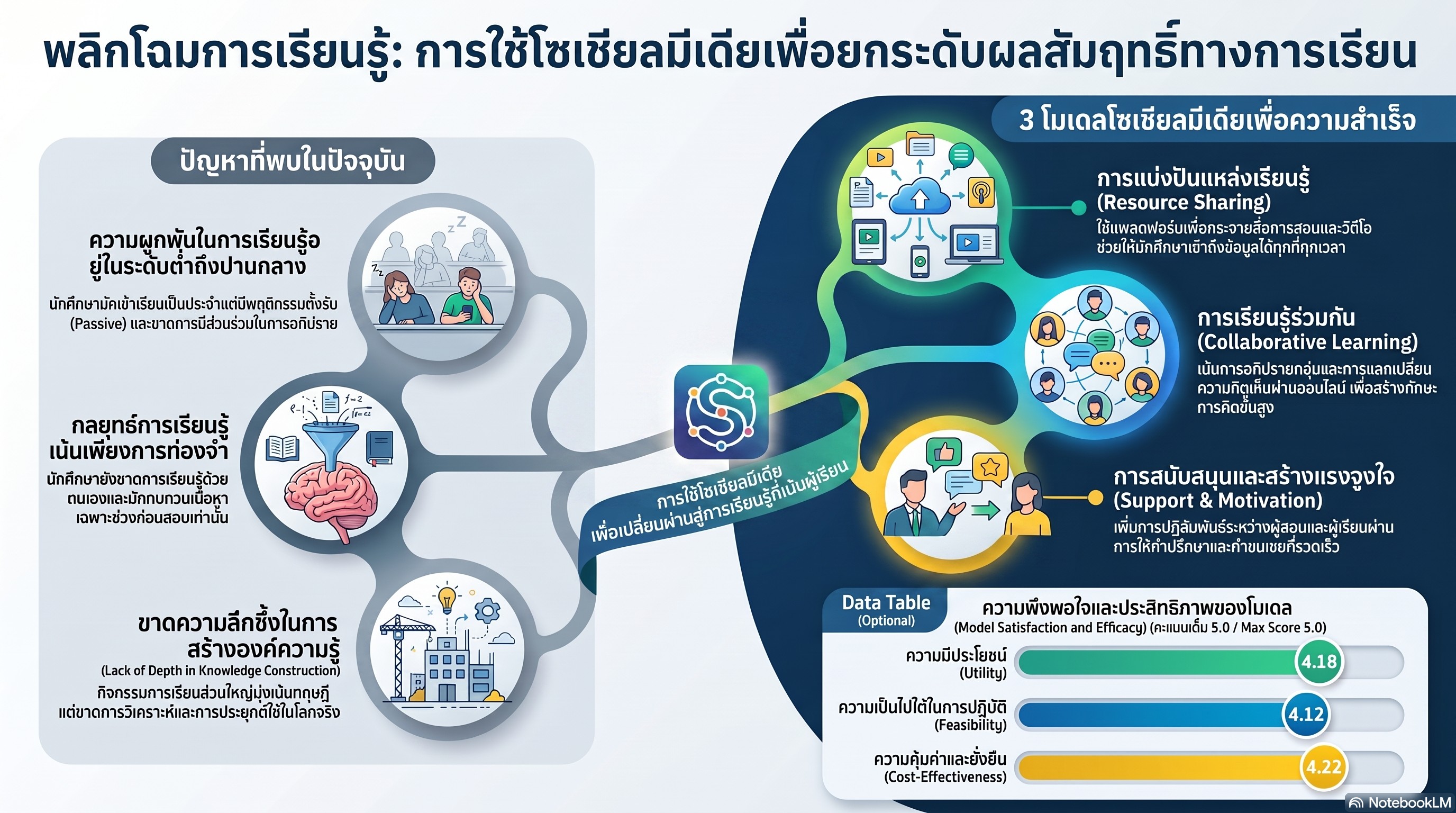
Academic performance reflects students’ learning outcomes and achievement in higher education. Although social media is widely used as a learning support tool, its effectiveness in systematically improving academic performance remains unclear, particularly in Chinese private higher education institutions. At Southwest Jiaotong University Hope College, ongoing challenges in learning engagement and academic motivation highlight the need for innovative learning approaches. The objectives of this study were: (1) to examine the current status and problems of academic performance among students at Southwest Jiaotong University Hope College; (2) to develop academic performance through the use of social media; and (3) to confirm the effectiveness of social media in enhancing students’ academic performance. A mixed-methods approach was adopted in this study. Quantitative data were obtained from undergraduate students using a five-point Likert scale questionnaire to assess academic performance, while qualitative data were collected through student interviews and expert reviews. The data were analyzed using descriptive and content-based analytical techniques, and the findings were confirmed through triangulation and expert validation based on Stufflebeam’s evaluation criteria. The findings revealed that students’ academic performance was at a moderate level across all dimensions. Major problems were identified in learning engagement, academic self-efficacy, learning strategies, and depth of knowledge construction. Based on these findings, three instructional models were developed: (1) Social Media for Resource Sharing, (2) Social Media for Collaborative Learning, and (3) Social Media for Academic Support and Motivation. The confirmation results showed high levels of agreement among experts and students across all five evaluation criteria, indicating that social media-based learning is effective, practical, ethically appropriate, accurate, and cost-effective. Overall, the results confirm that social media can be effectively utilized as an innovative and sustainable approach to enhancing students’ academic.
References
Ainin, S., Naqshbandi, M. M., Moghavvemi, S., & Jaafar, N. I. (2020). Facebook usage, socialization and academic performance. Computers & Education, 83, 64–73. https://doi.org/10.1016/j.compedu.2014.12.018
Al-Rahmi, W. M., Aldraiweesh, A., Yahaya, N., Bin Kamin, Y., & Zeki, A. M. (2023). Massive open online courses (MOOCs): Data on higher education students’ learning engagement, motivation and satisfaction. Data in Brief, 29, 105118. https://doi.org/10.1016/j.dib.2020.105118
Bandura, A. (2021). Toward a psychology of human agency: Pathways and reflections. Perspectives on Psychological Science, 15(6), 130–136. https://doi.org/10.1177/1745691620903343
Bond, M., Buntins, K., Bedenlier, S., Zawacki-Richter, O., & Kerres, M. (2020). Mapping research in student engagement and educational technology in higher education: A systematic evidence map. International Journal of Educational Technology in Higher Education, 17(1), 1–30. https://doi.org/10.1186/s41239-019-0176-8
Broadbent, J., & Poon, W. L. (2020). Self-regulated learning strategies and academic achievement in online higher education learning environments. The Internet and Higher Education, 27, 1–13. https://doi.org/10.1016/j.iheduc.2015.04.007
Cendrero Ramos, N., & Valverde Berrocoso, J. (2024). Social media in higher education: Systematic literature review (2018–2023). IJERI: International Journal of Educational Research and Innovation.
Chugh, R., & Ruhi, U. (2021). Social media in higher education: A literature review of Facebook. Education and Information Technologies, 26, 983–1001. https://doi.org/10.1007/s10639-020-10213-5
Davis, K., Deil-Amen, R., Rios-Aguilar, C., & González Canché, M. S. (2021). Social media in higher education: A literature review and research directions. Journal of Higher Education, 93(1), 1–32. https://doi.org/10.1080/00221546.2021.1904456
Hamid, S., Waycott, J., Kurnia, S., & Chang, S. (2022). Understanding students’ perceptions of the benefits of online social networking use for teaching and learning. The Internet and Higher Education, 54, 100857. https://doi.org/10.1016/j.iheduc.2022.100857
Kahu, E. R., & Nelson, K. (2020). Student engagement in the educational interface: Understanding the mechanisms of student success. Higher Education Research & Development, 39(1), 58–71. https://doi.org/10.1080/07294360.2019.1644447
Leung, L., & Lee, P. S. N. (2023). Impact of Internet literacy, Internet addiction symptoms, and Internet activities on academic performance. Social Science Computer Review, 41(2), 375–392. https://doi.org/10.1177/08944393211013770
Limniou, M., Mansfield, R., & McLaughlin, P. (2023). Social media engagement and academic performance: A self-determination theory perspective. Computers & Education, 190, 104601. https://doi.org/10.1016/j.compedu.2022.104601
Liu, Y., & Chen, X. (2023). Digital learning engagement in Chinese higher education: Opportunities and challenges. Educational Technology Research and Development, 71(4), 2145–2163. https://doi.org/10.1007/s11423-023-10177-4
Lukose, J. M., & Agbeyangi, A. O. (2025). Is social media hindering or helping academic performance? arXiv.
Makkar, N. (2023). Social media and student engagement in education: A systematic review. International Journal of Arts, Humanities and Social Studies, 5(2), 84–90.
Manca, S. (2020). Snapping, pinning, liking or texting: Investigating social media in higher education beyond Facebook. The Internet and Higher Education, 44, 100707. https://doi.org/10.1016/j.iheduc.2019.100707
Manca, S., & Ranieri, M. (2020). Facebook and the others: Potentials and obstacles of social media for teaching in higher education. Computers & Education, 95, 216–230. https://doi.org/10.1016/j.compedu.2016.01.012
Martin, F., & Bolliger, D. U. (2022). Engagement matters: Student perceptions on the importance of engagement strategies in the online learning environment. Online Learning Journal, 26(1), 205–222. https://doi.org/10.24059/olj.v26i1.2609
OECD. (2021). Education at a glance 2021: OECD indicators. OECD Publishing. https://doi.org/10.1787/b35a14e5-en
Panadero, E. (2021). A review of self-regulated learning: Six models and four directions for research. Frontiers in Psychology, 12, 624548. https://doi.org/10.3389/fpsyg.2021.624548
Rasheed, R. A., Kamsin, A., & Abdullah, N. A. (2021). Challenges in the online component of blended learning: A systematic review. Computers & Education, 144, 103701. https://doi.org/10.1016/j.compedu.2019.103701
Richardson, M., Abraham, C., & Bond, R. (2020). Psychological correlates of university students’ academic performance: A systematic review and meta-analysis. Psychological Bulletin, 138(2), 353–387. https://doi.org/10.1037/a0026838
Rogers, E. M. (2020). Diffusion of innovations (5th ed.). Free Press.
Schunk, D. H., & DiBenedetto, M. K. (2020). Motivation and social cognitive theory. Contemporary Educational Psychology, 60, 101832. https://doi.org/10.1016/j.cedpsych.2019.101832
Social Psychology of Education. (2025). Social media use and academic outcomes: The mediating role of grit.
Sumetchanthasiri, P., Polyiam, N., & Kraisin, I. (2020). Effect on social media: Its impacts on Thai education. Academic MCU Buriram Journal, 5(1), 248–261.
Sutherland, K. A., Davis, C., Terton, U., & Visser, I. (2020). University student social media use and its influence on academic outcomes. Active Learning in Higher Education, 21(1), 21–35. https://doi.org/10.1177/1469787418782811
Tess, P. A. (2020). The role of social media in higher education classes (real and virtual): A literature review. Computers in Human Behavior, 29(5), A60–A68. https://doi.org/10.1016/j.chb.2012.12.032
Wang, Y., Fang, W., Han, J., & Chen, N. S. (2022). Exploring the affordances of WeChat for facilitating teaching and learning in higher education. Educational Technology & Society, 25(1), 76–89.
York, T. T., Gibson, C., & Rankin, S. (2019). Defining and measuring academic success. Practical Assessment, Research, and Evaluation, 20(5), 1–20. https://doi.org/10.7275/hz5x-tx03
Zhang, W., & Li, Z. (2021). WeChat-assisted learning in Chinese higher education: Students’ perceptions and learning outcomes. International Journal of Educational Technology in Higher Education, 18(1), 1–18. https://doi.org/10.1186/s41239-021-00261-4
Downloads
Published
How to Cite
Issue
Section
Categories
License
Copyright (c) 2026 Journal of Buddhist Education and Research (JBER)

This work is licensed under a Creative Commons Attribution-NonCommercial-NoDerivatives 4.0 International License.