The Teacher's Perspective on Chinese Contemporary Dance at Three Vocational College of Art, Jiangxi Province, The People's Republic of China
Keywords:
Teacher's Perspective, Chinese Contemporary, Dance Chinese Contemporary MusicAbstract
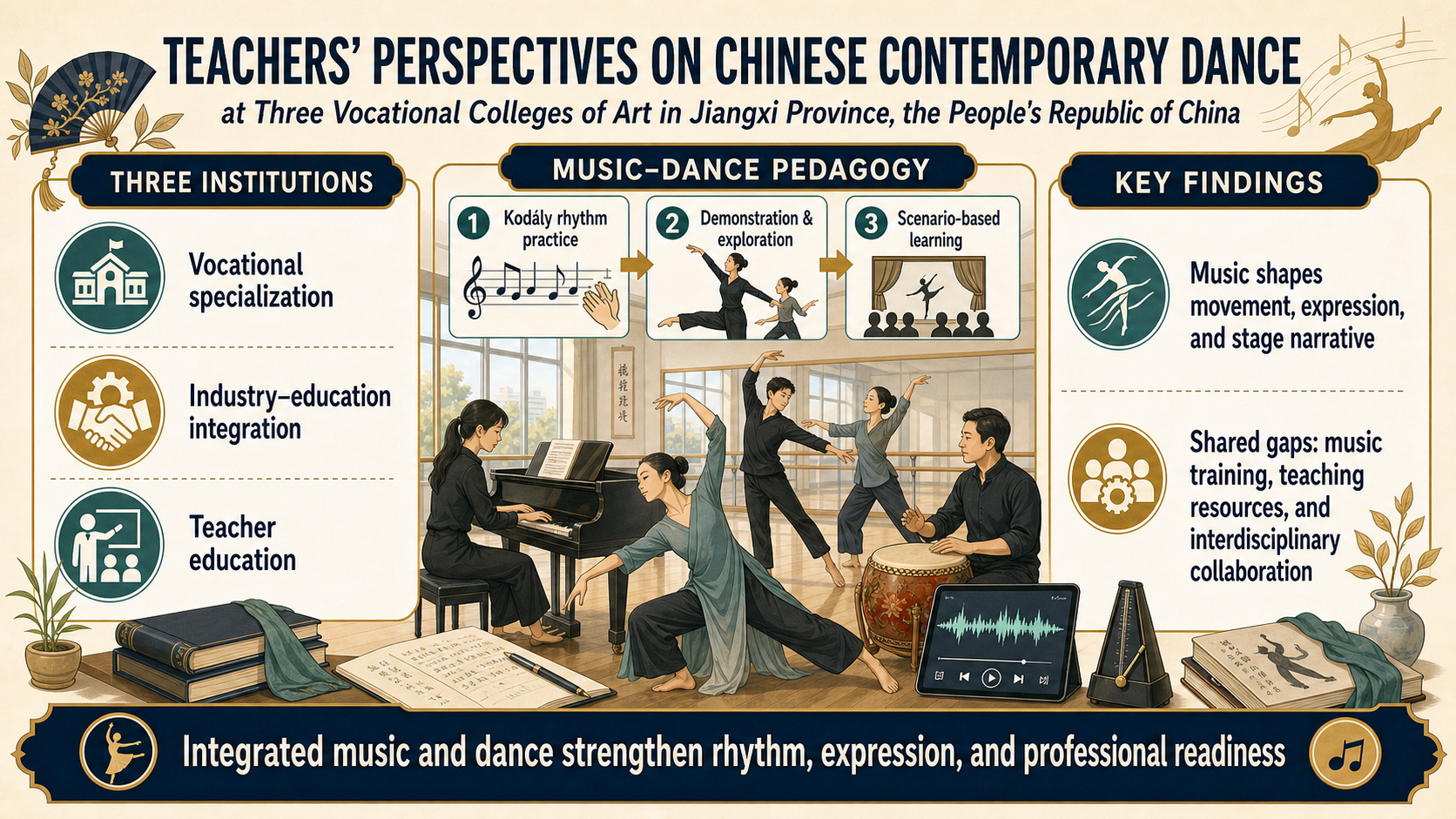
This study aims to systematically investigate teachers’ perspectives on music teaching for Chinese contemporary dance in three representative vocational art institutions in Jiangxi Province, China: Jiangxi Vocational College of Art, Nanchang Vocational University, and Nanchang Normal University. The research seeks to examine the current implementation of music teaching within contemporary dance programs, identify core teaching methods shaped by differing institutional orientations, analyze the practical challenges encountered by frontline teachers, and propose targeted strategies to optimize integrated music–dance pedagogy. Focusing on two key dimensions commonly used music types in teaching and practical music teaching methods this study addresses a notable gap in existing research concerning the limited empirical exploration of music–dance teaching practices in regional vocational art colleges and provides both theoretical and practical support for the reform and development of contemporary dance music education in China’s vocational education sector. A qualitative research design was adopted to ensure the authenticity and depth of the findings. Data were collected between August and December 2025 through semi-structured interviews with six key teachers and sustained classroom observations across multiple teaching cycles. All participants met strict selection criteria, including over ten years of teaching experience in Chinese contemporary dance, possession of a doctoral degree in music or dance performance or an associate professor title, and a demonstrated willingness to share professional teaching experiences. Interview protocols covered seven core dimensions: curriculum and teaching objectives, teaching methods, instructional media and tools, classroom environment, evaluation and assessment, practical activities, and student engagement and motivation. Multiple data sources including interview transcripts, classroom observation notes, and curriculum documents were analyzed using descriptive qualitative methods to identify key themes, compare institutional practices, and systematically present teachers’ professional understandings and pedagogical experiences. The findings reveal that music-related courses in the three institutions are closely aligned with their respective educational orientations. Jiangxi Vocational College of Art, characterized by vocational specialization, integrates regional folk music resources such as Jiangxi tea-picking opera melodies and traditional drum rhythms into core courses to enhance students’ professional stage performance skills. Nanchang Vocational University, emphasizing industry education integration, focuses on digital music technology and commercial application contexts, equipping students with practical competencies such as audio editing and electronic music matching. Nanchang Normal University, oriented toward teacher education, prioritizes music–dance pedagogy, guiding students to transform professional music knowledge into teachable content suitable for basic education settings. Across institutions, commonly adopted teaching methods include Kodály-based solfège practice to strengthen rhythmic perception and music–movement coordination, demonstration-guided practice that balances standardized instruction with creative exploration, and scenario-based simulation adapted to vocational performance, commercial production, or teaching practice contexts. Despite these strengths, several shared challenges were identified. Many teachers possess strong dance backgrounds but lack systematic formal training in music, which constrains in-depth musical analysis and improvisational accompaniment. Additionally, specialized teaching resources remain insufficient, including a shortage of curated contemporary dance music textbooks, limitations in audio equipment for reproducing complex multilayered soundscapes, and the absence of stable interdisciplinary collaboration mechanisms between music and dance departments. Nevertheless, teachers across all three institutions consistently recognize music as a core expressive component of contemporary dance rather than a mere background element. Teaching practices such as eight-beat rhythm movement phrase creation, campus art exhibitions, and interdisciplinary workshops have effectively enhanced students’ learning motivation, rhythmic sensitivity, movement expressiveness, and understanding of the artistic essence of contemporary dance.
References
Chen, Y., & Liu, Q. (2021). The localization process of modern dance in Chinese higher education. Journal of Dance Education Research, 29(3), 85–92.
He, M. (2020). From technical mastery to aesthetic cultivation: Reflections on contemporary dance education in China. Arts Education Review, 14(2), 34–41.
Jin, J., & Snook, B. (2022). Comprehensively strengthening and improving aesthetic education in a new era: An examination of the dance education major at the Beijing Dance Academy. International Journal of Chinese Education, 11(3). https://doi.org/10.1177/2212585X221127451
Liu, R., & Zhao, X. (2022). Practical challenges in modern dance curriculum design at vocational colleges. Vocational Arts Research, 18(4), 102–108.
Sun, L. (2021). The transformation of educational goals in Chinese modern dance education. Contemporary Art Studies, 16(3), 57–63.
Wu, R. (2025). Incorporating dance into primary school music education: A perspective on China’s new curriculum standards. Quality in Sport, 37, Article 57827. https://doi.org/10.12775/QS.2025.37.57827
Yin, J. (2018). Cross-cultural integration characteristics of Chinese contemporary dance music.
Downloads
Published
How to Cite
Issue
Section
Categories
License
Copyright (c) 2026 Journal of Buddhist Education and Research (JBER)

This work is licensed under a Creative Commons Attribution-NonCommercial-NoDerivatives 4.0 International License.