The Development of a Self-Efficacy Measurement Tool and an Assessment Framework for Academic English-Speaking Ability among EFL Pre-Service Teachers
Keywords:
Self-efficacy, Academic English speaking, Instrument development, EFL pre-service teachersAbstract
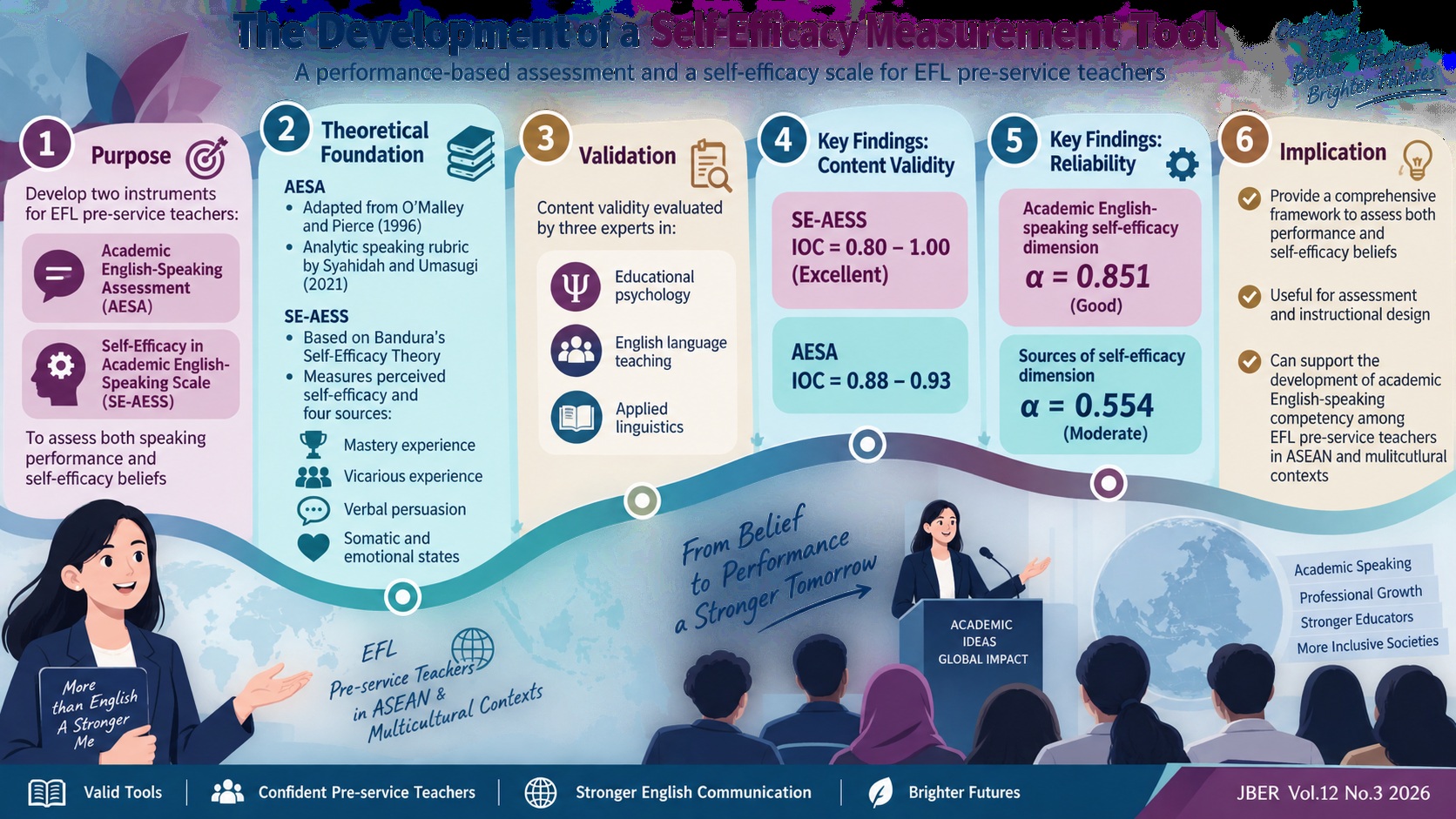
Academic English-speaking competence and strong self-efficacy are essential for EFL pre-service teachers, yet context-specific instruments that assess both performance and self-beliefs remain limited. Therefore, this study aims to (1) develop a performance-based Academic English-Speaking Assessment (AESA) and (2) develop and preliminarily validate the Self-Efficacy in Academic English-Speaking Scale (SE-AESS) for EFL pre-service teachers. The AESA was adapted from the authentic assessment framework proposed by O’Malley and Pierce (1996) and the analytic speaking rubric developed by Syahidah and Umasugi (2021). The SE-AESS was constructed based on Bandura’s Self-Efficacy Theory, encompassing both perceived academic English-speaking self-efficacy and its four sources: mastery experience, vicarious experience, verbal persuasion, and somatic and emotional states. Content validity of both instruments was evaluated by three experts in educational psychology, English language teaching, and applied linguistics. The SE-AESS demonstrated excellent content validity, with item–objective congruence (IOC) values ranging from 0.80 to 1.00, while the AESA showed IOC values between 0.88 and 0.93. Reliability analysis revealed good internal consistency for the academic English-speaking self-efficacy dimension (α = 0.851) and moderate reliability for the sources of self-efficacy dimension (α = 0.554). Both instruments achieved the minimum psychometric requirements for early-stage instrument development, even though the latter reflected the multidimensional and experiential nature of the construct. The AESA and SE-AESS together provide a comprehensive framework for assessing both observable academic English-speaking performance and learners’ self-efficacy beliefs. In order to improve academic English-speaking competency among EFL pre-service teachers in ASEAN and multicultural contexts, these tools may be crucial for assessment and instructional design.
Keywords: Self-efficacy, Academic English speaking, Instrument development, EFL pre-service teachers
References
Bachman, L. F., & Palmer, A. S. (2010). Language assessment in practice: Developing language assessments and justifying their use in the real world. Oxford University Press.
Bandura, A. (1986). Social foundations of thought and action: A social cognitive theory. Prentice Hall.
Bandura, A. (1994). Self-efficacy. In V. S. Ramachandran (Ed.), Encyclopedia of human behavior (Vol. 4, pp. 71–81). Academic Press.
Bandura, A. (1997). Self-efficacy: The exercise of control. W. H. Freeman.
Bandura, A. (2001). Social cognitive theory: An agentic perspective. Annual Review of Psychology, 52, 1–26.
Brown, H. D. (2012). Principles of language learning and teaching (6th ed.). Pearson Education.
Brown, H. D., & Abeywickrama, P. (2019). Language assessment: Principles and classroom practices (3rd ed.). Pearson.
Chang, P., Zhou, L., & Zhang, L. J. (2024). The roles of task-specific self-efficacy and enjoyment in EFL learners’ development of speaking CALF: A longitudinal study. System, 127, Article 103539.
Creswell, J. W. (2018). Educational research: Planning, conducting, and evaluating quantitative and qualitative research (6th ed.). Pearson.
Dörnyei, Z., & Taguchi, T. (2010). Questionnaires in second language research: Construction, administration, and processing (2nd ed.). Routledge.
Eckes, T. (2015). Introduction to many-facet Rasch measurement: Analyzing and evaluating rater-mediated assessments. Peter Lang.
El-Hmoudová, D. (2015). Developing speaking skills through task-based learning. Procedia – Social and Behavioral Sciences, 197, 219–223.
Fulcher, G. (2010). Practical language testing. Hodder Education.
Hair, J. F., Black, W. C., Babin, B. J., & Anderson, R. E. (2019). Multivariate data analysis (8th ed.). Cengage Learning.
Maddux, J. E. (2018). Self-efficacy: The power of believing you can. In J. E. Maddux (Ed.), Self-efficacy, adaptation, and adjustment (pp. 3–35). Routledge.
Kitikanan, P., & Sasimonton, P. (2017). The relationship between English self-efficacy and English learning achievement of L2 Thai learners. LEARN Journal, 10(1), 149–164.
Koo, T. K., & Li, M. Y. (2016). A guideline for selecting and reporting intraclass correlation coefficients for reliability research. Journal of Chiropractic Medicine, 15(2), 155–163.
Lin, Y., Mohamad, M. B. T., & Mahmud, M. I. (2025). Exploring the relationship between classroom English proficiency and teacher self-efficacy among polytechnic EFL teachers. Arab World English Journal, 16(2), 80–95.
Luoma, S. (2004). Assessing speaking. Cambridge University Press.
McNamara, T. (1996). Measuring second language performance. Longman.
Mills, K., Pajares, F., & Herron, C. (2006). A reevaluation of the role of anxiety: Self-efficacy, anxiety, and their relation to reading and listening proficiency in foreign language learning. Foreign Language Annals, 39(2), 276–295.
Nguyen, T. T. M., & Habók, A. (2022). Developing and validating a self-efficacy questionnaire for CEFR A2 level EFL learners. MEXTESOL Journal, 46(2), 1–17.
O’Malley, J. M., & Pierce, L. V. (1996). Authentic assessment for English language learners: Practical approaches for teachers. Addison-Wesley.
Prada, J. (2010). Effects of a family program on perceived caregiving behavioral self-efficacy (Master’s thesis). Chulalongkorn University.
Rahimi, M. (2007). Self-efficacy, attribution, and achievement in English as a foreign language. Journal of Applied Linguistics, 10(2), 119–137.
Schunk, D. H., & DiBenedetto, M. K. (2020). Self-efficacy and human motivation. In Advances in motivation science (Vol. 7, pp. 153–179). Elsevier.
Siriporn, C., Intaraprasert, C., & Akkakoson, S. (2017). Factors affecting English speaking ability of Thai undergraduate students. Journal of Asia TEFL, 14(3), 507–521.
Siritararatn, N. (2013). English self-efficacy beliefs of EFL low proficiency graduate students. Academic Journal of Interdisciplinary Studies, 2(3), 461–468.
Sirithes, P., Intaraprasert, C., & Akkakoson, S. (2019). Thai EFL learners’ willingness to communicate in English: The roles of speaking self-efficacy and anxiety. PASAA, 56, 1–30.
Suharja. (2022). The relationship between self-efficacy and speaking performance of EFL students. Journal of English Language Teaching, 11(1), 45–54.
Syahidah, W., & Umasugi, R. (2021). Developing an English-speaking assessment rubric for academic purposes. Journal of English for Academic Purposes, 54, 101041.
Tavakol, M., & Dennick, R. (2011). Making sense of Cronbach’s alpha. International Journal of Medical Education, 2, 53–55.
Tilfarlioglu, F. Y., & Cinkara, E. (2009). Self-efficacy in EFL: Differences among proficiency groups and relationship with success. Novitas-ROYAL, 3(2), 129–142.
Tschannen-Moran, M., & Hoy, A. W. (2001). Teacher efficacy: Capturing an elusive construct. Teaching and Teacher Education, 17(7), 783–805.
Tschannen-Moran, M., & Hoy, A. W. (2007). The differential antecedents of self-efficacy beliefs of novice and experienced teachers. Teaching and Teacher Education, 23(6), 944–956.
Wang, C., Kim, D.-H., Bong, M., & Ahn, H. S. (2013). Examining measurement properties of an English self-efficacy scale for English language learners. International Journal of Educational Research, 59, 68–79.
Weigle, S. C. (2002). Assessing writing. Cambridge University Press.
Downloads
Published
How to Cite
Issue
Section
Categories
License
Copyright (c) 2026 Journal of Buddhist Education and Research (JBER)

This work is licensed under a Creative Commons Attribution-NonCommercial-NoDerivatives 4.0 International License.