Policy Recommendations to Promote Active Learning Management in the VUCA World Era for School in the Special Area of Phob Pra district, Tak province
Keywords:
Policy recommendations, Active learning, Schools in special areasAbstract
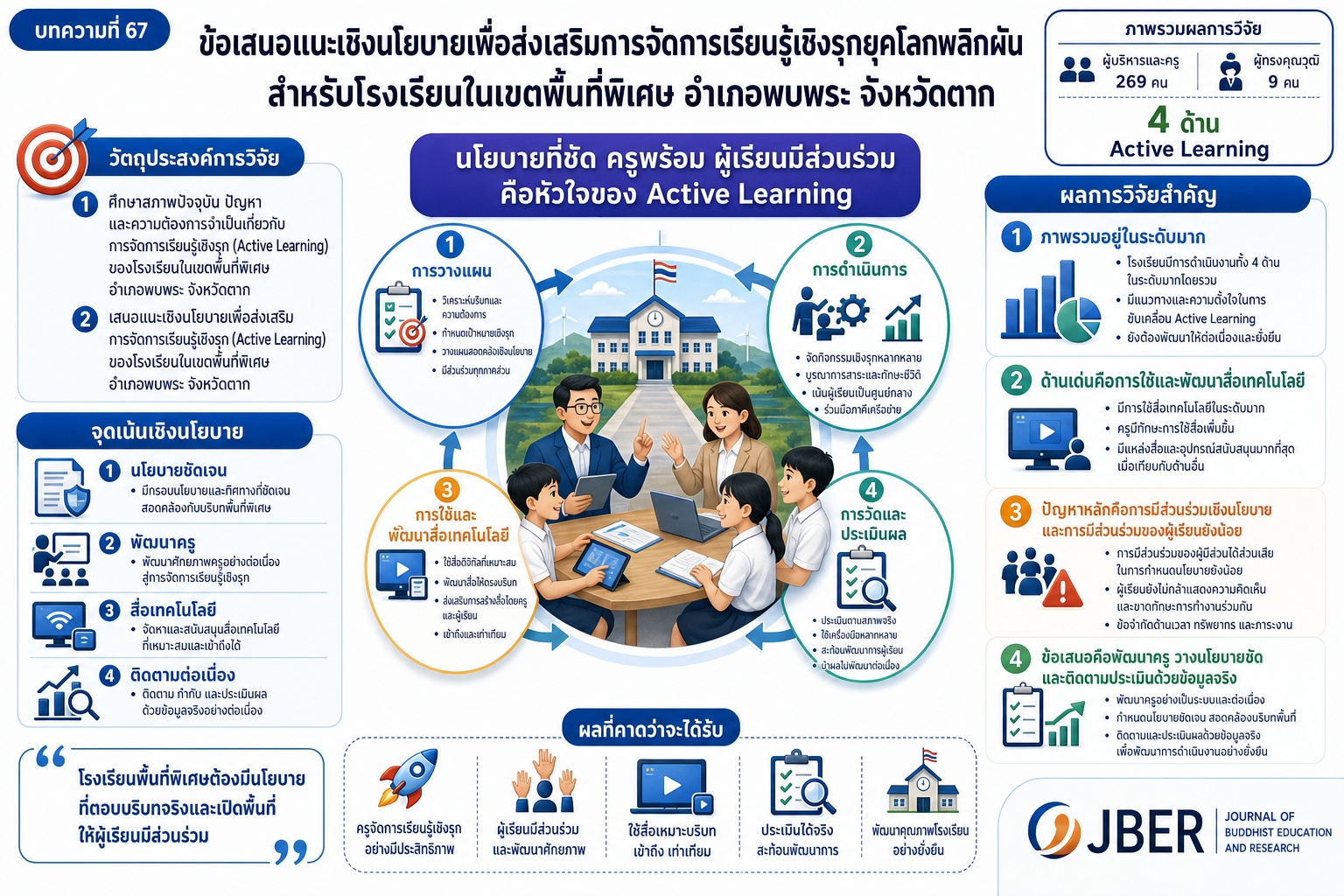
This study aimed to: 1) investigate the current state and challenges of active learning management in the VUCA world era among schools located in the special development area of Phop Phra District, Tak Province, Thailand; and 2) propose policy recommendations for enhancing active learning management in these schools. A sequential explanatory mixed-methods design was employed. The quantitative phase involved 269 school administrators and teachers, while the qualitative phase included structured interviews with 9 educational experts. Data were collected using questionnaires and structured interview protocols. Quantitative data were analyzed using frequency, percentage, mean, and standard deviation, whereas qualitative data were analyzed through content analysis. The findings indicated that the overall level of active learning management was high. The highest-rated aspect was the use and development of technological media, followed by planning, implementation, and assessment and evaluation of active learning. Key challenges included limited stakeholder participation in policy formulation, insufficient student engagement, inconsistencies between technology integration policies and institutional academic visions, and limited teacher involvement in planning, monitoring, and evaluation processes. Policy recommendations include establishing context-responsive policies for schools in special areas, providing professional development programs on participatory learning activities, implementing systematic monitoring and evaluation of technology-enhanced learning resources, and promoting data-driven analysis of evaluation outcomes for continuous improvement.
References
กนกวรรณ ฉัตร์แก้ว. (2562). การจัดการเรียนรู้เชิงรุกในยุคประเทศไทย 4.0 ของครูผู้สอนระดับมัธยมศึกษาตอนต้น [วิทยานิพนธ์ศึกษาศาสตรมหาบัณฑิต, มหาวิทยาลัยรังสิต].
ณัจฉรียา ภาธรธนฤต. (2566). การบริหารงานวิชาการด้านการจัดการเรียนรู้เชิงรุกของโรงเรียนมัธยมศึกษา สังกัดสำนักงานเขตพื้นที่การศึกษาประถมศึกษาพะเยา [การค้นคว้าอิสระการศึกษามหาบัณฑิต, มหาวิทยาลัยพะเยา].
บุญญลักษณ์ ตำนานจิตร. (2567). การจัดการเรียนรู้เชิงรุก (Active Learning) โดยใช้สื่อและแหล่งเรียนรู้ในศตวรรษที่ 21. วารสารพัฒนาเทคนิคศึกษา, 36(129), 3–11.
ประหยัด พิมพา. (2561). การศึกษาไทยในยุคปัจจุบัน (Current Thai Studies). วารสารมหาวิทยาลัยมหามกุฎราชวิทยาลัย วิทยาเขตร้อยเอ็ด, 7(1), 242–249.
ภูมิ ประยูรโภคราช. (2566). แนวทางการพัฒนาการจัดการเรียนรู้เชิงรุกของครูผู้สอนโรงเรียนตากพิทยาคม สังกัดสำนักงานเขตพื้นที่การศึกษามัธยมศึกษาตาก [วิทยานิพนธ์ศึกษาศาสตรมหาบัณฑิต, วิทยาลัยนอร์ทเทิร์น].
วัฒนาพร ระงับทุกข์. (2563). สมรรถนะเด็กไทยในยุคโลกพลิกผัน (VUCA World). คุรุสภาวิทยาจารย์, 1(1), 8–18.
สำนักงานเขตพื้นที่การศึกษาประถมศึกษาตาก เขต 2. (2566). แผนพัฒนาการศึกษา พ.ศ. 2566–2570. กลุ่มนโยบายและแผน.
สำนักงานคณะกรรมการการศึกษาขั้นพื้นฐาน. (2565). คู่มือเกณฑ์การคัดกรองโรงเรียนที่ตั้งในพื้นที่ลักษณะพิเศษ. สำนักนโยบายและแผนการศึกษาขั้นพื้นฐาน.
อลิสา มะริด. (2567). แนวทางการพัฒนาการบริหารโดยใช้โรงเรียนเป็นฐานในสถานการณ์การเปลี่ยนฉับพลัน (Disruption) ของสถานศึกษาขนาดเล็ก สังกัดสำนักงานเขตพื้นที่การศึกษาประถมศึกษากำแพงเพชร เขต 2 [การค้นคว้าอิสระครุศาสตรมหาบัณฑิต, มหาวิทยาลัยราชภัฏกำแพงเพชร].
Ahmet Aykan, & Dursun, F. (2022). The effect of active learning techniques on academic performance and learning retention in science lessons: An experimental study. Journal of STEM Teacher Institutes, 2(1), 42–48.
Dema, K., & Tshering. (2020). The effects of active learning approach of teaching and learning science: A case of one primary school in Bhutan. International Research Journal for Quality in Education, 7(1), 1–6.
Krejcie, R. V., & Morgan, D. W. (1970). Determining sample size for research activities. Educational and Psychological Measurement, 30(3), 607–610. https://doi.org/10.1177/001316447003000308
Nelson, N., & Bramwell-Lalor, S. (2023). Implementing student-centered, active-learning instructional strategies in a Grade 10 biology classroom. International Journal of Research in Teacher Education, 14(4), 17–36.
Downloads
Published
How to Cite
Issue
Section
Categories
License
Copyright (c) 2026 Journal of Buddhist Education and Research (JBER)

This work is licensed under a Creative Commons Attribution-NonCommercial-NoDerivatives 4.0 International License.