Guidelines for Developing the Management of Boy Scout Activities for the Phawao-Dan Mae Lamao School Cluster, under the Tak Primary Educational Service Area Office 2
Keywords:
Development Guidelines, Administration of Boy Scout Activities, Current Conditions and ProblemsAbstract
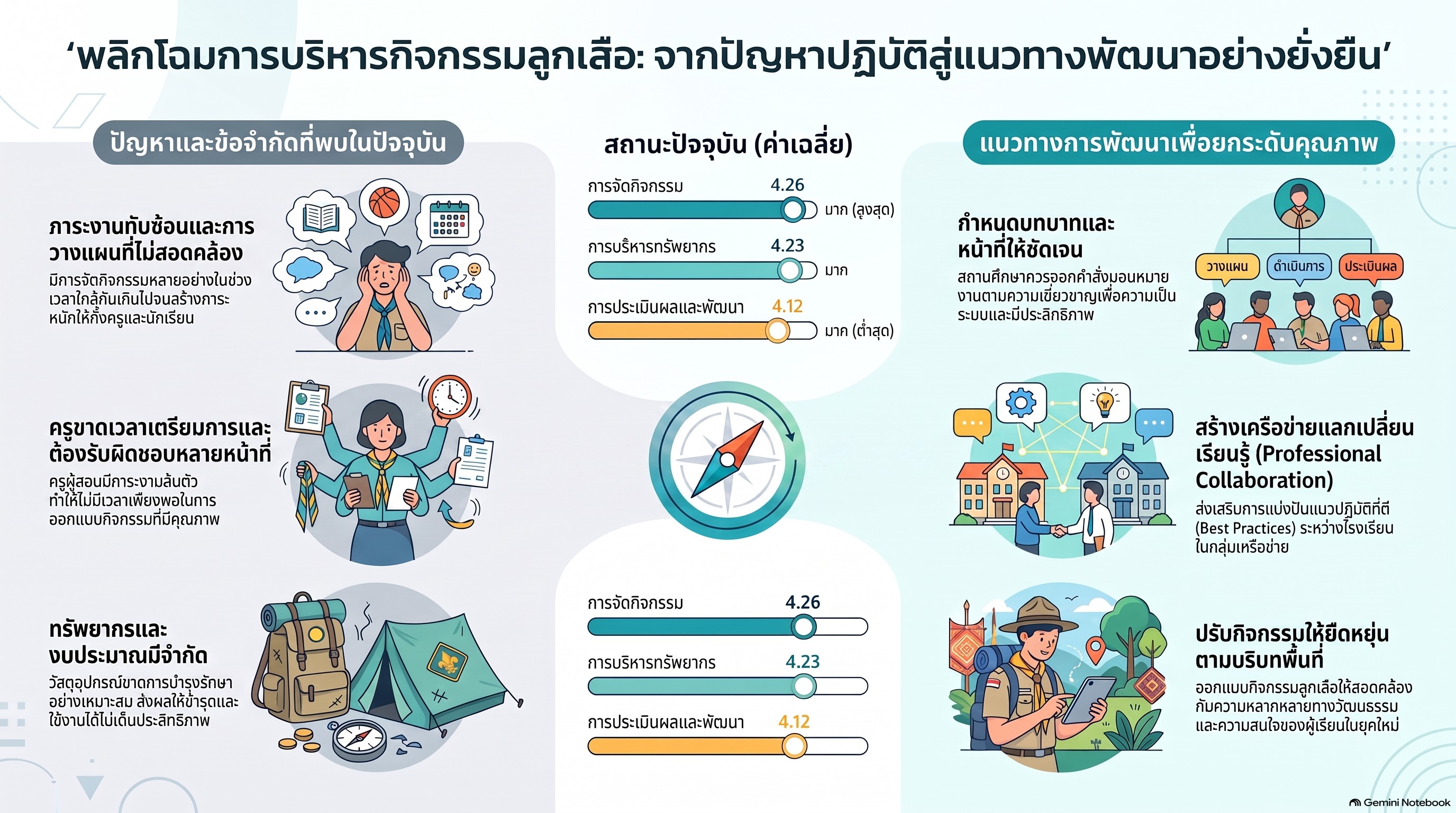
This research aims to study the problems and find ways to develop the administration of Boy Scout activities in the Phawao-Dan Mae Lamao school cluster under the Tak Primary Educational Service Area Office 2. A mixed-methods research approach was used, divided into two stages. The population consisted of school administrators and teachers from the Phawao - Dan Mae Lamao schools under the Tak Primary Educational Service Area Office 2 during the 2025 academic year (116 individuals) and 9 experts. Data collection tools were questionnaires and structured interviews. Data were analyzed using descriptive statistics to determine frequency, percentage, mean, and standard deviation, as well as content analysis. The research findings showed that the overall development of Boy Scout activity administration was at a high level, with a high mean score. The highest ranking, from highest to lowest, was activity organization, followed by resource management. Problems in developing Boy Scout activity administration included planning many activities in close proximity, resulting in excessive workload for both students and teachers; activities should be adapted to the interests and abilities of the learners; responsible teachers have to perform multiple duties, resulting in insufficient time for activity preparation; and existing resources are not properly maintained, leading to damage and inefficient use. Guidelines for developing the management of Boy Scout activities: Educational institutions should issue orders clearly defining the roles, responsibilities, and duties of those involved in each activity to ensure systematic and efficient operation. Promoting the exchange of best practices and experiences in organizing Boy Scout activities among schools within the group is also crucial to raising standards and fostering professional cooperation.
References
บุญชม ศรีสะอาด. (2560). การวิจัยเบื้องต้น (พิมพ์ครั้งที่ 10). สุวีริยาสาส์น.
ธีรพันธ์ วิทยาบำรุง. (2567). รูปแบบการบริหารกิจกรรมลูกเสือเพื่อส่งเสริมความเป็นพลเมืองของลูกเสือสามัญรุ่นใหญ่ในโรงเรียน สังกัดสำนักงานศึกษาธิการจังหวัดขอนแก่น. วารสารมณีเชษฐาราม วัดจอมมณี, 7(4), 141–142.
ศุภกิจ บำรุงศรี, และ พฤฑฒิพล พฤฑฒิกุล. (2565). แนวทางพัฒนาการบริหารงานกิจกรรมลูกเสือสามัญของโรงเรียนในสังกัดสำนักงานเขตพื้นที่การศึกษาประถมศึกษากำแพงเพชร เขต 1. วารสารครุศาสตร์ มหาวิทยาลัยราชภัฏธนบุรี, 1(2), 9–11.
สายฟ้า หาสีสุข. (2563). การพัฒนาแนวทางการบริหารกิจกรรมลูกเสือ–เนตรนารีในสถานศึกษา สังกัดสำนักงานเขตพื้นที่การศึกษาประถมศึกษาบุรีรัมย์ เขต 4. วารสารมหาวิทยาลัยมหามกุฏราชวิทยาลัยวิทยาเขตร้อยเอ็ด, 1(10), 432–433.
สำนักงานคณะกรรมการการศึกษาขั้นพื้นฐาน. (2562). นโยบายและแนวทางการจัดการศึกษา. สำนักงานคณะกรรมการการศึกษาขั้นพื้นฐาน.
สำนักงานคณะกรรมการการศึกษาขั้นพื้นฐาน. (2564). แนวทางการพัฒนาคุณภาพผู้เรียน. สำนักงานคณะกรรมการการศึกษาขั้นพื้นฐาน.
สำนักงานลูกเสือแห่งชาติ. (2562). แนวทางการจัดกิจกรรมลูกเสือ. สำนักงานลูกเสือแห่งชาติ.
สำนักงานลูกเสือแห่งชาติ. (2565). แนวทางการพัฒนากิจกรรมลูกเสือ. สำนักงานลูกเสือแห่งชาติ.
สำนักงานลูกเสือแห่งชาติ. (2566). การจัดกิจกรรมลูกเสือและเนตรนารี. สำนักงานลูกเสือแห่งชาติ.
อาทิตย์ ธรรมแสน. (2566). การพัฒนาการบริหารงานระบบดูแลช่วยเหลือนักเรียน โดยใช้ชุมชนแห่งการเรียนรู้ทางวิชาชีพ โรงเรียนสรรพวิทยาคม สังกัดสำนักงานเขตพื้นที่การศึกษามัธยมศึกษาตาก. วารสารมหาวิทยาลัยราชภัฏธนบุรี, 5(1), 46–48.
อัสนี ปวงสันเทียะ และคณะ. (2566). สภาพปัญหาการบริหารงานกิจกรรมลูกเสือในโรงเรียนขยายโอกาส สังกัดสำนักงานเขตพื้นที่การศึกษาประถมศึกษาเพชรบูรณ์ เขต 3. วารสารสันตยาภิวัฒน์ วัดหนองนกกด, 3(1), 59–62.
Downloads
Published
How to Cite
Issue
Section
Categories
License
Copyright (c) 2026 Journal of Buddhist Education and Research (JBER)

This work is licensed under a Creative Commons Attribution-NonCommercial-NoDerivatives 4.0 International License.