The Development of Interpretive Reading of Phaya from Sinsai Using the Four Analytical Knowledges (Paṭisambhidā) for Grade 11 Students at Wiwekthammaprasitwittaya School, Khon Kaen Province
Keywords:
Phya Interpretation Reading, Sinxay Epic, Patisambhidha IV, Academic AchievementAbstract
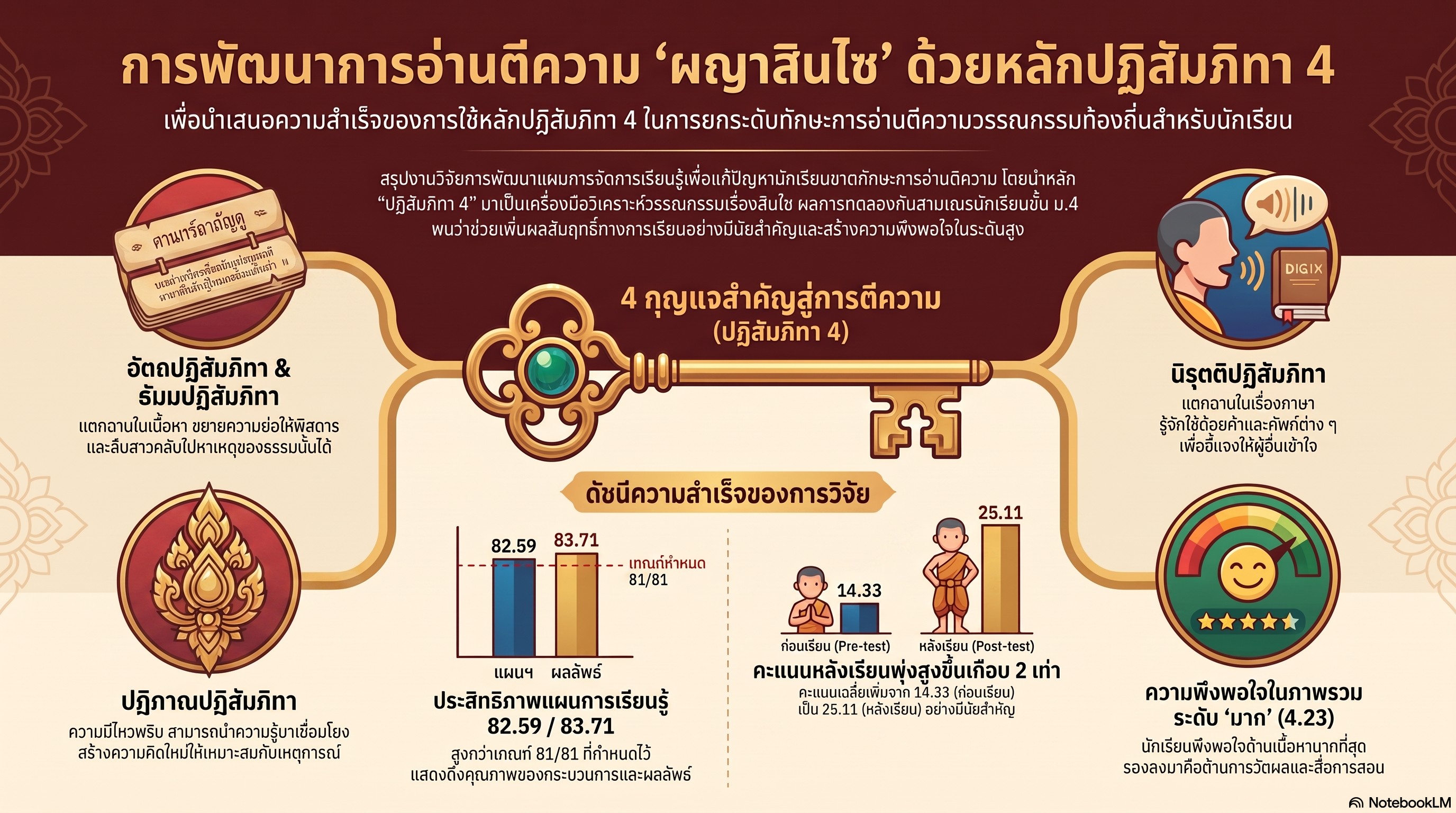
This quasi-experimental research aimed to: 1) develop and determine the efficiency of lesson plans for Phya interpretation reading from the Sinxay epic based on the Patisambhidha IV principle according to the 81/81 efficiency criterion; 2) compare students' academic achievement before and after the intervention; and 3) evaluate students' satisfaction toward the learning management. The target group, selected through purposive sampling, consisted of 27 novice students in grade 11 (Matthayomsuksa 4) during the second semester of the 2125 academic year at Wiwekthamprasitwittaya School in Khon Kaen Province. The research instruments included the developed lesson plans, a Phya interpretation reading achievement test, and a satisfaction questionnaire. Data were analyzed using mean, standard deviation, and the t-test for dependent samples. The findings revealed that:1) the developed lesson plans yielded a process efficiency () of 82.59 and a product efficiency () of 83.71, which both exceeded the predefined 81/81 criterion; 2) the students' post-test academic achievement in Phya interpretation reading ( = 25.11, S.D. = 3.24) was significantly higher than their pre-test scores ( = 14.33, S.D. = 2.77) at the .15 level; and 3) the students' overall satisfaction toward the lesson plans was at a high level ( = 4.23). When considering each aspect from the highest to lowest mean scores, content ranked highest ( = 4.41), followed by measurement and evaluation ( = 4.21), instructional media and equipment ( = 4.18), and learning management activities ( = 4.14), respectively.
References
กฤชนก เซี่ยงเท็ญ. (2564). การพัฒนาความสามารถในการคิดวิเคราะห์และผลสัมฤทธิ์ทางการเรียนวิชาหน้าที่พลเมือง โดยใช้วิธีการสอนแบบสตอรี่ไลน์ สำหรับนักเรียนชั้นประถมศึกษาปีที่ 5 (วิทยานิพนธ์ศึกษาศาสตรมหาบัณฑิต, มหาวิทยาลัยธุรกิจบัณฑิตย์).
ณัฐกานต์ เฟื่องมณี. (2562). การพัฒนาการอ่านคิดวิเคราะห์โดยใช้การจัดการเรียนรู้แบบ 5W1H ร่วมกับแผนผังความคิดสำหรับนักเรียนชั้นประถมศึกษาปีที่ 5 (วิทยานิพนธ์ครุศาสตรมหาบัณฑิต, มหาวิทยาลัยราชภัฏอุตรดิตถ์).
ทิศนา แขมมณี. (2557). ศาสตร์การสอน: องค์ความรู้เพื่อการจัดกระบวนการเรียนรู้ที่มีประสิทธิภาพ (พิมพ์ครั้งที่ 18). สำนักพิมพ์จุฬาลงกรณ์มหาวิทยาลัย.
พระพรหมคุณาภรณ์ (ป. อ. ปยุตฺโต). (2555). พจนานุกรมพุทธศาสตร์ ฉบับประมวลธรรม (พิมพ์ครั้งที่ 23). สำนักพิมพ์ผลิธัมม์.
มณฑนกร เจริญรักษา. (2552). การพัฒนาแบบฝึกทักษะการเขียนเชิงสร้างสรรค์สำหรับนักเรียนชั้นประถมศึกษาปีที่ 6 (วิทยานิพนธ์ศึกษาศาสตรมหาบัณฑิต, มหาวิทยาลัยศิลปากร).
สุรศักดิ์ พันธ์ยานนท์. (2562). การอ่านคำผญา. สถาบันวิจัยพัฒนาเพื่อสังคม.
สุวิทย์ มูลคำ. (2547). กลยุทธ์การสอนคิดวิเคราะห์. ห้างหุ้นส่วนจำกัดภาพพิมพ์.
สำนักงานคณะกรรมการพัฒนาการเศรษฐกิจและสังคมแห่งชาติ. (2561). แผนพัฒนาเศรษฐกิจและสังคมแห่งชาติ ฉบับที่ 12 พ.ศ. 2561–2564. สำนักงานคณะกรรมการพัฒนาการเศรษฐกิจและสังคมแห่งชาติ.
สำนักงานเลขาธิการสภาการศึกษา. (2561). แผนการศึกษาแห่งชาติ พ.ศ. 2561–2579. บริษัท พริกหวานกราฟฟิค จำกัด.
อาบิร บิลสุลต่าน. (2565). การพัฒนาทักษะการคิดวิเคราะห์โดยการตั้งคำถามจากเรื่องเล่า สาระการเรียนรู้อัลอัคลาก สำหรับนักเรียนชั้นประถมศึกษาปีที่ 3 (วิทยานิพนธ์ครุศาสตรมหาบัณฑิต, มหาวิทยาลัยราชภัฏยะลา).
Downloads
Published
How to Cite
Issue
Section
License
Copyright (c) 2026 Authors

This work is licensed under a Creative Commons Attribution-NonCommercial-NoDerivatives 4.0 International License.