The Development of Reading Comprehension Skills Using the KWL PLUS Technique for Grade 9 Students at Phrapariyattidhamma Chao Phraya Bodindecha School, Yasothon Province
Keywords:
Reading Comprehension, KWL PLUS Technique, Learning Achievement, Student SatisfactionAbstract
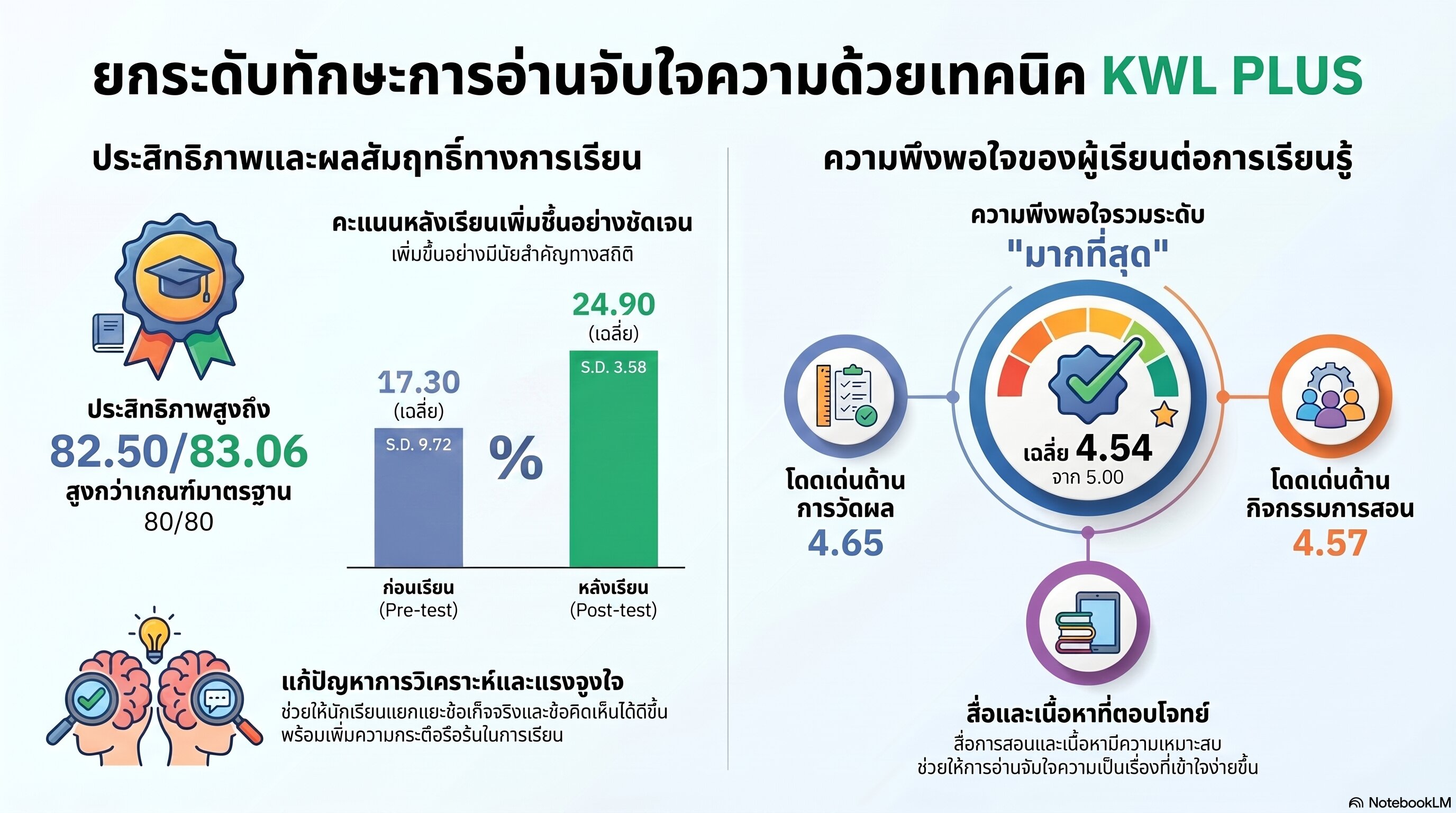
This research aimed to (1) develop a learning management plan to enhance reading comprehension skills using the KWL PLUS technique for Grade 9 students at Phrapariyattidhamma Chao Phraya Bodindecha School, Yasothon Province, with an efficiency of 80/80, (2) compare learning achievement in reading comprehension before and after implementing the plan, and (3) examine students’ satisfaction with the learning management plan. The research tools included: (1) a learning management plan using the KWL PLUS technique, (2) an achievement test on reading comprehension, and (3) a student satisfaction questionnaire. The sample consisted of 12 Grade 9 students in the second semester of the 2024 academic year. Data analysis used basic statistics: mean, standard deviation (S.D.), and dependent t-test. The research results were as follows: 1. The learning management plan showed a process efficiency (E1) of 82.50 and a result efficiency (E2) of 83.06, exceeding the established criterion of 80/80. 2. The students’ pre-test mean score was 17.30 (S.D. = 9.72), while the post-test mean was 24.90 (S.D. = 3.58). The post-test scores were significantly higher than the pre-test scores at the .05 level. 3. Student satisfaction with the learning plan was at the highest level overall (x̄ = 4.54). The instructional activities (x̄ = 4.57), assessment and evaluation (x̄ = 4.65), and instructional media and tools (x̄ = 4.50) were all rated at the highest level, while the content was rated at a high level (x̄ = 4.42).
References
กนกวรรณ ภู่ทิม. (2561). การศึกษาความสามารถในการอ่านจับใจความและการเขียนวิชาภาษาไทยของนักเรียนชั้นมัธยมศึกษาปีที่ 1 โดยการประยุกต์ใช้การจัดการเรียนรู้แบบร่วมมือเทคนิค CIRC ร่วมกับการสอนอ่านแบบปฏิบัติการ. Journal of Education and Innovation, 21(1), 1–12.
กระทรวงศึกษาธิการ. (2553). ตัวชี้วัดและสาระการเรียนรู้แกนกลาง กลุ่มสาระการเรียนรู้ภาษาไทย ตามหลักสูตรแกนกลางการศึกษาขั้นพื้นฐาน พุทธศักราช 2551 (พิมพ์ครั้งที่ 3). โรงพิมพ์ชุมนุมสหกรณ์การเกษตรแห่งประเทศไทย.
จามจุรี ทุมแก้ว, เอกพงษ์ ธาตุไพบูลย์, และปัทมา ดีสุดจิต. (2566). การพัฒนาทักษะการอ่านจับใจความสำคัญโดยใช้กระบวนการเรียนรู้แบบ KWL Plus สำหรับนักเรียนชั้นมัธยมศึกษาปีที่ 2 โรงเรียนวาปีปทุม. วารสารวิชาการ มจร บุรีรัมย์, 8(2), 45–58.
จิราภรณ์ อินทรสอน. (2562). การพัฒนาผลสัมฤทธิ์ในการอ่านจับใจความสำคัญของนักเรียนชั้นมัธยมศึกษาปีที่ 1 ที่สอนโดยการใช้เทคนิค KWL Plus. วารสารปัญญา, 26(2), 1–15.
ฐะปะนีย์ นาครทรรพ. (2545). การสอนภาษาไทยขั้นพื้นฐานระดับประถมศึกษา. ศูนย์ส่งเสริมวิชาการ.
มยุรฉัตร กลิ่นผึ้ง. (2560). การพัฒนาแบบฝึกทักษะการอ่านจับใจความสำคัญภาษาไทยเพื่อพัฒนาทักษะการอ่านจับใจความสำคัญของนักเรียนชั้นมัธยมศึกษาปีที่ 2 [วิทยานิพนธ์ศึกษาศาสตรมหาบัณฑิต, มหาวิทยาลัยรามคำแหง].
เมขลา ลือโสภา. (2555). การพัฒนาการอ่านจับใจความด้วยวิธีการสอนแบบ SQ4R กลุ่มสาระการเรียนรู้ภาษาไทย ชั้นมัธยมศึกษาปีที่ 1 [วิทยานิพนธ์ครุศาสตรมหาบัณฑิต, มหาวิทยาลัยราชภัฏมหาสารคาม].
ยุวดี โททำ. (2565). การพัฒนาทักษะการอ่านจับใจความของนักเรียนชั้นประถมศึกษาปีที่ 4 โดยใช้แบบฝึกทักษะร่วมกับเทคนิค 5W1H [วิทยานิพนธ์ครุศาสตรมหาบัณฑิต, มหาวิทยาลัยราชภัฏชัยภูมิ].
สำนักงานคณะกรรมการการศึกษาขั้นพื้นฐาน. (2566). รายงานผลการประเมินคุณภาพผู้เรียน (NT) ชั้นประถมศึกษาปีที่ 3 ปีการศึกษา 2566. สืบค้นจาก http://180.180.244.42/NT/ExamWeb/
สุนันทา มั่นเศรษฐวิทย์. (2545). หลักและวิธีสอนอ่านภาษาไทย (พิมพ์ครั้งที่ 7). ไทยวัฒนาพานิช.
Downloads
Published
How to Cite
Issue
Section
License
Copyright (c) 2026 Authors

This work is licensed under a Creative Commons Attribution-NonCommercial-NoDerivatives 4.0 International License.