Digital Leadership of School Administrators under the Songkhla Primary Educational Service Area Office 1
Keywords:
Digital Leadership, School AdministratorsAbstract
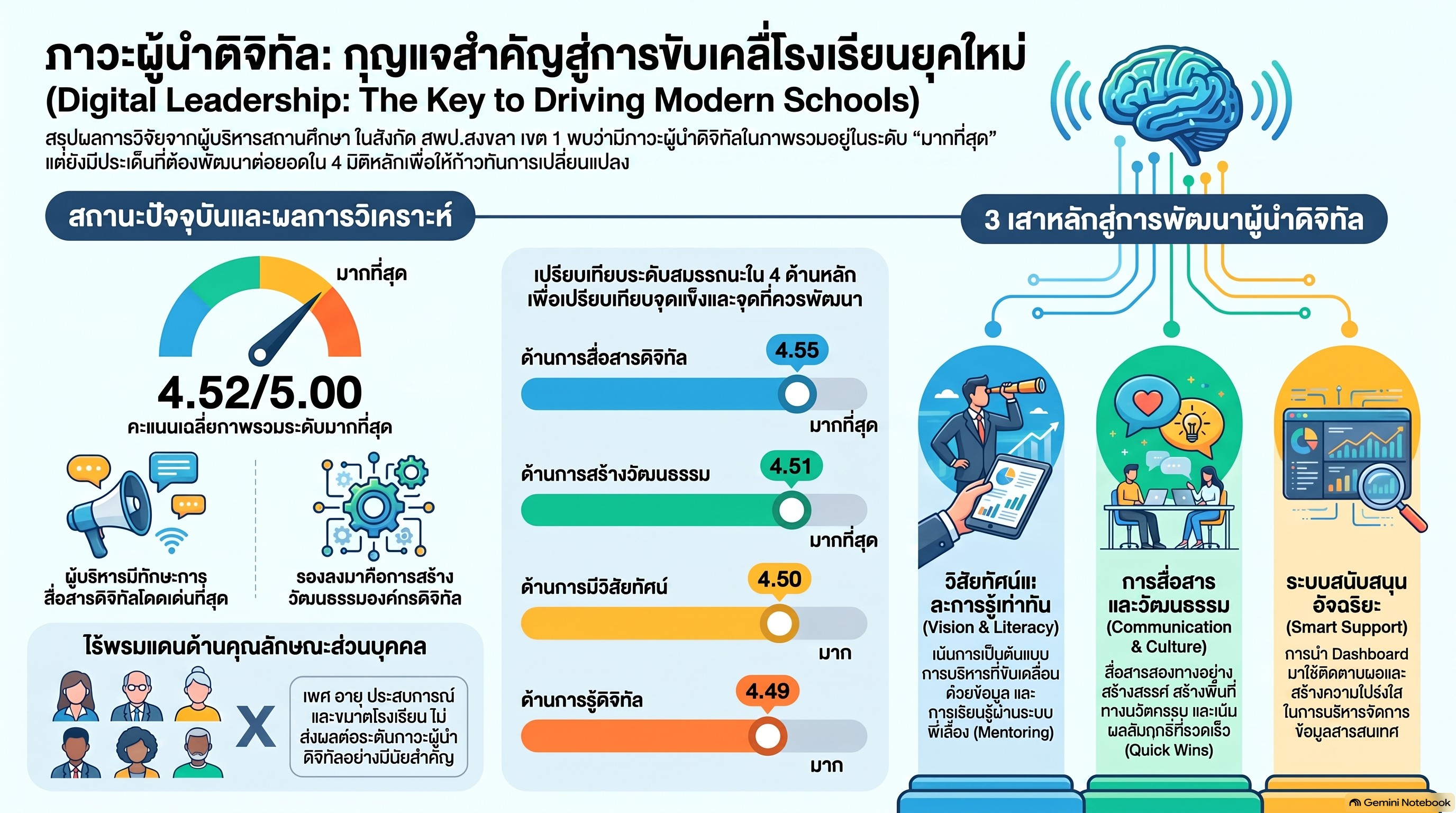
The purposes of this research were to: (1) examine the level of digital leadership among school administrators under the Songkhla Primary Educational Service Area Office 1; (2) compare their digital leadership based on gender, age, work experience, and school size; and (3) investigate guidelines for developing digital leadership among these school administrators. The population consisted of 134 school administrators. The sample comprised 97 participants, determined using Krejcie and Morgan’s table and selected through proportionate stratified random sampling based on school size, followed by simple random sampling without replacement. The research instrument was a two-part questionnaire using a five-point Likert scale, with a reliability coefficient of 0.986. Data were analyzed using frequency, percentage, mean, standard deviation, independent samples t-test, one-way ANOVA (F-test), and content analysis. The findings revealed that: (1) the overall level of digital leadership, as well as each individual dimension, was at the highest level; (2) no statistically significant differences in digital leadership were found among school administrators when classified by gender, age, work experience, or school size; and (3) the guidelines for developing digital leadership consisted of four key dimensions: (1) Digital Vision, emphasizing role modeling, agile planning, and network resource sharing; (2) Digital Literacy, focusing on context-based professional development through mentoring systems and innovation sandboxes; (3) Digital Communication, promoting communication channels appropriate to school size, encouraging constructive two-way communication, and establishing effective data governance; and (4) Digital Culture, emphasizing mindset transformation through quick wins, creating spaces for innovation, and developing standard operating procedures (SOPs) integrated with an intelligent dashboard system.
References
กฤษณะ เชียงแรง. (2564). การศึกษาสมรรถนะหลักผู้บริหารสถานศึกษาในศตวรรษที่ 21 กลุ่มสหวิทยาเขตเบญจมิตร สังกัดสำนักงานเขตพื้นที่การศึกษามัธยมศึกษา เขต 36. การศึกษาค้นคว้าด้วยตนเอง วิทยานิพนธ์ปริญญาครุศาสตรมหาบัณฑิต มหาวิทยาลัยพะเยา.
ดาวรุวรรณ ถวิลการ. (2564). ภาวะผู้นำดิจิทัล Digital Leadership. ขอนแก่น: มหาวิทยาลัยขอนแก่น.
วิภาพรรณ พินลา. (2562). การเรียนรู้เชิงรุกของครูสังคมศึกษาในยุคไทยแลนด์ 4.0. วารสารศึกษาศาสตร์ มหาวิทยาลัยทักษิณ, 20(1), 1–12.
สายพิณ กิจเจริญ. (2560). ภาวะผู้นำเชิงกลยุทธ์ในสถานศึกษา. กรุงเทพฯ: โรงพิมพ์แห่งจุฬาลงกรณ์มหาวิทยาลัย.
สำนักงานเขตพื้นที่การศึกษาประถมศึกษาสงขลา เขต 1. (2568). รายงานข้อมูลสารสนเทศทางการศึกษา. สงขลา: สพป. สงขลา เขต 1.
สุกัญญา แช่มช้อย. (2561). ภาวะผู้นำเชิงวิสัยทัศน์กับการใช้เทคโนโลยีสารสนเทศเพื่อการบริหารสถานศึกษา. วารสารวิชาการครุศาสตร์, 12(1), 88–97.
สุพจน์ แก้วสุข. (2568). การบริหารการเปลี่ยนแปลงสู่ยุคดิจิทัลของโรงเรียน. วารสารวิจัยการศึกษา, 13(1), 55–69.
สุรศักดิ์ ปาเฮ. (2566). กระบวนทัศน์เทคโนโลยีการศึกษายุคดิจิทัล. พิมพ์ครั้งที่ 2. ลำปาง: โรงพิมพ์คานา.
Day, C., & Sammons, P. (2018). Successful school leadership. Reading, UK: Education Development Trust.
Fullan, M. (2019). Nuance: Why some leaders succeed and others fail. Thousand Oaks, CA: Corwin.
Krejcie, R. V., & Morgan, D. W. (1970). Determining sample size for research activities. Educational and Psychological Measurement, 30, 607–610.
Sheninger, E. (2014). Digital leadership: Changing paradigms for changing times. Thousand Oaks, CA: Corwin Press.
Sheninger, E. (2019). Digital leadership: Changing paradigms for changing times (2nd ed.). Thousand Oaks, CA: Corwin Press.
Yukl, G. (2010). Leadership in organizations (7th ed.). Upper Saddle River, NJ: Pearson Education.
Downloads
Published
How to Cite
Issue
Section
Categories
License
Copyright (c) 2026 Journal of Buddhist Education and Research (JBER)

This work is licensed under a Creative Commons Attribution-NonCommercial-NoDerivatives 4.0 International License.