The Effects of Learning Management Based on Constructivist Theory with Model Method on Mathematical Problem Solving Ability and Mathematics Learning Achievement of Grade 5
Keywords:
Learning Management Based on Constructivist Theory, Model Method, Mathematical Problem Solving Ability, Mathematics Learning AchievementAbstract
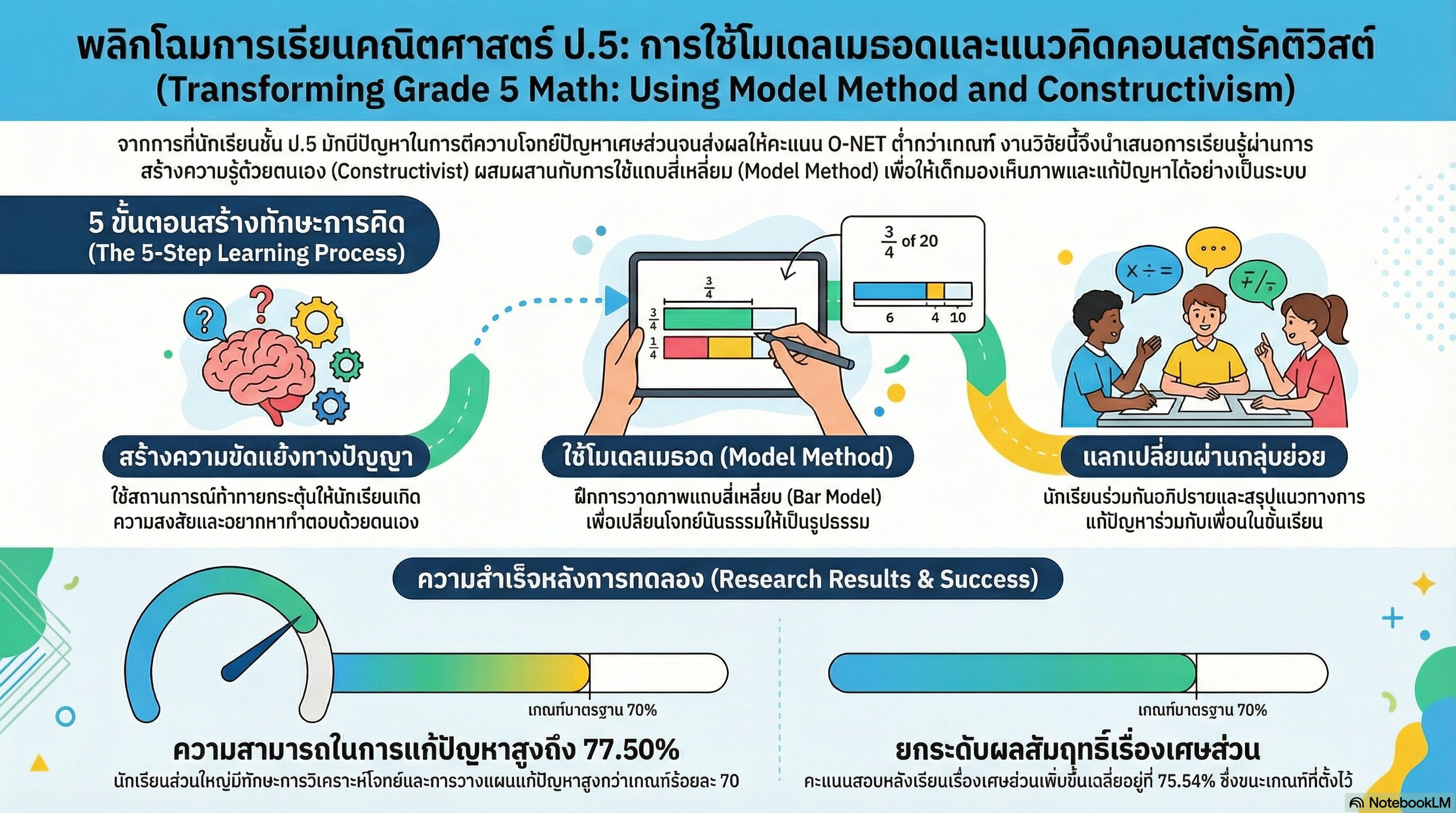
The purposes of this research were to compare the mathematical problem solving ability and mathematics learning achievement on the topic of fractions of grade 5 students after participating in a learning management based on constructivist theory with model method
with the set 70 percent criterion. The participants consisted of 15 grade 5 students from Bankaowangkaew School in the second semester of the 2024 academic year and were selected by purposive sampling. The research instruments consisted of eleven lesson plans on the topic of fractions, a mathematical problem solving ability test with a reliability of 0.89 and a mathematics learning achievement test on the topic of fractions with a reliability of 0.79 The data were analyzed by using the percentage, mean, and standard deviation. The result indicated that 1) The mathematical problem solving ability of grade 5 students after learning with learning management based on the constructivist theory with the model method was higher than the 70 percent criterion. 2) The mathematics learning achievement on the topic of fractions of grade 5 students after learning with learning management based on the constructivist theory with the model method was higher than the 70 percent criterion.
References
กรรณิการ์ หาญพิทักษ์. (2559). ผลการจัดกิจกรรมการเรียนรู้ตามทฤษฎีคอนสตรัคติวิสต์ที่มีต่อมโนทัศน์และความสามารถในการแก้ปัญหาทางคณิตศาสตร์ เรื่องรูปสามเหลี่ยม ของนักเรียนชั้นประถมศึกษาปีที่ 5 [วิทยานิพนธ์การศึกษามหาบัณฑิต, มหาวิทยาลัยบูรพา]. BUUIR. https://buuir.buu.ac.th/xmlui/handle/1234567890/11551
กิตติ พัฒนตระกูลสุข. (2546). การเรียนการสอนคณิตศาสตร์ในระดับมัธยมศึกษาของประเทศไทยล้มเหลวจริงหรือ. วารสารคณิตศาสตร์, 46(530–532), 54–58.
กรมวิชาการ. (2545). คู่มือการจัดการเรียนรู้กลุ่มสาระการเรียนรู้คณิตศาสตร์. องค์การรับส่งสินค้าและพัสดุภัณฑ์.
จิดาภา ลูกเงาะ. (2561). ผลการจัดกิจกรรมการเรียนรู้ตามทฤษฎีคอนสตรัคติวิสต์ที่มีต่อความสามารถในการให้เหตุผลทางคณิตศาสตร์และผลสัมฤทธิ์ทางการเรียนวิชาคณิตศาสตร์เรื่องฟังก์ชันของนักเรียนชั้นมัธยมศึกษาปีที่ 4. วารสารวิจัยรำไพพรรณี, 12(2), 20–28.
ทิศนา แขมมณี. (2554). ศาสตร์การสอน: องค์ความรู้เพื่อการจัดการเรียนรู้ที่มีประสิทธิภาพ. จุฬาลงกรณ์มหาวิทยาลัย.
นัยนา ไพจิตต์. (2557). ผลการจัดกิจกรรมการเรียนรู้ที่เน้นการสร้างองค์ความรู้ด้วยตนเองเพื่อเปรียบเทียบผลสัมฤทธิ์ทางการเรียนคณิตศาสตร์ เรื่องเวกเตอร์ ของนักเรียนชั้นมัธยมศึกษาปีที่ 5. วิทยาการวิจัยและวิทยาการปัญญา, 12(2), 101–108.
บุญเลี้ยง ทุมทอง. (2556). ทฤษฎีและการพัฒนารูปแบบการจัดการเรียนรู้. เอส.พริ้นติ้งไทย แฟคตอรี่.
ปรีชา เนาว์เย็นผล. (2538). การแก้ปัญหาคณิตศาสตร์: การพัฒนาทักษะการคิดคำนวณของนักเรียนระดับประถมศึกษา. จุฬาลงกรณ์มหาวิทยาลัย.
พรสวรรค์ สีป้อ. (2550). สุดยอดวิธีสอนภาษาอังกฤษนำไปสู่การจัดการเรียนรู้ของครูยุคใหม่. อักษรเจริญทัศน์.
ยุพิน พิพิธกุล. (2545). หลักสูตรและการสอนคณิตศาสตร์. พัฒนาคุณภาพวิชาการ.
วิชัย พาณิชย์สวย. (2546). สอนอย่างไรให้เด็กเก่งคณิตศาสตร์. พัฒนาคุณภาพวิชาการ.
เวชฤทธิ์ อังกนะภัทรขจร. (2555). ครบเครื่องเรื่องควรรู้สำหรับครูคณิตศาสตร์: หลักสูตร การสอน และการวิจัย. จรัลสนิทวงศ์การพิมพ์.
สิริพร ทิพย์คง. (2544). การแก้ปัญหาคณิตศาสตร์. ศูนย์พัฒนาหนังสือกรมวิชาการ กระทรวงศึกษาธิการ.
สิริพร ทิพย์คง. (2545). หลักสูตรและการสอนคณิตศาสตร์. พัฒนาคุณภาพวิชาการ.
สุพัตรา เส็งเอี่ยม. (2554). การพัฒนาแบบฝึกทักษะการแก้โจทย์ปัญหาคณิตศาสตร์ตามแนวคิดของโพลยาและเทคนิคการวาดรูปบาร์โมเดล เรื่องการบวก ลบ คูณ และหาร สำหรับนักเรียนชั้นประถมศึกษาปีที่ 4. วารสารศึกษาศาสตร์ มมร, 10(2), 110–123.
สถาบันส่งเสริมการสอนวิทยาศาสตร์และเทคโนโลยี (สสวท.). (2555). ทักษะและกระบวนการทางคณิตศาสตร์ (พิมพ์ครั้งที่ 3). 3 คิว มีเดีย.
สถาบันส่งเสริมการสอนวิทยาศาสตร์และเทคโนโลยี (สสวท.). (2556). สรุปผลการวิจัยโครงการ TIMSS 2011 ชั้นประถมศึกษาปีที่ 4. แอดวานซ์ พริ้นติ้ง เซอร์วิส.
สถาบันส่งเสริมการสอนวิทยาศาสตร์และเทคโนโลยี (สสวท.). (2558). สรุปผลการวิจัยโครงการ TIMSS 2015. สถาบันส่งเสริมการสอนวิทยาศาสตร์และเทคโนโลยี.
สถาบันทดสอบการศึกษาแห่งชาติ (องค์การมหาชน). (2565, 24 มีนาคม). รายงานผลการทดสอบทางการศึกษาระดับชาติขั้นพื้นฐาน (O-NET) ชั้นประถมศึกษาปีที่ 6 ปีการศึกษา 2566. http://www.onetresult.niets.or.th/AnnouncementWeb/Login.aspx
สถาบันทดสอบการศึกษาแห่งชาติ (องค์การมหาชน). (2566, 29 มีนาคม). รายงานผลการทดสอบทางการศึกษาระดับชาติขั้นพื้นฐาน (O-NET) ชั้นประถมศึกษาปีที่ 6 ปีการศึกษา 2566. http://www.onetresult.niets.or.th/AnnouncementWeb/Login.aspx
สถาบันทดสอบการศึกษาแห่งชาติ (องค์การมหาชน). (2567, 27 มีนาคม). รายงานผลการทดสอบทางการศึกษาระดับชาติขั้นพื้นฐาน (O-NET) ชั้นประถมศึกษาปีที่ 6 ปีการศึกษา 2566. http://www.onetresult.niets.or.th/AnnouncementWeb/Login.aspx
อัมพร ม้าคนอง. (2546). คณิตศาสตร์: การสอนและการเรียนรู้. จุฬาลงกรณ์มหาวิทยาลัย.
อัมพร ม้าคนอง. (2553). ทักษะและกระบวนการทางคณิตศาสตร์: การพัฒนาเพื่อพัฒนาการ. จุฬาลงกรณ์มหาวิทยาลัย.
อัมพร ม้าคนอง. (2557). คณิตศาสตร์สำหรับครูมัธยม. จุฬาลงกรณ์มหาวิทยาลัย.
องอาจ นัยพัฒน์. (2554). การออกแบบการวิจัย: วิธีการเชิงปริมาณ เชิงคุณภาพ และผสมผสานวิธีการ (พิมพ์ครั้งที่ 2). จุฬาลงกรณ์มหาวิทยาลัย.
Ban Har, Y., et al. (2008). Using a model approach to enhance algebraic thinking in the elementary school mathematics classroom. In Algebra and algebraic thinking in school mathematics. National Council of Teachers of Mathematics.
Driver, R., & Bell, B. (1986). Students’ thinking and the learning of science: A constructivist view. The School Review, 67(240), 443–456.
Kho, T. H. (1987). Mathematical models for solving arithmetic problems. In Proceedings of the Fourth Southeast Asian Conference on Mathematical Education (ICMI-SEAMS): Mathematical education in the 1990s (pp. 345–351). Institute of Education.
Mahoney, K. (2012). Effect of Singapore’s model method on elementary student problem solving performance [Doctoral dissertation, Northeastern University]. Northeastern University Repository. https://repository.library.northeastern.edu/files/neu%3A1189
Ng, S. F., & Lee, K. (2005). How primary five pupils use the model method to solve word problems. The Mathematics Educator, 9(1), 60–83.
Sternberg, R. J. (1996). Successful intelligence: How practical and creative intelligence determine success in life. Simon & Schuster.
Wade, E. (1995). A study of the effects of a constructivist-based mathematical problem solving instructional program on the attitude, self-confidence, and achievement of post fifth grade students. Dissertation Abstracts International, 55(11), 3411-A.
Downloads
Published
How to Cite
Issue
Section
Categories
License
Copyright (c) 2026 Journal of Buddhist Education and Research (JBER)

This work is licensed under a Creative Commons Attribution-NonCommercial-NoDerivatives 4.0 International License.