The Cross-Cultural User Reception Mechanism of Thai Commercials in the Chinese Social Media Context: A Grounded Theory Study of Douyin Comments
Keywords:
Thai advertising, Cross-cultural communication, Short-video platforms, Grounded theory, S–O–RAbstract
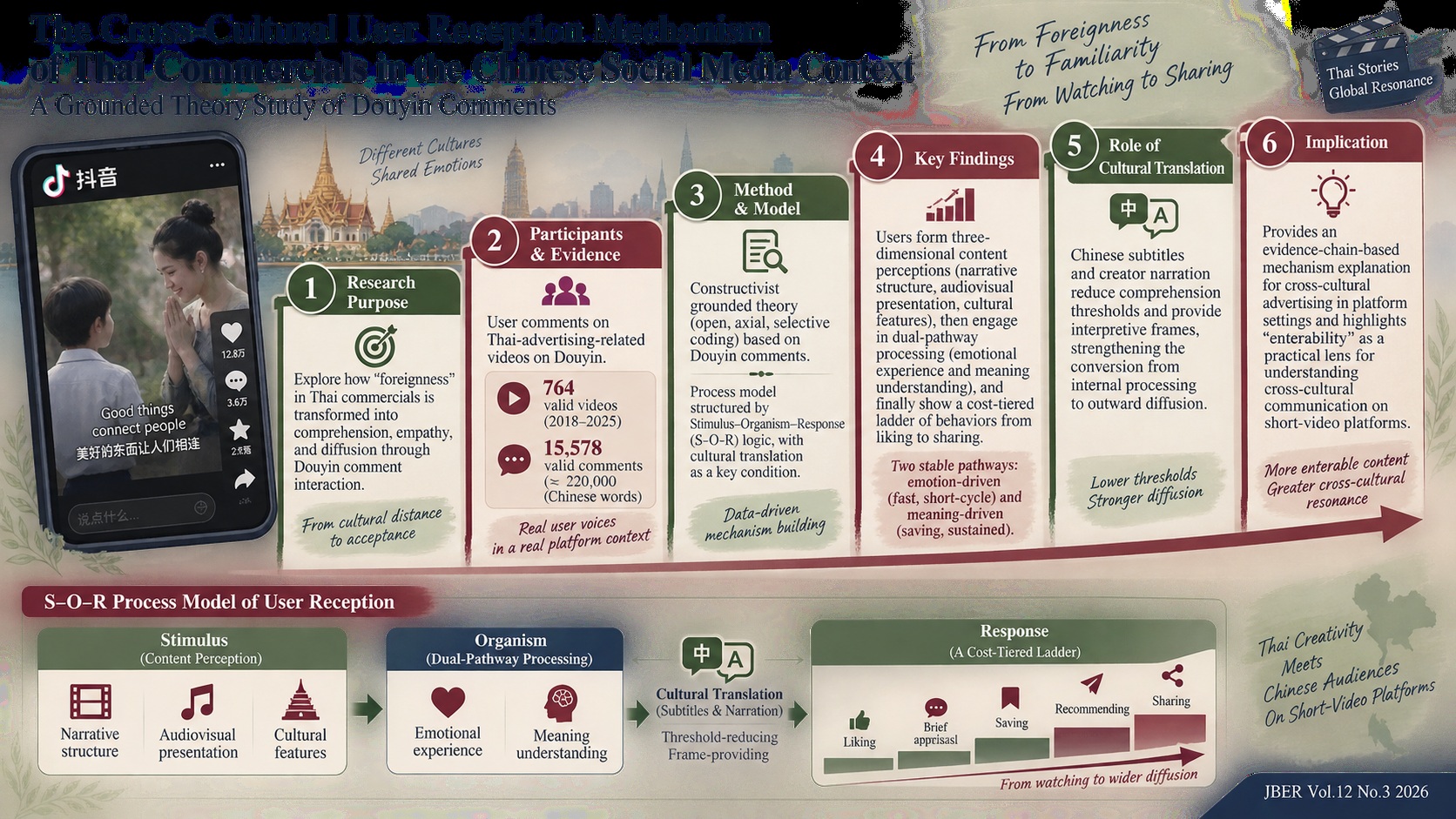
This study examines the mechanism through which Thai commercials are received on Chinese short-video platforms, with particular attention to how “foreignness” is transformed into comprehension, empathy, and diffusion through comment interaction. Using user comments on Thai-advertising-related videos on Douyin as qualitative data, the study adopts a constructivist grounded theory approach (open, axial, and selective coding) to develop a process model structured by the Stimulus–Organism–Response (S–O–R) logic. Findings show that users first form three-dimensional content perceptions—narrative structure, audiovisual presentation, and cultural features (Stimulus)—then engage in dual-pathway processing through emotional experience and meaning understanding (Organism), and finally externalize reception via a cost-tiered ladder of behaviors from liking and brief appraisal to saving, recommending, and sharing (Response). Cultural translation (Chinese subtitles and creator narration) functions as both a threshold-reducing and frame-providing condition, strengthening conversion from internal processing to outward diffusion. Two relatively stable pathways are further synthesized: an emotion-driven path associated with fast engagement and short-cycle diffusion, and a meaning-driven path supporting saving and sustained circulation. The study contributes an evidence-chain-based mechanism explanation for cross-cultural advertising in platform settings and highlights “enterability” as a practical lens for understanding cross-cultural communication on short-video platforms.
References
Cao, C. Z., Li, R. X., & Liu, Y. (2024). The impact of corporate social responsibility on user loyalty on short-video platforms: An empirical study based on S–O–R theory. Sustainable Development, 14, 2683.
Cheng, M. H., & Wang, X. Y. (2024). Communication effects of public-welfare short videos on the Douyin platform and improvement strategies: Evidence from audiovisual language and emotional expression. Advances in Psychology, 14, 711.
Feng, Y. (2024). A study on digital advertising of the Thai cosmetics brand Mistine in China. Voice & Screen World, (24), 101–104, 110.
Gao, S., & Liu, T. Y. (2025). Narrative features, practical dilemmas, and optimization strategies of film/TV commentary short videos. Journalism and Communications, 13, 800.
Glaser, B. G., & Strauss, A. L. (1967). The discovery of grounded theory: Strategies for qualitative research. Aldine.
Hoskins, C., & Mirus, R. (1988). Reasons for the US dominance of the international trade in television programmes. Media, Culture & Society, 10(4), 499–515.
Hu, J., & Chen, C. S. (2022). The impact of short-video content marketing on customer citizenship behavior: Exploring the roles of perceived value, product involvement, and electronic word of mouth. Journal of China-ASEAN Studies, 2(2), 32–48.
Hu, M. M., Hu, Q. Y., & Yang, L. M. (2025). The effect of narration voice on identification with tourism short-video communication. Tourism Tribune, 40(6).
Li, B., & Shang, Q. (2023). Drivers of the “Thai advertising” phenomenon and its cultural communication logic: Advertising samples themed on “happy family.” Journal of Hainan Normal University (Social Sciences), 36(1), 114–122. https://doi.org/10.16061/j.cnki.cn46-1076/c.2023.01.014
Li, C. X., Wu, F., & Sun, Q. (2023). Information dissemination effects in social interaction contexts. Journal of Industrial Engineering and Engineering Management, (2), 22–34. https://doi.org/10.13587/j.cnki.jieem.2023.02.003
Liu, Q., & Zhou, Y. (2024). How do screen advertisements win with emotion? A fantasy-theme analysis of emotional narratives in Thai screen advertising. Thai Studies Review, 2(1), 106–119.
Lu, H. Y. (2024). The representation and application of emotional elements in advertising. Journalism and Communications, 12, 1661.
Mehrabian, A., & Russell, J. A. (1974). An approach to environmental psychology. MIT Press.
Munaro, A. C., Hübner Barcelos, R., Francisco Maffezzolli, E. C., Santos Rodrigues, J. P., & Cabrera Paraiso, E. (2021). To engage or not engage? The features of video content on YouTube affecting digital consumer engagement. Journal of Consumer Behaviour, 20(5), 1336–1352.
Petty, R. E., & Cacioppo, J. T. (2012). Communication and persuasion: Central and peripheral routes to attitude change. Springer Science & Business Media.
Ren, K., Asavaratanа, W., & Numtong, K. (2024). Comment register analysis of Bilibili users on overseas bloggers’ videos from a cross-cultural communication perspective. Chinese Language and Culture Journal, 11(1), 465–488.
Ren, X. Y. (2023). Pathways for guiding online public opinion under group psychological effects. Advances in Psychology, 13, 3130.
Straubhaar, J. (2021). Cultural proximity. In The Routledge handbook of digital media and globalization. Routledge.
Tajfel, H. (Ed.). (2010). Social identity and intergroup relations. Cambridge University Press.
Tang, H., & Tian, L. (2024). Factors influencing users’ platform-use behavior on bullet-screen video sites: Evidence from Bilibili. Journal of Academic Library and Information Science, 42(1).
Tian, L. (2025). Short-video creation in digital media art from the perspective of the emotion economy: Empathic narratives and mechanisms of emotion manipulation. Chinese Journal of Modern Education, 1(4), 60–64.
Wang, D., & Shen, X. F. (2022). Cross-cultural communication strategies of Thai advertising and implications for telling Chinese brand stories well. Audio-Visual, (9), 50–52. https://doi.org/10.19395/j.cnki.1674-246x.2022.09.028
Wang, J. Z., Zhao, S., Wu, C., Adams, R. B., Newman, M. G., Shafir, T., & Tsachor, R. (2023). Unlocking the emotional world of visual media: An overview of the science, research, and impact of understanding emotion. Proceedings of the IEEE, 111(10), 1236–1286.
Wang, L. (2024). A study of subtitle translation from the perspective of Skopos theory. Modern Linguistics, 12, 62.
Yan, H., Singyabuth, S., Deekhuntod, B., Zhanhua, L., & Zongjing, D. (2024). Thai advertising in China: Re-invention of media production in the process of transnational borders. Migration Letters, 21(3), 1170–1185.
Yao, X., & Yao, J. (2024). Symbolic interaction: Social identity construction in brand digital communication. Journalism and Communication Review, 77(4), 96–107.
Ye, Z. (2024). Language barriers in intercultural communication and their translation strategies. In International Conference on Finance and Economics, Humanistic Sociology and Educational Development (EHSED 2024) (Vol. 6, No. 1).
Zeng, R. X., & Mo, M. L. (2022). Differences in multi-platform dissemination effects of short videos and their influencing factors. Journal of Guangxi Normal University (Philosophy and Social Sciences), 58(1), 133–144.
Downloads
Published
How to Cite
License
Copyright (c) 2026 Journal of Buddhist Education and Research (JBER)

This work is licensed under a Creative Commons Attribution-NonCommercial-NoDerivatives 4.0 International License.