Construction The Exercise Book for Piano Beginner Students
คำสำคัญ:
Piano Foundation Learning, Piano Beginners, Piano Exercise Bookบทคัดย่อ
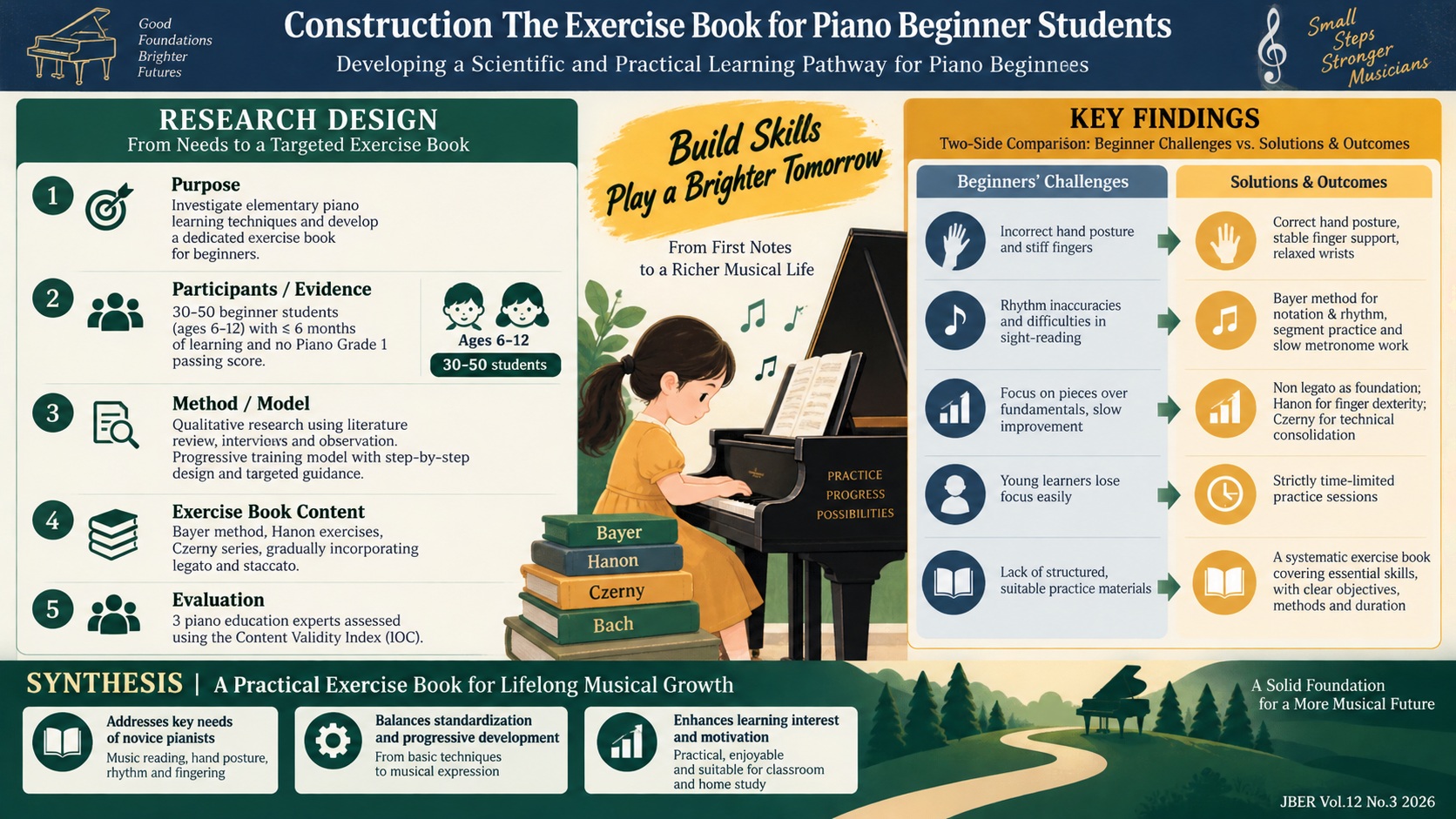
This thesis aims to investigate the techniques for elementary piano foundation learning and develop a dedicated exercise book for piano beginners, and it primarily employs qualitative research methods to achieve these objectives.
This thesis used the qualitative research, respondents highlighted that piano beginners’ foundational instruction should prioritize the establishment of correct hand posture, stable finger support, relaxed wrists, and scientific touch, with Non legato playing serving as the basis for constructing a solid technical framework. For introductory teaching, the Bayer method is commonly used for basic music notation and rhythmic training, supplemented by Hanon exercises to enhance finger dexterity and the Czerny series for technical consolidation, while gradually incorporating articulations such as legato and staccato. This integrated teaching strategy achieves a balance between standardized foundational training and progressive skill development.
The core outcome of this research is the compilation of a specialized piano exercise book targeted at absolute beginners. Centered on the foundational training demands of the introductory stage, the book systematically develops practical and targeted practice materials that can be used for both classroom teaching and independent practice. It effectively addresses the core learning needs of novice pianists, covering essential fundamental skills including music reading, hand posture, rhythm, and fingering.
เอกสารอ้างอิง
Guo, X. (2017). The importance of acquiring correct hand position and playing technique in the initial stage of piano performance. Yellow River Voice, (1), 28–29. https://doi.org/10.19340/j.cnki.hhzs.2017.01.014
Hao, N. (2022). On key aspects of piano learning in the initial stage (Part one): Fundamental techniques. Musical Instruments, (6), 56–58.
Hao, N. (2022). On key aspects of piano learning in the initial stage (Part two): Music notation systems. Musical Instruments, (7), 49–51.
Liu, T. (2019). An exploration of effective strategies for the initial stage of piano learning. Science, Education and Culture Review (Late Edition), (24), 147–148, 151. https://doi.org/10.16871/j.cnki.kjwhc.2019.08.067
Yang, Y. (2023). A brief analysis of the crucial role of piano performance techniques in
musical emotional expression. Yellow River Voice, (24), 114–117. https://doi.org/10.19340/j.cnki.hhzs.2023.24.033
Yu, Y., & Li, C. (2018). A brief analysis of how piano beginners can achieve success. Yellow River Voice, (16), 108. https://doi.org/10.19340/j.cnki.hhzs.2018.16.084
Zeng, H. (2025). The interplay between music theory and piano design: An analysis of innovative approaches. Art Panorama, (13), 108–110.
Zhang, Q. (2025). On the development of piano performance techniques and skills. Craftsmanship, (8), 84–86.
Zhang, Y. (2015). Issues to note in piano instruction during the initial learning stage. Northern Music, 35(15), 128.
Zhao, S. (2024). A study on performance techniques for commonly used repertoire in piano beginner instruction. Theatre Home, (27), 103–105.
Zhu, X., & Jia, Y. (2019). A brief discussion on issues teachers should pay attention to during the initial stage of children's piano learning. Tomorrow's Fashion, (17), 141.
ดาวน์โหลด
เผยแพร่แล้ว
รูปแบบการอ้างอิง
ฉบับ
ประเภทบทความ
หมวดหมู่
สัญญาอนุญาต
ลิขสิทธิ์ (c) 2026 Journal of Buddhist Education and Research (JBER)

อนุญาตภายใต้เงื่อนไข Creative Commons Attribution-NonCommercial-NoDerivatives 4.0 International License.