A Study on Stress Groups Among Students at Chitralada Technology Institute
Keywords:
Stress, Students, Stress assessment (SPST-20)Abstract
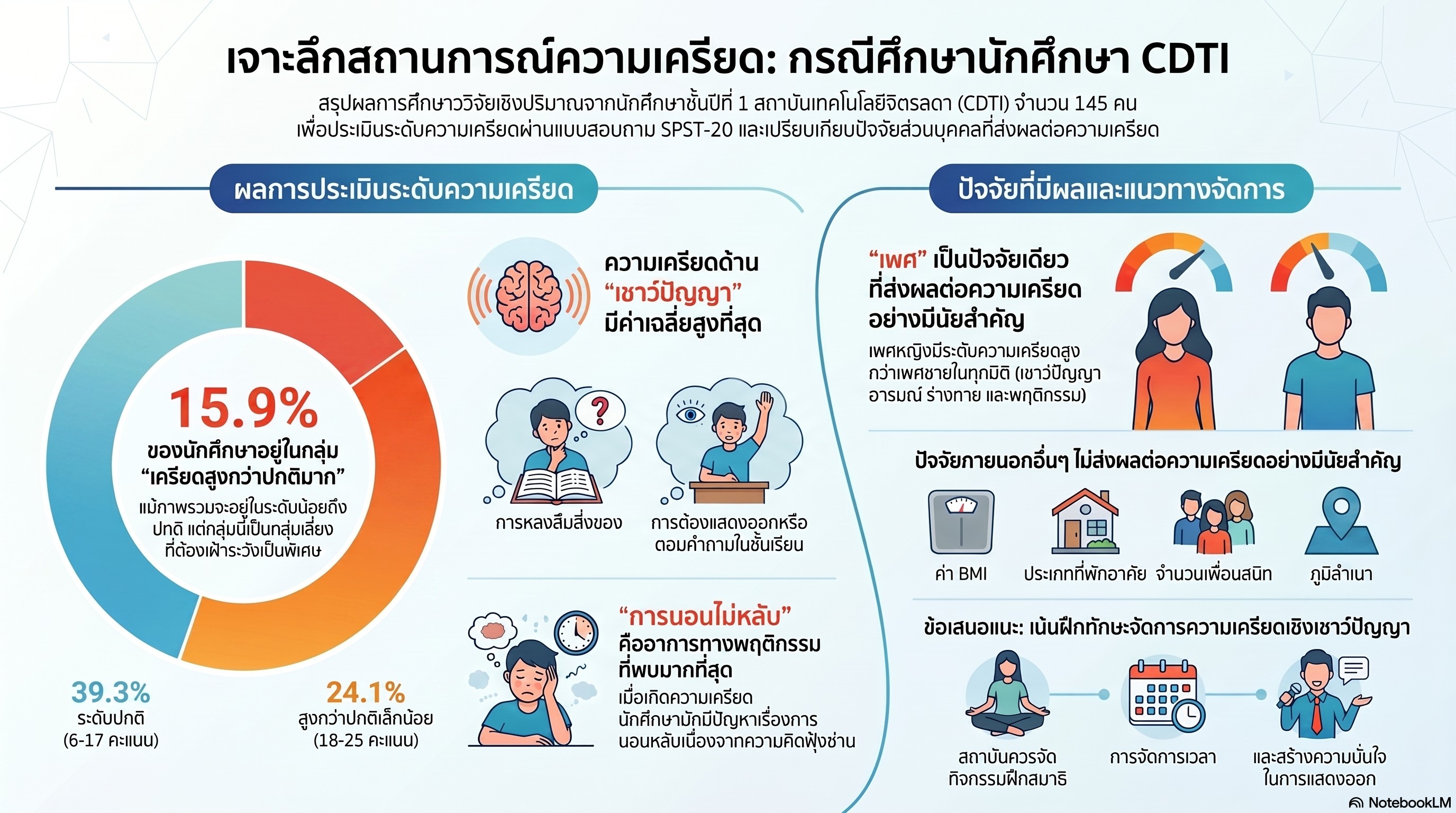
A Study on Stress Groups Among Students at Chitralada Technology Institute. This study aimed to (1) examine stress groups among students at Chitralada Technology Institute, (2) assess the stress levels of these students, and (3) compare personal demographic data with stress group classifications. The research employed a quantitative methodology, collecting data via the SPST-20 questionnaire from a sample of 145 first-year undergraduate students. Descriptive statistics (frequency, percentage, mean, and standard deviation) were analyzed, and differences were tested using ANOVA (α = .05). Overall, the sample exhibited low to normal stress levels (mean total score: ( = 2.64, SD = 0.87). Nevertheless, 15.9 % of the sample reported markedly elevated stress (total score 30–60). Among the SPST-20 subscales, the cognitive domain yielded the highest mean score (M = 3.08, SD = 0.89). Comparative analysis revealed that gender exerted a statistically significant influence on stress scores across all dimensions (p < .05). Conversely, other variables—such as body mass index (BMI), accommodation type, number of close friends, and hometown showed no statistically significant effects. Practical Implications included: (1) Development of cognitive-oriented stress-management programs, (2) Implementation of gender-sensitive mental-health support initiatives, and (3) Establishment of systematic monitoring systems to identify and support high-stress student groups in a timely manner.
References
กรมสุขภาพจิต. (2559). แบบทดสอบด้านสุขภาพจิต. https://dmh.go.th/test
ไทยพีบีเอส. (2566). สถานการณ์สุขภาพจิตคนไทยเจอวิกฤตความรุนแรง-เศรษฐกิจ. https://policywatch.thaipbs.or.th/article/life-7
ธเนศ แม้นอินทร์. (2566). พฤติกรรมเสี่ยงทางด้านสุขภาพของนักศึกษาระดับปริญญาตรี สถาบันเทคโนโลยีจิตรลดา. สำนักวิชาศึกษาทั่วไป สถาบันเทคโนโลยีจิตรลดา.
นิธิสนี รุจิรังสีเจริญ, และคณะ. (2564). ปัจจัยที่สัมพันธ์กับระดับความเครียดของนักเรียนระดับมัธยมศึกษา สังกัดกรุงเทพมหานคร. วารสารสมาคมจิตแพทย์แห่งประเทศไทย, 66(1), 53–68.
ฝ่ายทะเบียนและประเมินผล สถาบันเทคโนโลยีจิตรลดา. (2568). จำนวนนักศึกษาที่ลงทะเบียนเรียนในภาคต้น ปีการศึกษา 2568. https://www.cdti.ac.th/facilities/registration-and-evaluation/
ภัณฑิรา เตชบวรเกียรติ. (2561). ความเครียดด้านการเรียนของนักเรียนมัธยมศึกษาตอนปลายโรงเรียนสาธิตมหาวิทยาลัยศรีนครินทรวิโรฒ ปทุมวัน [วิจัยรายบุคคล, มหาวิทยาลัยศิลปากร].
รุ่งทิวา พุขุนทด, และคณะ. (2564). ปัจจัยที่มีความสัมพันธ์กับระดับความเครียดของนักศึกษาระดับปริญญาตรี. วารสารวิจัยสาธารณสุขศาสตร์ มหาวิทยาลัยขอนแก่น, 14(3), 115–125.
สถาบันวิจัยสังคม จุฬาลงกรณ์มหาวิทยาลัย. (2566). การสำรวจพฤติกรรมสุขภาพของนิสิตนักศึกษาในมหาวิทยาลัย. สถาบันวิจัยสังคม จุฬาลงกรณ์มหาวิทยาลัย.
สำนักงานกองทุนสนับสนุนการสร้างเสริมสุขภาพ. (2563). เทคนิคดูแลความเครียดในวัยรุ่น. https://www.thaihealth.or.th
Barbayannis, G., Bandari, M., Zheng, X., Baquerizo, H., Pecor, K. W., & Ming, X. (2022). Academic stress and mental well-being in college students: Correlations, affected groups, and COVID. Frontiers in Psychology, 13, Article 886344. https://doi.org/10.3389/fpsyg.2022.886344
Taylor, S. E. (2012). Health psychology (8th ed.). McGraw-Hill.
Downloads
Published
How to Cite
Issue
Section
Categories
License
Copyright (c) 2026 Journal of Buddhist Education and Research (JBER)

This work is licensed under a Creative Commons Attribution-NonCommercial-NoDerivatives 4.0 International License.