Guidelines for Developing Creative Leadership among Directors of Child Development Centers under Local Administrative Organizations in Nakhon Ratchasima Province
Keywords:
Guidelines for Development; Creative LeadershipAbstract
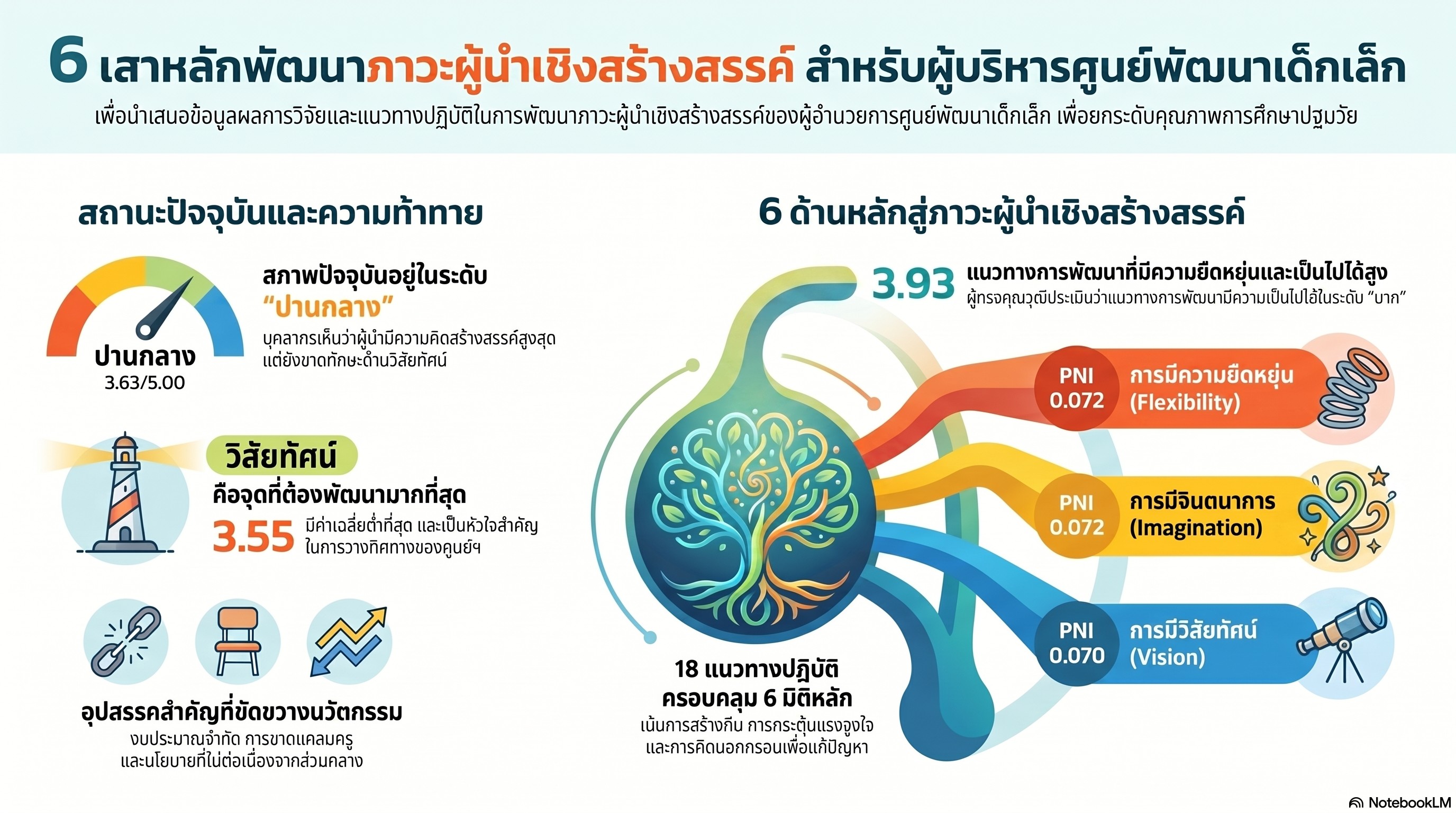
This research is a mixed methods study with two objectives: 1) The first phase examines the current state, desired state, and needs of creative leadership among directors of early childhood development centers under local government organizations in Nakhon Ratchasima province. The study sample includes 110 early childhood development center directors and 144 teachers (civil service teachers, government employes, contract teachers, and personnel working within early childhood development centers), totaling 254 people. The sample size was determined using the Krejcie and Morgan table (1970), and stratified random sampling was employed. The research instruments used were a 5-point Likert scale questionnaire, a semi-structured interview, and a suitability and feasibility assessment. The statistics used for data analysis were percentage, mean, standard deviation, and the Prioritized Needs Index Modified (PNIModified). In addition, 9 experts were interviewed specifically. The research findings revealed that: 1) The overall current state was at a moderate level ( x̄ = 3.63, S.D. = 0.45) and when considering each aspect individually, it was found that all aspects were at a moderate level. The top 3 rankings were: creativity ( x̄ = 3.73, S.D. = 0.48) is the highest average, followed by motivation (x̄ = 3.70, S.D. = 0.42) and teamwork ( x̄ = 3.65, S.D. = 0.44) for imagination ( x̄ = 3.61, S.D. = 0.45) and flexibility ( x̄ = 3.58, S.D. = 0.45) respectively. The lowest average was in the area of vision ( x̄ = 3.55, S.D. = 0.47) and the overall desired condition was moderate ( =34.86, S.D. = 0.28) and when considered by dimension, it was found that all dimensions were at a moderate level, with the top 3 being creativity ( x̄ = 3.91, S.D. = 0.25) is the side with the highest average. Following that, there are two sides: motivation (x̄ = 3.89, S.D. = 0.28) and teamwork (x̄ = 3.89, S.D. = 0.26) in terms of imagination ( = 3.87, S.D. = 0.30) and the flexibility aspect (x̄ = 3.84, S.D. = 0.31) respectively. The lowest average was in the area of vision (x̄ = 3.80, S.D. = 0.33) and the needs, ranked from highest to lowest, are: flexibility (PNIModified = 0.063). The needs, ranked from highest to lowest, are: flexibility (PNIModified = 0.072), imagination (PNIModified = 0.072), vision (PNIModified = 0.070), teamwork (PNIModified = 0.065), motivation (PNIModified = 0.051), and creativity (PNIModified = 0.048), respectively. Phase 2: Guidelines for Developing Creative Leadership in Directors of Early Childhood Development Centers under Local Administrative Organizations in Nakhon Ratchasima Province include a total of 6 areas and 18 guidelines: 1) Visionary Leadership (3 guidelines), 2) Flexibility (3 guidelines), 3) Imagination (3 guidelines), 4) Motivation (3 guidelines), 5) Teamwork (3 guidelines), and 6) Creativity (3 guidelines). The overall suitability of these 18 guidelines is moderate, with an average score of (x̄ = 3.45, S.D. = 0.51) and the possibility is very high, with an average of ( x̄ = 3.93, S.D. = 0.20).
References
กรองทิพย์ นาควิเชตร. (2552). ภาวะผู้นำสร้างสรรค์เพื่อการศึกษา. ธีรสาส์น.
แก้วมณี ปัทมะ. (2564). แนวทางการพัฒนาภาวะผู้นำเชิงสร้างสรรค์ของผู้บริหารสถานศึกษา สังกัดสำนักงานเขตพื้นที่การศึกษามัธยมศึกษาสุรินทร์ [วิทยานิพนธ์การศึกษามหาบัณฑิต, มหาวิทยาลัยมหาสารคาม].
จินดารัตน์ โพธิ์นอก. (2561). [ตรวจสอบข้อมูลบรรณานุกรมฉบับสมบูรณ์].
จินดารัตน์ โพธิ์นอก. (2561, 23 สิงหาคม). ผู้นำเชิงสร้างสรรค์. เดลินิวส์, 23.
ณิรดา เวชญาลักษณ์. (2564). ภาวะผู้นำ: แนวคิด ทฤษฎี เพื่อการประยุกต์ใช้ทางการศึกษา. วินิดาการพิมพ์.
ไพฑูรย์ สินลารัตน์, และ นักรบ หมี้แสน. (2561). ความเป็นผู้นำทางการศึกษา. สำนักพิมพ์แห่งจุฬาลงกรณ์มหาวิทยาลัย.
เสาวณีย์ สมบูรณ์ศิโรรัตน์. (2562). การศึกษาภาวะผู้นำเชิงสร้างสรรค์ของผู้บริหารสถานศึกษา สังกัดสำนักงานเขตพื้นที่การศึกษาประถมศึกษาปทุมธานี เขต 2 [วิทยานิพนธ์ศึกษาศาสตรมหาบัณฑิต, มหาวิทยาลัยเทคโนโลยีราชมงคลธัญบุรี].
อรรถชัย แนวเงินดี. (2564). รูปแบบภาวะผู้นำเชิงสร้างสรรค์ในศตวรรษที่ 21. วารสารมนุษยศาสตร์และสังคมศาสตร์ มมร วิทยาเขตอีสาน, 2(1), 13–21.
Krejcie, R. V., & Morgan, D. W. (1970). Determining sample size for research activities. Educational and Psychological Measurement, 30(3), 607–610. https://doi.org/10.1177/001316447003000308
Downloads
Published
How to Cite
Issue
Section
Categories
License
Copyright (c) 2026 Journal of Buddhist Education and Research (JBER)

This work is licensed under a Creative Commons Attribution-NonCommercial-NoDerivatives 4.0 International License.