Development of an Integrated Interdisciplinary Learning Model for the Subject of Humanities and Living in the Digital Age for First-Year Students in the Faculty of Education, Mahamakut Buddhist University
Keywords:
Model development, Learning management, digital ageAbstract
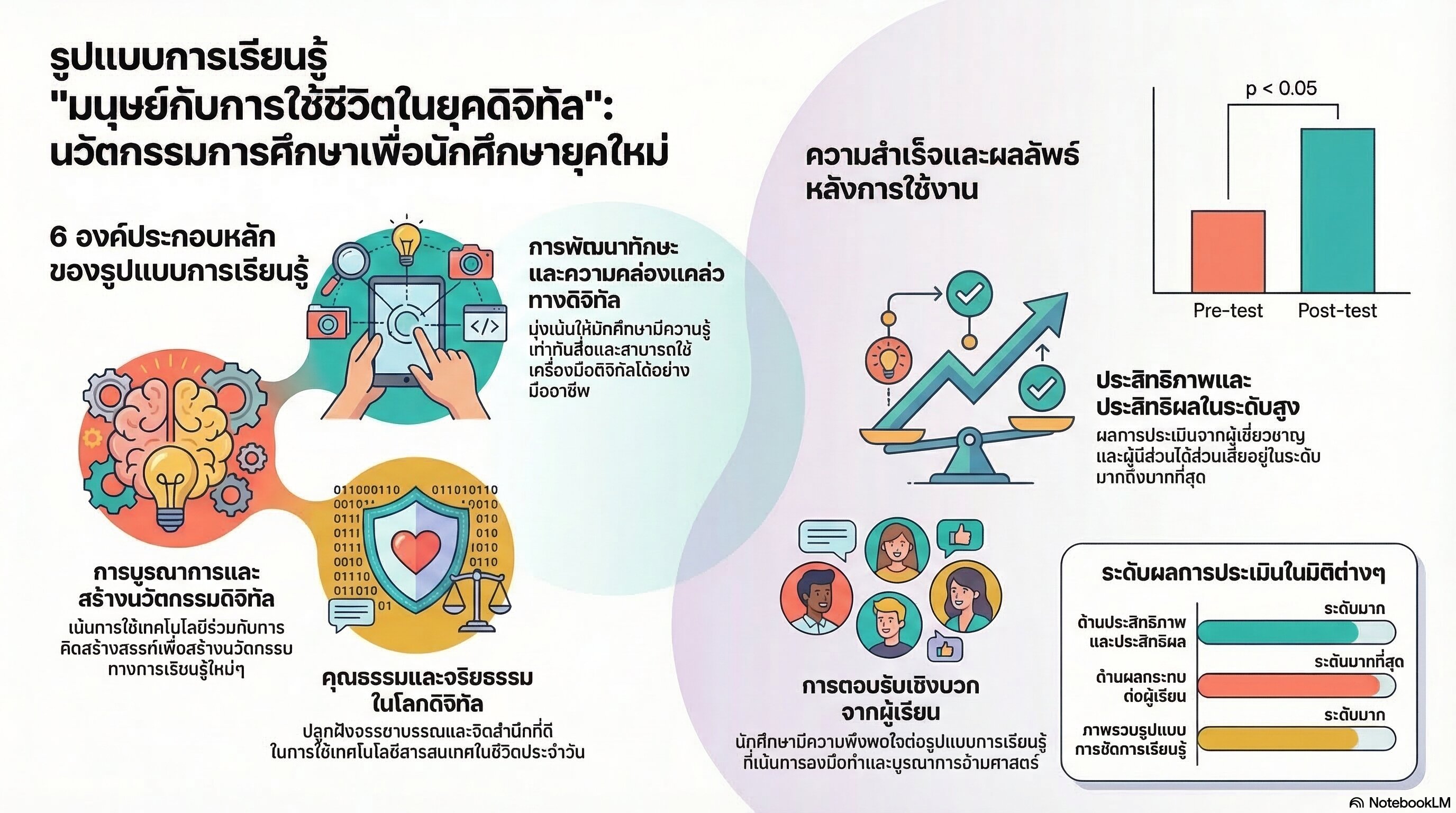
This research aimed: 1) to study the current problems and guidelines for developing the model, 2) to develop the model, 3) to implement the model, and 4) to evaluate the integrated interdisciplinary learning management model for the course "Humanity and Life in the Digital Era" for first-year students at the Faculty of Education, Mahamakut Buddhist University. The research employed a research and development (R&D) approach. The sample group consisted of 96 monks/students. The key informants included 10 instructors and administrators. A group of 5 experts was engaged to verify content validity (IOC). A focus group discussion was conducted with 10 experts selected through purposive sampling. The target group for model implementation consisted of 25 monks/students. Another group of 10 stakeholders was involved to evaluate the model’s efficiency, effectiveness, and impact. Research instruments included questionnaires, interview forms, focus group discussion guides, and the curriculum manual. Statistical tools used were frequency, percentage, mean, standard deviation, and dependent t-test. The findings of the research were as follows: 1. The current state of learning management in the course "Humanity and Life in the Digital Era" using an integrated interdisciplinary approach for first-year students at the Faculty of Education, Mahamakut Buddhist University was overall at a high level. The highest mean score was in creative thinking and the use of digital technology in learning management, while the lowest mean score was in integrating digital technology into learning management. 2. The integrated interdisciplinary learning management model for the course "Humanity and Life in the Digital Era" for first-year students was developed using a curriculum structure comprising: (1) Background, (2) Principles of the Model, (3) Objectives, (4) Process of the Model, (5) Design Structure, (6) Content, (7) Media and Materials, and (8) Measurement and Evaluation. The model consisted of six key components: (1) Integration of digital technology into learning management, (2) Development of digital fluency, (3) Creation of learning innovations using digital technology, (4) Digital literacy, (5) Creative thinking in applying digital technology in learning management, and (6) Ethics, morals, and professional code of conduct in using digital technology. 3. The implementation of the integrated interdisciplinary learning management model showed a statistically significant difference at the 0.05 level between pretest and posttest scores. 4. The evaluation of the model indicated that the overall assessment was at a high level. The efficiency and effectiveness dimensions had mean scores at a high level, while the impact dimension had a mean score at the highest level.
References
จิณณวัตร ปะโคทัง. (2561). ภาวะผู้นำยุคดิจิทัลสำหรับผู้บริหารสถานศึกษามืออาชีพ. ศิริธรรมออฟเซ็ท.
ทรงเกียรติ พืชมงคล และคณะ. (2559). การจัดการเรียนรู้ของประเทศไทย. สืบค้นจาก https://so06.tci-thaijo.org/index.php/JSC/article/view/264153
สถาบันทดสอบทางการศึกษาแห่งชาติ (องค์การมหาชน). (2560). รายงานประจำปี 2560. สถาบันทดสอบทางการศึกษาแห่งชาติ.
สุชาติ ศิริสุขไพบูลย์. (2527). ทฤษฎีการเรียนรู้กระบวนแบบ MIAP. โรงพิมพ์แห่งประเทศไทย.
กรองทิพย์ นาควิเชียร. (ม.ป.ป.). คุณลักษณะครูมืออาชีพยุคการศึกษา 4.0: กรณีศึกษาครูที่ได้รับรางวัลสมเด็จเจ้าฟ้ามหาจักรี รางวัลครูคุณากร และรางวัลครูยิ่งคุณ. สืบค้นจาก https://so06.tci-thaijo.org/index.php/JSC/article/view/264153
กัญชพร ค้าทอง. (2563). กลยุทธ์การบริหารงานวิชาการในยุคไทยแลนด์ 4.0 ของโรงเรียนประถมศึกษา สังกัดสำนักงานเขตพื้นที่การศึกษาประถมศึกษา จังหวัดขอนแก่น. วารสารสังคมศาสตร์และมานุษยวิทยาเชิงพุทธ.
อินทิรา ชูศรีทอง. (2563). รูปแบบการพัฒนาครูการใช้เทคโนโลยีสารสนเทศและการสื่อสารเพื่อการจัดการเรียนรู้ในโรงเรียนประถมศึกษา สังกัดสำนักงานศึกษาธิการภาค 11 [วิทยานิพนธ์ครุศาสตรดุษฎีบัณฑิต, มหาวิทยาลัยราชภัฏสกลนคร].
WICE Logistics Public Company Limited. (2018). Underpricing of initial public offerings: The Thai stock market evidence.
Downloads
Published
How to Cite
Issue
Section
Categories
License
Copyright (c) 2026 Journal of Buddhist Education and Research (JBER)

This work is licensed under a Creative Commons Attribution-NonCommercial-NoDerivatives 4.0 International License.