A Causal Factor Model of the Effectiveness of Student Support System Management Based on Buddhist Principles in Schools under the Suphanburi Secondary Educational Service Area Office
Keywords:
Causal Factor Model, Student Support System, Four Brahmaviharas, EffectivenessAbstract
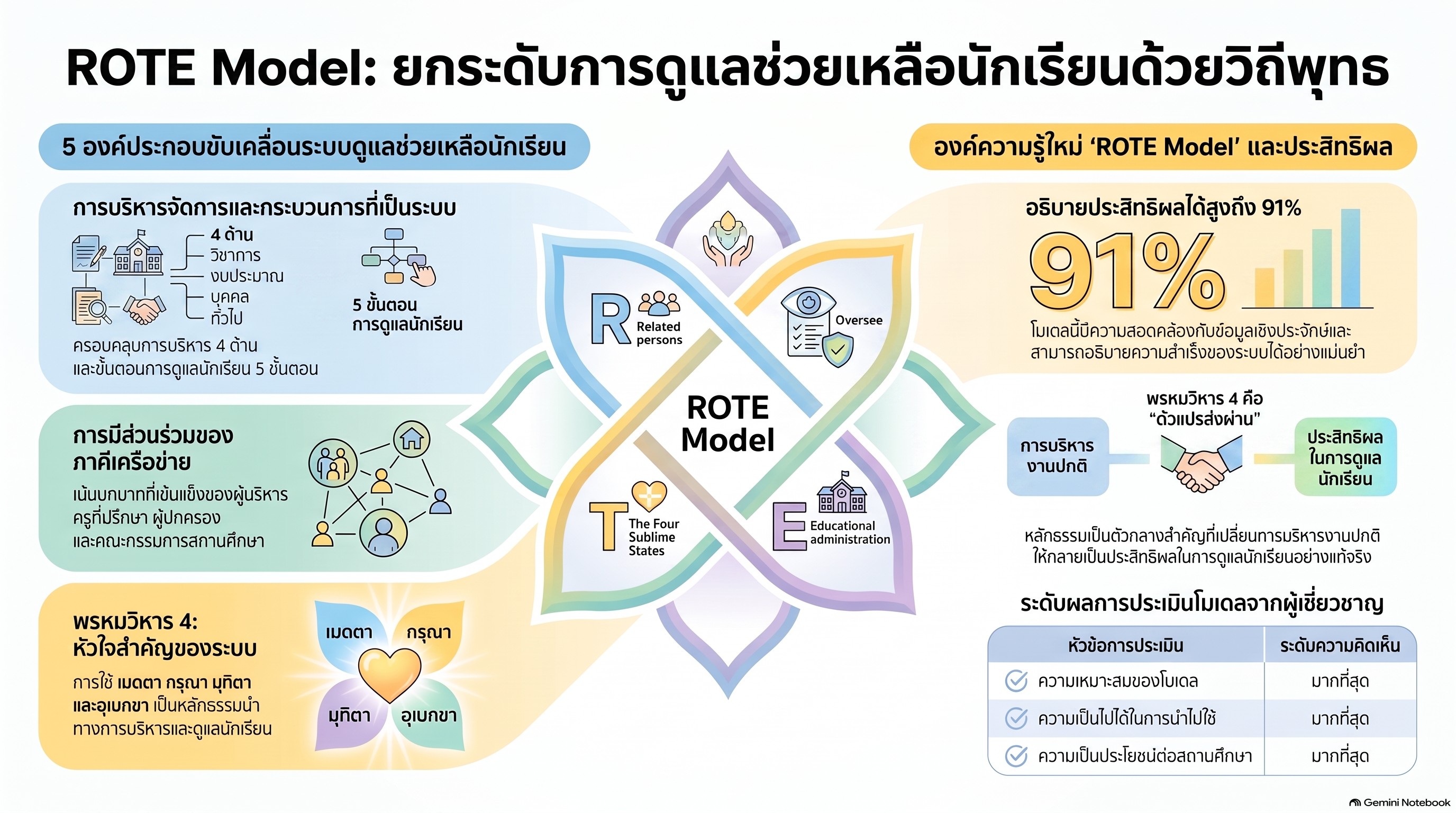
This dissertation has the following objectives: 1) to study the components of the student support management system of schools under the Suphanburi Secondary Educational Service Area Office, 2) to develop causal factor model of the effectiveness of student support management system according to buddhist principles in schools under the office of Suphanburi Secondary Educational Service Area Office, and 3) to evaluate the effectiveness of the student support management model based on Buddhist principles for schools under the Suphanburi Secondary Educational Service Area Office. The research employs a mixed-methods approach divided into three phases: Phase 1 involves qualitative research to study the components thru document analysis and in-depth interviews with key informants, including educational leaders, those involved in student support, and experts in school administration, selected thru purposive sampling (12 people). Phase 2 uses both qualitative and quantitative research methods, with focus group discussions involving 9 participants selected thru purposive sampling. Data analysis is conducted thru inductive reasoning and the use of questionnaires, with a sample size of 10 people per path representing the relationship between variables in the model, totaling 55 paths. Therefore, the appropriate sample size should be 550 people, Data analysis is conducted using a computer software program. Phase 3 involves qualitative research for evaluation purposes, with 17 participants selected thru purposive sampling. Data analysis is conducted using a computer software program, with results interpreted regarding the appropriateness, feasibility, and benefits of the effectiveness model. Results were shown as follows: 1. The components of the causal factor model for the student support system management according to Buddhist principles in schools under the Suphanburi Secondary Educational Service Area Office consist of five components: 1) School administration, 2) The process of the student support system, 3) Parental involvement and the roles of stakeholders in the student support system, 4) The four Brahmaviharas, and 5) The effectiveness of the student support system. 2. The model of causal factor of the student support system management according to Buddhist principles in schools under the Suphanburi Secondary Educational Service Area Office consists of five latent variables, divided into three external latent variables, two internal latent variables, and nineteen observable variables. The model of causal factor of the student support system management according to Buddhist principles in schools under the Suphanburi Secondary Educational Service Area Office is consistent with empirical data (Chi-square = 215.76, df= 187, p= .07339, GFI=.976, AGFI=.946, RMR=.017). It can explain 91.0% of the variance in the effectiveness of the student support system. This indicates that school management, the process of the student support system, parental involvement, the roles of stakeholders in the student support system, and the four Brahmaviharas can promote the effectiveness of the student support system, with the four Brahmaviharas being the mediating variable. 3. The evaluation results of the feasibility, benefits, and appropriateness of causal factor model of the effectiveness of student support management system according to buddhist principles in schools under the office of Suphanburi Secondary Educational Service Area Office are overall at the highest level in all aspects. This includes the "ROTE Model," which consists of Related persons, oversee, The Four Sublime States of Mind, and Educational institution administration.
References
กรมสุขภาพจิต กระทรวงสาธารณสุข. (2554). คู่มือครูที่ปรึกษาระบบการดูแลช่วยเหลือนักเรียน. ยูเรนัสอิมเมจกรุ๊ป
กรมสุขภาพจิต กระทรวงสาธารณสุข. (2560). คู่มือครูที่ปรึกษาระบบการดูแลช่วยเหลือนักเรียน. ยูเรนัสอิมเมจกรุ๊ป
กระทรวงศึกษาธิการ. (2546). พระราชบัญญัติการศึกษาแห่งชาติ พ.ศ. 2542 และแก้ไขเพิ่มเติม (ฉบับที่ 2 พ.ศ. 2545). โรงพิมพ์องค์การรับส่งสินค้าและพัสดุภัณฑ์
กระทรวงศึกษาธิการ. (2556). พระราชบัญญัติการศึกษาแห่งชาติ พ.ศ. 2544 ฉบับปรับปรุง ครั้งที่ 2 พ.ศ. 2545. โรงพิมพ์คุรุสภาลาดพร้าว
แก้ว ชิดตะขบ. (2547). รวมวิชาธรรมศึกษา ชั้นตรี. โรงพิมพ์การศาสนา
ชมแข พงษ์เจริญ. (2555). การพัฒนารูปแบบการจัดการโรงเรียนเชิงสร้างสรรค์และผลิตภาพในประเทศไทย. วารสารสุทธิปริทัศน์, 26(79), 167–184. https://so05.tci-thaijo.org/index.php/DPUSuthiparithatJournal/article/view/245672
ณัฏฐพันธ์ เขจรนันทน์. (2547). การจัดการ. ซีเอ็ดยูเคชั่น
ตุลา มหาสุธานนท์. (2545). หลักการจัดการและหลักการบริหาร. ธนธัชการพิมพ์
นงลักษณ์ วิรัชชัย. (2552). วิจัยและสถิติ: คำถามชวนตอบ. ไอคอน พริ้นติ้ง
นิตย์ สัมมาพันธ์. (2529). การบริหารเชิงพุทธ. โอ. เอส. พริ้นติ้งเฮ้าส์
เนตร์พัณณา ยาวิราช. (2548). การจัดการสมัยใหม่. เซ็นทรัลเอ็กซ์เพรส
บุญชม ศรีสะอาด. (2545). การวิจัยเบื้องต้น (พิมพ์ครั้งที่ 5). ชมรมเด็ก
บุญมี แท่นแก้ว. (2539). จริยศาสตร์. โอเดียนสโตร์
ประสงค์ ประณีตพลกรัง และคณะ. (2553). การบริหารการผลิตและการปฏิบัติการ. Diamond in Business World
ปัญญานันทภิกขุ (ปั่น ปญฺญานนฺโท). (2541). หน้าที่ของคน ฉบับสมบูรณ์. ธรรมสภา
พระคันธสารภิวงศ์. (2549). โพธิปักขิยธรรม. บุญศิริการพิมพ์
พระธรรมกิตติวงศ์ (ทองดี สุรเตโช). (2541). พระในบ้าน. คาธาวรรณการพิมพ์
พระธรรมโกศาจารย์ (ประยูร ธมฺมจิตฺโต). (2549). พุทธวิธีในการบริหาร (พิมพ์ครั้งที่ 4). มหาจุฬาลงกรณราชวิทยาลัย
พระธรรมปิฎก (ป. อ. ปยุตฺโต). (2542). พุทธธรรม. มหาวิทยาลัยมหาจุฬาลงกรณราชวิทยาลัย
พระราชวรมุนี (ประยุทธ์ ปยุตฺโต). (2537). พุทธศาสนากับสังคมไทย. มหาวิทยาลัยมหาจุฬาลงกรณราชวิทยาลัย
มหาจุฬาลงกรณราชวิทยาลัย. (2539). พระไตรปิฎกภาษาไทยฉบับมหาจุฬาลงกรณราชวิทยาลัย. โรงพิมพ์มหาจุฬาลงกรณราชวิทยาลัย
ราชบัณฑิตยสถาน. (2525). พจนานุกรม ฉบับราชบัณฑิตยสถาน. อักษรเจริญทัศน์
ราชบัณฑิตยสถาน. (2548). พจนานุกรมศัพท์ศาสนาสากล อังกฤษ–ไทย ฉบับราชบัณฑิตยสถาน (พิมพ์ครั้งที่ 2). ห้างหุ้นส่วนจำกัดอรุณการพิมพ์
วิภาดา คุปตานนท์. (2551). การจัดการและพฤติกรรมองค์การ: เทคนิคการจัดการสมัยใหม่. ส เจริญ การพิมพ์
วิโรจน์ สารรัตนะ. (2542). การบริหาร: หลักการ ทฤษฎี และประเด็นทางการศึกษา. โรงพิมพ์ทิพย์วิสุทธิ์
วีระ อำพันสุข. (2526). พุทธธรรมกับการบริหารบุคคล (พิมพ์ครั้งที่ 2). เอราวัณการพิมพ์
ศิริพร พงศ์ศรีโรจน์. (2540). องค์การและการจัดการ (พิมพ์ครั้งที่ 7). เทคนิค 19
สมคิด บางโม. (2550). องค์การและการจัดการ (พิมพ์ครั้งที่ 4). วิทยพัฒน์
สมเด็จพระญาณสังวร (เจริญ สุวฑฺฒโน). (2534). พุทธศาสนสุภาษิต. ชมรมพุทธศาสน์ กฟผ.
สมาน รังสิโยกฤษฎ์ และสุธี สุทธิสมบูรณ์. (2527). หลักการบริหาร. โรงพิมพ์สวัสดิการสำนักงาน ก.พ.
สุนทร โคตรบรรเทา. (2551). หลักการและทฤษฎีการบริหารการศึกษา. ปัญญาชน
ไพโรจน์ เคนวิเศษ, เผ่าพงษ์พัฒน์ บุญกะนันท์, และกระพัน ศรีงาน. (2561). การพัฒนารูปแบบความสัมพันธ์โครงสร้างเชิงเส้นของปัจจัยที่มีอิทธิพลต่อประสิทธิผลของระบบการดูแลช่วยเหลือนักเรียนในสถานศึกษาขั้นพื้นฐาน. วารสารช่อพะยอม, 29(1), 211–224. https://so01.tci-thaijo.org/index.php/ejChophayom/article/view/126458
Downloads
Published
How to Cite
Issue
Section
License

This work is licensed under a Creative Commons Attribution-NonCommercial-NoDerivatives 4.0 International License.