Effects of Using Phonics-Based Board Game to Enhance English Word Reading and Spelling Skills for Grade - 3 Students at Banlumklongyang School, Sukhothai Province
Keywords:
reading and spelling skills, phonics instruction, board game, satisfactionAbstract
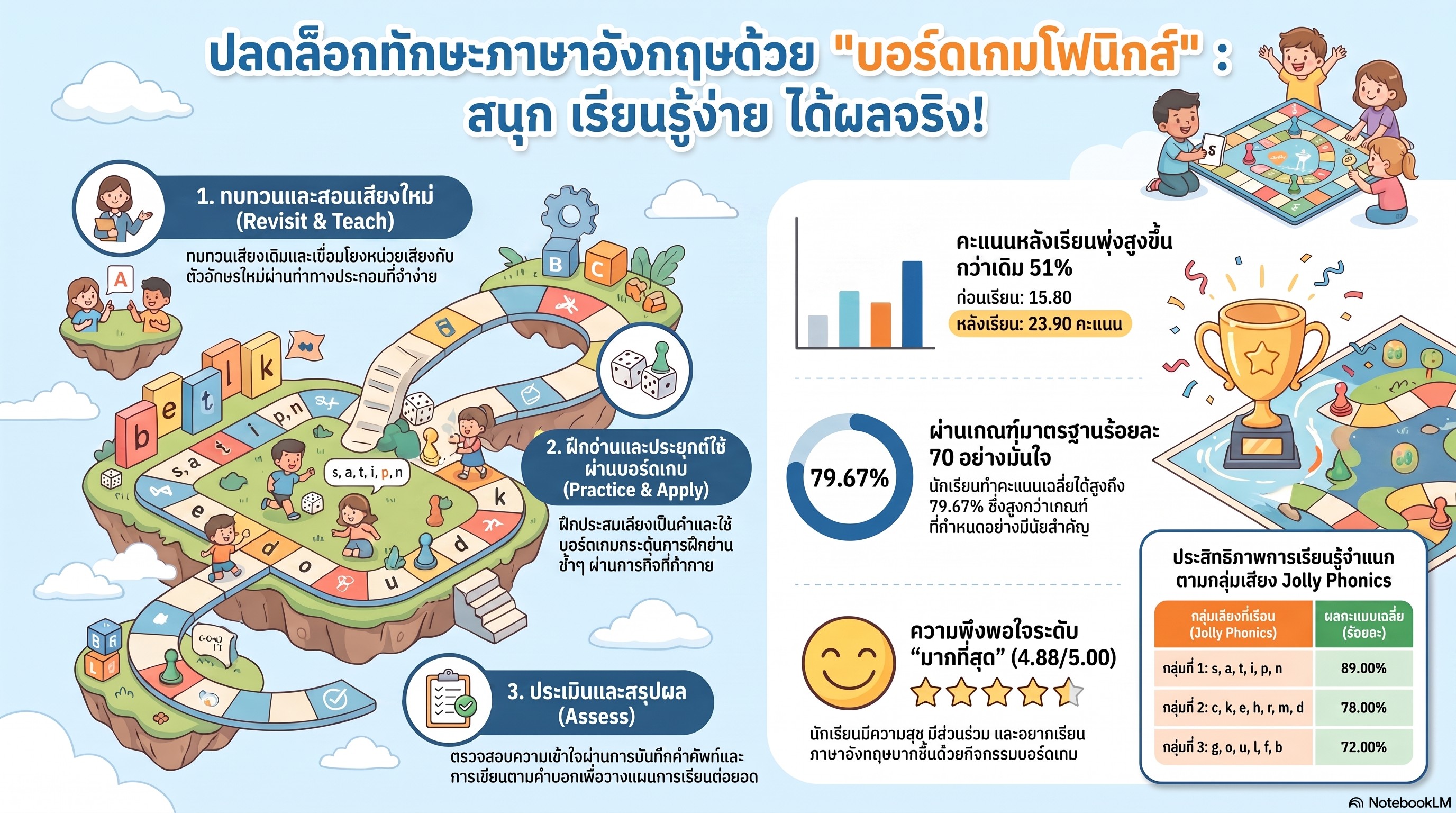
This research aimed to: 1) compare the English word reading and spelling skills of Grade 3 students after implementing a phonics-based board game against a 70% criterion; 2) compare the students' reading and spelling skills before and after the intervention; and 3) investigate the students' satisfaction with learning through the phonics-based board game. The study purposively sampled 10 Grade 3 students at Banlumklongyang School, Sukhothai Province, in the second semester of the 2025 academic year. The research instruments comprised: 1) lesson plans incorporating the phonics-based board game, 2) pre-tests and post-tests measuring word reading and spelling skills, and 3) a satisfaction questionnaire. Data were analyzed using mean, standard deviation, percentage, a dependent (paired-samples) t-test, and a one-sample t-test. The results revealed that: 1) the students' post-test English word reading and spelling scores significantly exceeded the 70% criterion at the .05 level (t = 2.89, p < .05); 2) the students' post-test English word reading and spelling skills were significantly higher than their pre-test scores at the .05 level (t = 25.76, p < .05); and 3) the students' overall satisfaction with learning through the phonics-based board game was at the highest level (M = 4.88, S.D. = 0.29).
References
กระทรวงศึกษาธิการ. (2551). ตัวชี้วัดและสาระการเรียนรู้แกนกลาง กลุ่มสาระการเรียนรู้ภาษาต่างประเทศตามหลักสูตรแกนกลางการศึกษาขั้นพื้นฐาน พุทธศักราช 2551. กระทรวงศึกษาธิการ.
กรุณา พิทักษ์ทนต์. (2561). การศึกษาความสามารถอ่านคำมาตราตัวสะกดแม่กนและแม่กดของนักเรียนที่มีปัญหาทางการอ่านระดับชั้นมัธยมศึกษาตอนปลายโดยใช้วิธีโฟนิกส์ร่วมกับเกมกระดาน [วิทยานิพนธ์ปริญญามหาบัณฑิต, มหาวิทยาลัยศรีนครินทรวิโรฒ].
ฉวีวรรณ วัฒนานุกิจ. (2565). การพัฒนาชุดกิจกรรมการเรียนรู้ด้วยการสอนแบบโฟนิกส์เพื่อส่งเสริมการอ่านออกเสียงภาษาอังกฤษ หน่วยการเรียนรู้เรื่องสระเสียงสั้น สำหรับนักเรียนชั้นประถมศึกษาปีที่ 1. วารสารวิจัยรำไพพรรณี, 16(3), 104–114.
ทิศนา แขมมณี. (2560). ศาสตร์การสอน: องค์ความรู้เพื่อการจัดกระบวนการเรียนรู้ที่มีประสิทธิภาพ (พิมพ์ครั้งที่ 21). สำนักพิมพ์แห่งจุฬาลงกรณ์มหาวิทยาลัย.
นริศรา ทองสุขุม. (2566). ผลการใช้บอร์ดเกมที่มีต่อความรู้คำศัพท์ภาษาอังกฤษของนักเรียนชั้นประถมศึกษาปีที่ 3 โรงเรียนอนุบาลอุดรธานี จังหวัดอุดรธานี [การศึกษาค้นคว้าอิสระปริญญาศึกษาศาสตรมหาบัณฑิต, มหาวิทยาลัยสุโขทัยธรรมาธิราช].
บำรุง โตรัตน์. (2544). วิธีสอนภาษาอังกฤษเป็นภาษาต่างประเทศ. คณะศึกษาศาสตร์ มหาวิทยาลัยศิลปากร.
ปลายฟ้า ล้วนอำนวยโชค, & น้ำทิพย์ องอาจวาณิชย์. (2568). การพัฒนาการอ่านสะกดคำโดยใช้ชุดกิจกรรมตามแนวคิดออร์ตัน-กิลลิงแฮมร่วมกับบอร์ดเกมสำหรับนักเรียนชั้นประถมศึกษาปีที่ 1. วารสารศึกษาศาสตร์ มหาวิทยาลัยราชภัฏนครสวรรค์, 8(2), 451–461.
สถาบันทดสอบทางการศึกษาแห่งชาติ. (2567). ผลการทดสอบทางการศึกษาระดับชาติขั้นพื้นฐาน (O-NET). https://newonetresult.niets.or.th/AnnouncementWeb/Notice/FrBasicStat.aspx
Adams, M. J. (1990). Beginning to read: Thinking and learning about print. MIT Press.
Department for Education and Skills. (2007). Letters and sounds: Principles and practice of high quality phonics. Primary National Strategy. https://www.gov.uk/government/publications/letters-and-sounds
Ehri, L. C. (2005). Learning to read words: Theory, findings, and issues. Scientific Studies of Reading, 9(2), 167–188. https://doi.org/10.1207/s1532799xssr0902_4
International Literacy Association. (2018). Explaining phonics instruction: An educator’s guide (Literacy leadership brief). https://www.literacyworldwide.org/docs/default-source/where-we-stand/ila-explaining-phonics-instruction
Kruse, K. M. (2002). Introduction to instructional design and the ADDIE model.
National Institute of Child Health and Human Development. (2000). Report of the National Reading Panel: Teaching children to read: An evidence-based assessment of the scientific research literature on reading and its implications for reading instruction. U.S. Government Printing Office.
Patel, P., Torppa, M., Aro, M., Richardson, U., & Lyytinen, H. (2022). Assessing the effectiveness of a game-based phonics intervention for first- and second-grade English language learners in India: A randomized controlled trial. Journal of Computer Assisted Learning, 38(1), 76–89. https://doi.org/10.1111/jcal.12592
Qamariah, H., & Wahyuni, S. (2018). Teaching spelling through games. Visipena, 9(1), 137–150. https://doi.org/10.46244/visipena.v9i1.447
Saban, M. (2024). Enhancing spelling competence for English as a foreign language learners: Digital game platform for phoneme–grapheme correspondence of closed syllables with short vowels. Frontiers in Education, 9, Article 1434336. https://doi.org/10.3389/feduc.2024.1434336
Viador, M., Carel, C., Sabenorio, K., & Agumbay, Y. (2025). Improving spelling skill of elementary pupils through spelling game relay. Cognizance Journal of Multidisciplinary Studies, 5(2), 553–557. https://doi.org/10.47760/cognizance.2025.v05i02.038
Witzel, B., Görgen-Rein, R., Galuschka, K., Huemer, S., Corvacho del Toro, I., Schulte-Körne, G., & Moll, K. (2024). Digital game-based spelling intervention for children with spelling deficits: A randomized controlled trial. Learning and Instruction, 89, Article 101842. https://doi.org/10.1016/j.learninstruc.2023.101842
Downloads
Published
How to Cite
Issue
Section
Categories
License
Copyright (c) 2026 Journal of Buddhist Education and Research (JBER)

This work is licensed under a Creative Commons Attribution-NonCommercial-NoDerivatives 4.0 International License.