Technological Leadership of School Administrators Affecting School Effectiveness under the Khon Kaen Primary Educational Service Area Office 3
Keywords:
School Effectiveness, School Administrators, Technological Leadership of School AdministratorsAbstract
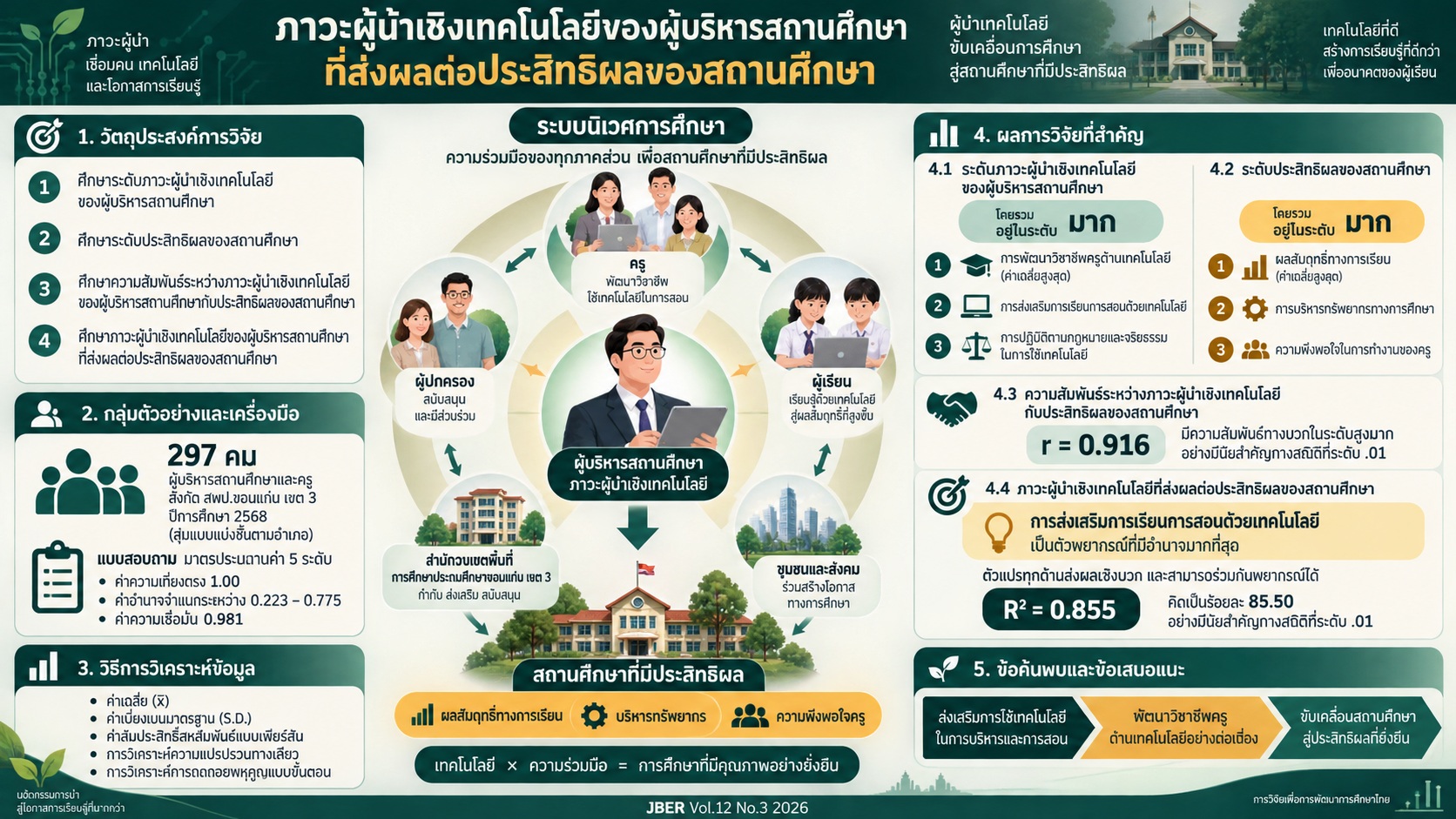
The purposes of this research were: 1) to investigate the level of technological leadership of school administrators, 2) to examine the level of school effectiveness, 3) to study the relationship between technological leadership of school administrators and school effectiveness, and 4) to identify the technological leadership factors of school administrators that influence school effectiveness. The sample consisted of 297 school administrators and teachers under the Office of Khon Kaen Primary Educational Service Area 3 in the 2025 academic year. The sample was obtained through stratified random sampling by district. The research instrument was a five-level rating scale questionnaire. The content validity index was 1.00, the item discrimination ranged from 0.223 to 0.775, and the reliability coefficient was 0.981. The statistical methods used for data analysis included mean, standard deviation, Pearson’s product–moment correlation coefficient, one-way analysis of variance, and stepwise multiple regression analysis. The research findings revealed that: 1. The overall, the technological leadership of school administrators was at a high level. The highest mean was found in the dimension of teachers’ professional development in technology, followed by the promotion of technology-enhanced teaching and learning, and compliance with laws and ethics in the use of technology. 2. The overall, school effectiveness was at a high level. The dimension with the highest mean was students’ academic achievement, followed by educational resource management and teachers’ job satisfaction. 3.Technological leadership of school administrators had a very high positive correlation with school effectiveness at the .01 level of statistical significance (r = 0.916). 4.All dimensions of technological leadership of school administrators positively influenced school effectiveness. The promotion of technology-enhanced teaching and learning was the strongest predictor. Together, these variables were able to predict school effectiveness at 85.50 percent (R² = 0.855), with statistical significance at the .01 level.
Keywords: school effectiveness, school administrators, technological leadership of school administrators
References
เอกสารอ้างอิง
กระทรวงศึกษาธิการ. (2560). ยุทธศาสตร์การพัฒนาการจัดการศึกษาสู่ยุคดิจิทัล. กรุงเทพฯ: กระทรวงศึกษาธิการ.
กระทรวงศึกษาธิการ. (2563). แผนปฏิบัติการดิจิทัลเพื่อการศึกษากระทรวงศึกษาธิการ พ.ศ. 2563–2565. กรุงเทพฯ: กระทรวงศึกษาธิการ.
จิณณวัตร ปะโคทัง. (2561). ภาวะผู้นำยุคดิจิทัลสำหรับผู้บริหารสถานศึกษามืออาชีพ. อุบลราชธานี: คณะครุศาสตร์ มหาวิทยาลัยราชภัฏอุบลราชธานี.
ทวิชชัย ต้นภูบาล. (2565). ภาวะผู้นำของผู้บริหารที่ส่งผลต่อประสิทธิผลการบริหารโรงเรียนประถมศึกษา สังกัดสำนักงานเขตพื้นที่การศึกษาประถมศึกษาสกลนคร เขต 3 (วิทยานิพนธ์ศึกษาศาสตรมหาบัณฑิต). มหาวิทยาลัยราชภัฏสกลนคร.
พะยอม วงศ์สารศรี. (2550). พฤติกรรมองค์การ. กรุงเทพฯ: สำนักพิมพ์แห่งจุฬาลงกรณ์มหาวิทยาลัย.
วรพจน์ วงศ์กิจรุ่งเรื่อง. (2561). ทักษะการใช้เทคโนโลยีดิจิทัลและการรับผิดชอบในโลกออนไลน์. กรุงเทพฯ: สำนักพิมพ์แห่งจุฬาลงกรณ์มหาวิทยาลัย.
วสันต์ชัย สดคมขำ. (2563). ภาวะผู้นำเชิงเทคโนโลยีของผู้บริหารสถานศึกษาที่ส่งผลต่อการบูรณาการเทคโนโลยีและเจตคติต่อการใช้เทคโนโลยีของครูในสถานศึกษา สังกัดสำนักงานเขตพื้นที่การศึกษาประถมศึกษาสุพรรณบุรี เขต 1 (วิทยานิพนธ์ศึกษาศาสตรมหาบัณฑิต). มหาวิทยาลัยราชภัฏสุพรรณบุรี.
ศริญาภัสร์ ชัชโชติสวัสดิ์. (2565). การศึกษาความสัมพันธ์ระหว่างภาวะผู้นำทางเทคโนโลยีของผู้บริหารกับการบริหารสถานศึกษา สังกัดสำนักงานเขตพื้นที่การศึกษามัธยมศึกษาเพชรบูรณ์ (วิทยานิพนธ์ศึกษาศาสตรมหาบัณฑิต). มหาวิทยาลัยราชภัฏเพชรบูรณ์.
ศักรินทร์ เหมหงษา. (2565). ภาวะผู้นำเชิงเทคโนโลยีของผู้บริหารสถานศึกษาที่ส่งผลต่อประสิทธิผลของโรงเรียน สังกัดสำนักงานเขตพื้นที่การศึกษาประถมศึกษาสุพรรณบุรี เขต 3 (วิทยานิพนธ์ศึกษาศาสตรมหาบัณฑิต). มหาวิทยาลัยราชภัฏสุพรรณบุรี.
สุกัญญา แช่มช้อย. (2561). การบริหารสถานศึกษาในยุคเทคโนโลยีดิจิทัล. กรุงเทพฯ: สำนักพิมพ์แห่งจุฬาลงกรณ์มหาวิทยาลัย.
สุนันทา สมใจ. (2561). การบริหารสถานศึกษาด้วยภาวะผู้นำทางเทคโนโลยี. วารสารวิทยาลัยดุสิตธานี, xx(x), xx–xx.
Anderson, R. E., & Dexter, S. L. (2005). School technology leadership: An empirical investigation of prevalence and effect. Educational Administration Quarterly, 41(1), 49–82. https://doi.org/10.1177/0013161X04269517
Downloads
Published
How to Cite
Issue
Section
Categories
License
Copyright (c) 2026 Journal of Buddhist Education and Research (JBER)

This work is licensed under a Creative Commons Attribution-NonCommercial-NoDerivatives 4.0 International License.