Surveying on Wuyin Paigu Teaching Method at Jinan Xingguan Percussion School, Jinan City, Shandong Province
คำสำคัญ:
Wuyin Paigu, Traditional Chinese music, Classroom observation, Jinan Xingguan Percussion schoolบทคัดย่อ
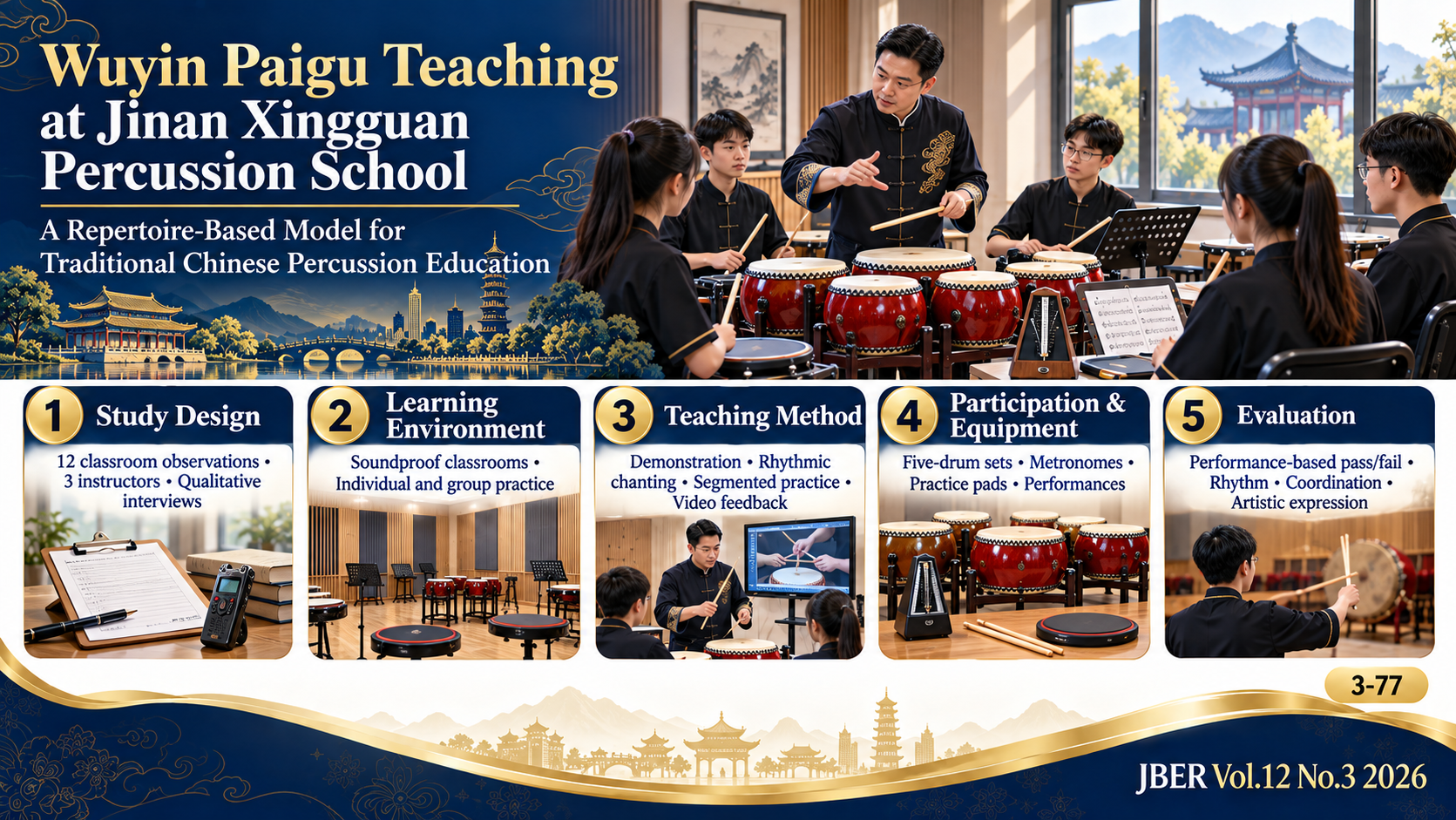
This qualitative study investigates the Wuyin Paigu teaching methods at Jinan Xingguan Percussion School in Shandong Province, China. Utilizing in-depth interviews with three key instructors, observation forms, and expert-validated protocols, the research identifies a comprehensive teaching model structured around seven core dimensions. First, the environment leverages professional acoustic design in specialized classrooms to foster student concentration. Second, teaching content follows a progressive structure, utilizing the "Paigu Performance Curriculum" to integrate technical challenges within traditional pieces like "Dancing on the Drums." Third, teaching methods blend traditional oral instruction and rhythmic chanting with modern video feedback for posture correction. Fourth, activities include regular talent shows and off-campus collaborations that enhance stage adaptability. Fifth, teaching equipment pairs traditional drum sets with metronomes and digital recording systems. Sixth, student participation is driven by interactive games and a disciplined daily practice regimen. Finally, evaluation shifts away from traditional grading toward a "pass/fail" system focused on rhythmic stability and artistic expression. Ultimately, the school successfully bridges traditional intangible cultural heritage with modern pedagogy, effectively cultivating students' technical proficiency and holistic development across moral, intellectual, and aesthetic domains.
เอกสารอ้างอิง
Altenmüller, E., Trappe, W., & Jabusch, H.-C. (2020). Expertise-related differences in cyclic motion patterns in drummers: A kinematic analysis. Frontiers in Psychology, 11, 538958.
Bader, R. (2022). Designing musical instruments and room acoustics with acoustic metamaterials. In R. Bader (Ed.), Springer handbook of systematic musicology: Update volume (Chap. 16). Springer.
China Daily. (2021, December 24). Chinese music tutorial 3: Get to know “paigu” drums.
Cook, G. D. (2018). Teaching percussion (3rd ed.). Cengage Learning.
Hartenberger, R. (2016). The Cambridge companion to percussion. Cambridge University Press.
Hattie, J., & Timperley, H. (2007). The power of feedback. Review of Educational Research, 77(1), 81–112.
Li, R. (2022). Chinese folk music: Study and dissemination through online learning courses. Education and Information Technologies, 27(7), 8997–9013.
Liu, Z., & Liu, Y. (2017). Teaching strategy and instructional system construction of Chinese national instrumental technology education. EURASIA Journal of Mathematics, Science and Technology Education, 13(8), 5645–5653.
McPherson, G. E., & Renwick, J. M. (2001). A longitudinal study of self-regulation in children’s musical practice. Music Education Research, 3(2), 169–186.
Schippers, H. (2010). Facing the music: Shaping music education from a global perspective. Oxford University Press.
Schippers, H., & Grant, C. (Eds.). (2016). Sustainable futures for music cultures: An ecological perspective. Oxford University Press.
Thrasher, A. R. (2000). Chinese musical instruments. Oxford University Press.
ดาวน์โหลด
เผยแพร่แล้ว
รูปแบบการอ้างอิง
ฉบับ
ประเภทบทความ
หมวดหมู่
สัญญาอนุญาต
ลิขสิทธิ์ (c) 2026 Journal of Buddhist Education and Research (JBER)

อนุญาตภายใต้เงื่อนไข Creative Commons Attribution-NonCommercial-NoDerivatives 4.0 International License.