Strategic Management Influencing the Development of Students Good Citizenship in Accordance with the Educational Royal Policy of King Rama X under Nakhon Si Thammarat Primary Educational Service Area Office 1
Keywords:
Strategic Management, Good Citizenship, Royal Educational PolicyAbstract
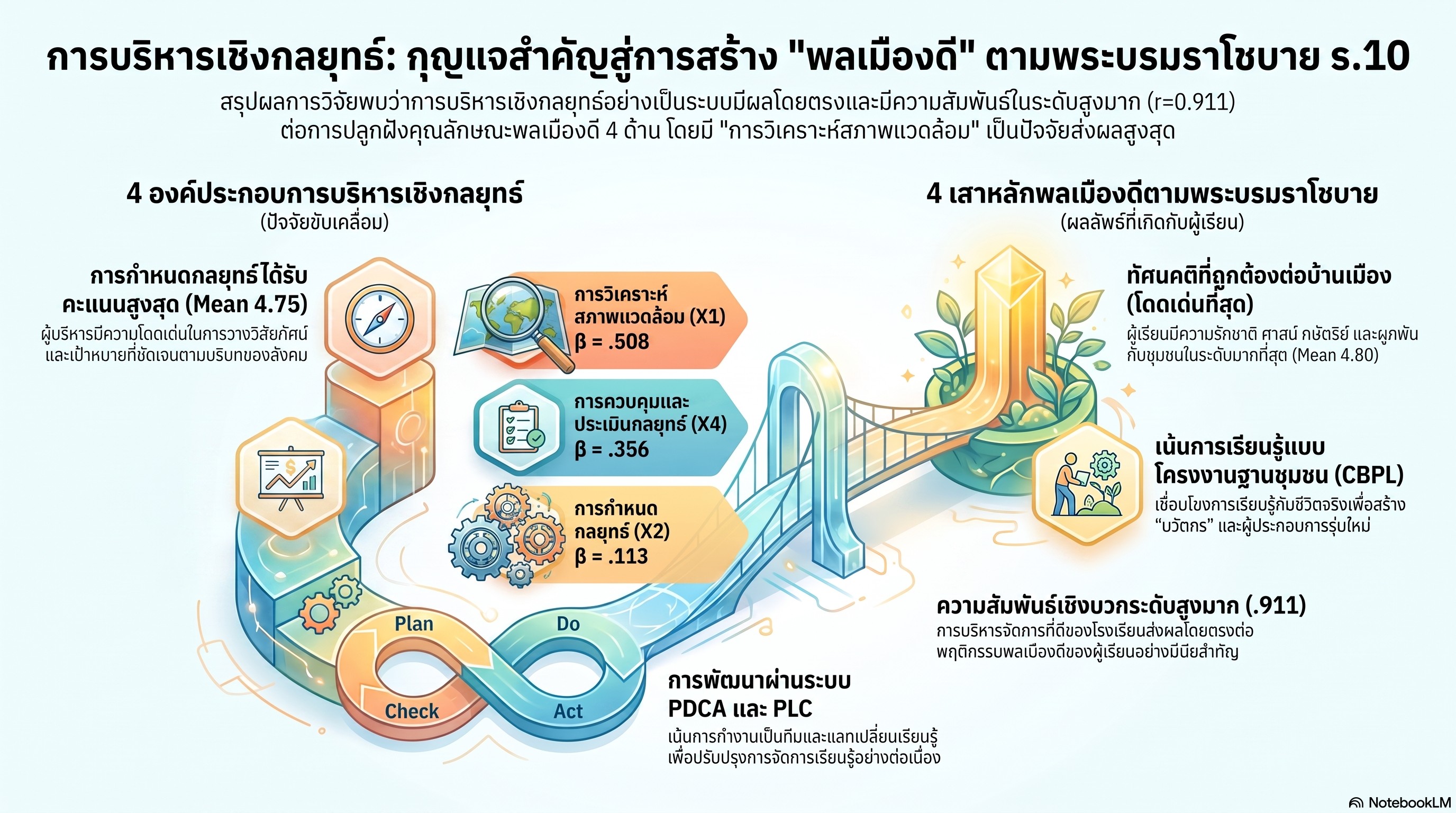
The objectives of this research were to: 1) study the strategic management of school administrators; 2) study the good citizenship of learners according to the royal educational policies of King Rama X; 3) study the strategic management affecting the good citizenship of learners according to the royal educational policies of King Rama X; and 4) study guidelines for developing strategic management affecting the good citizenship of learners according to the royal educational policies of King Rama X. The sample group consisted of 370 school administrators and teachers selected through stratified random sampling. The qualitative data were obtained from 8 key informants, including educational administrators, educational supervisors, and school administrators. The research instruments were questionnaires and interviews. The data were analyzed using percentage, mean, standard deviation, correlation coefficients, multiple regression analysis, and content analysis. The findings revealed that: 1) the overall strategic management of the schools was at the highest level, with strategy formulation showing the highest mean, followed by strategy implementation, environmental analysis, and strategic control and evaluation, respectively; 2) the overall good citizenship of learners according to the royal educational policies of King Rama X was at the highest level, with the highest mean in having the correct attitude toward the nation, followed by having a stable life foundation and morality, being a good citizen, and having work and a career, respectively; 3) strategic management had a very high positive correlation with learners' good citizenship at the .01 level of statistical significance, with environmental analysis, strategic control and evaluation, and strategy formulation as significant predictors, according to the equation Ŷ = .947 + .450(X1) + .252(X4) + .108(X2); and 4) the key development approaches include systematic and continuous implementation with an emphasis on community-based project learning through the participation of all stakeholders.
References
ชัยยศ จินารัตน์. (2565). แนวทางการพัฒนาปัจจัยองค์ประกอบความเป็นพลเมืองดีให้มีผลต่อประชาสังคมแนวใหม่. วารสารการบริหารการปกครองและนวัตกรรมท้องถิ่น, 4(3), 327–336.
ชุภิดา ไชยพิเดช, เอกลักษณ์ เพียสา, & วาโร เพ็งสวัสดิ์. (2568). องค์ประกอบการบริหารเชิงกลยุทธ์และความเป็นเลิศของโรงเรียน. วารสารการบริหารการศึกษาและภาวะผู้นำ มหาวิทยาลัยราชภัฏสกลนคร. (ควรตรวจสอบและเพิ่มปีที่ (Volume), ฉบับที่ (Issue) และเลขหน้า (Pages))
ณฐมล วัตรุจีกฤต, พระครูเขมธรรมโฆสิต, & บุญเลิศ วีระพรการต์. (2567). การบริหารสถานศึกษาตามพระบรมราโชบายด้านการศึกษา รัชกาลที่ 10 ของโรงเรียนราชประชานุเคราะห์ กลุ่ม 7 ฝั่งอันดามัน สังกัดสำนักบริหารงานการศึกษาพิเศษ. วารสารสังคมศาสตร์ปัญญาพัฒน์, 6(4), 361–372.
บุญใจ ศรีสถิตย์นรากูร. (2553). ระเบียบวิธีการวิจัยทางพยาบาลศาสตร์ (พิมพ์ครั้งที่ 5). คณะพยาบาลศาสตร์ จุฬาลงกรณ์มหาวิทยาลัย.
พรพิมล อุ่นเสียม. (2561). ความสัมพันธ์ของการบริหารเชิงกลยุทธ์ของผู้บริหารกับประสิทธิผลของสถานศึกษา สังกัดสำนักงานเขตพื้นที่การศึกษาประถมศึกษาสุราษฎร์ธานี เขต 3 [วิทยานิพนธ์ครุศาสตรมหาบัณฑิต, มหาวิทยาลัยศิลปากร].
สกุนตลา รัตนไพบูลย์วัฒนา. (2564). การบริหารเชิงกลยุทธ์กับการพัฒนาทรัพยากรมนุษย์ของโรงเรียนเอกชนในจังหวัดราชบุรี [วิทยานิพนธ์ศึกษาศาสตรมหาบัณฑิต, มหาวิทยาลัยศิลปากร].
สำนักงานคณะกรรมการการศึกษาขั้นพื้นฐาน. (2564). นโยบายและจุดเน้นของสำนักงานคณะกรรมการการศึกษาขั้นพื้นฐาน ประจำปีงบประมาณ พ.ศ. 2565. กระทรวงศึกษาธิการ.
หทัยชนก รสหอม, เบญจพร ชนะกุล, & สุภาพ เต็มรัตน์. (2567). การบริหารเชิงกลยุทธ์ที่ส่งผลต่อการบริหารงานบุคคลของสถานศึกษา สังกัดสำนักงานเขตพื้นที่การศึกษาประถมศึกษานครศรีธรรมราช เขต 1. วารสาร มจร อุบลปริทรรศน์, 9(2), 833–846.
Banks, J. A. (2017). Failed citizenship and transformative civic education. Educational Researcher, 46(7), 366–377.
European Commission/EACEA/Eurydice. (2017). Citizenship education at school in Europe 2017. Publications Office of the European Union.
González-Valencia, G., Massip Sabater, M., & Santisteban Fernández, A. (2022). Critical global citizenship education: A study on secondary school students. Frontiers in Education, 7, Article 867113. https://doi.org/10.3389/feduc.2022.867113
Kalev, L., Hytti, M., Hallik, M., & Sandström, N. (2025). Citizenship education for contemporary democracy: Challenges and gaps in six European countries. Societies, 15(12), 355. https://doi.org/10.3390/soc15120355
Krejcie, R. V., & Morgan, D. W. (1970). Determining sample size for research activities. Educational and Psychological Measurement, 30(3), 607–610. https://doi.org/10.1177/001316447003000308
Likert, R. (1967). The method of constructing an attitude scale. In M. Fishbein (Ed.), Readings in attitude theory and measurement (pp. 90–95). Wiley.
Downloads
Published
How to Cite
Issue
Section
Categories
License
Copyright (c) 2026 Journal of Buddhist Education and Research (JBER)

This work is licensed under a Creative Commons Attribution-NonCommercial-NoDerivatives 4.0 International License.