The Effect of Growth Mindset Program Based on Belief Change for Industrial Students
Keywords:
Growth Mindset, belief change, Industrial StudentsAbstract
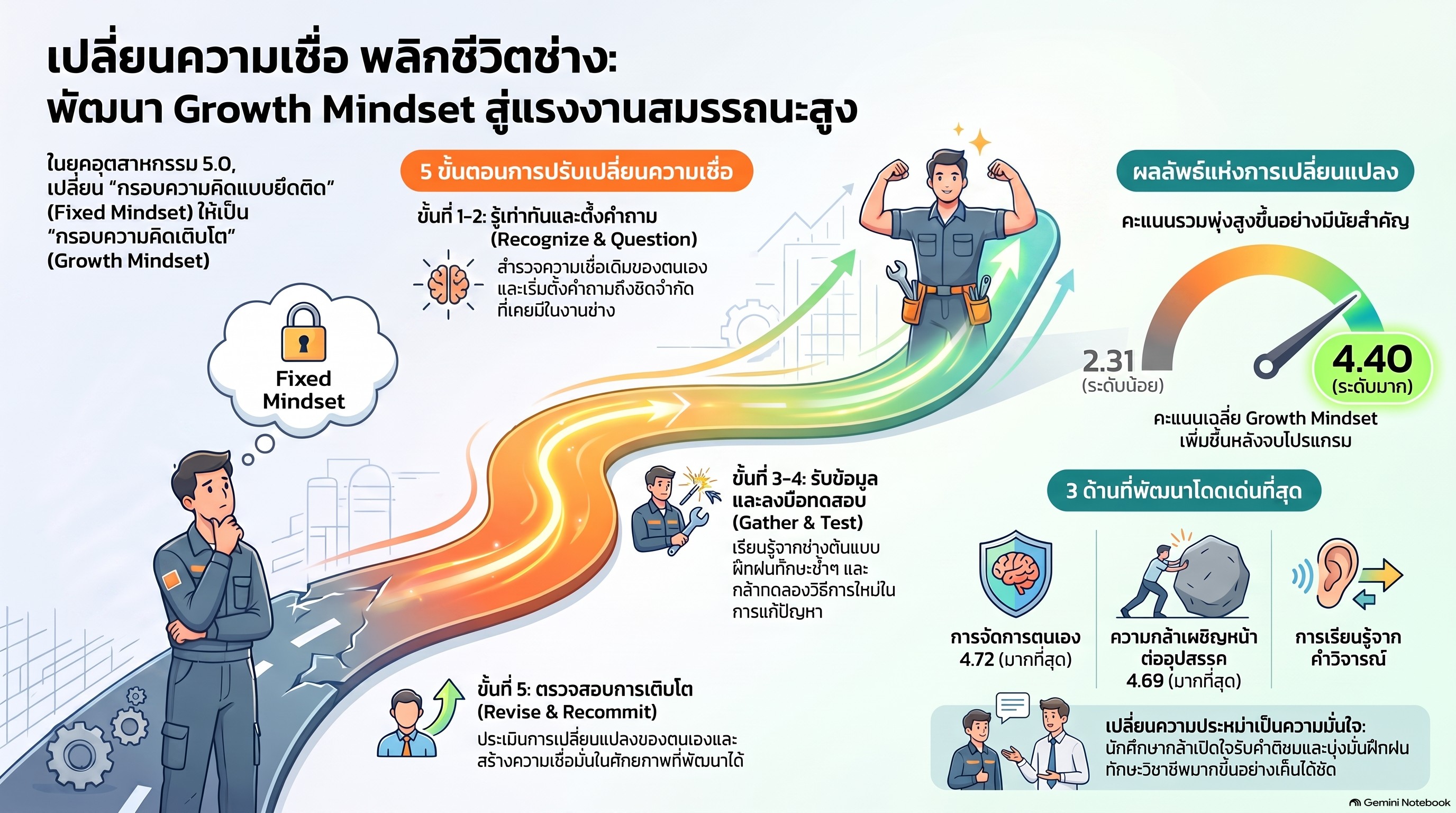
Enhancing a growth mindset is an approach to developing learners’ awareness that abilities can be improved through effort, practice, and learning from mistakes. This research aimed to: 1) develop a growth mindset enhancement program based on belief change for industrial students and 2) compare students’ growth mindset scores before and after participating in the program. The sample consisted of eight first- to third-year Vocational Certificate (Voc. Cert.) students, selected through purposive sampling. The research instruments included: 1) the growth mindset enhancement program based on belief change for industrial students, 2) the growth mindset scale for industrial students, and 3) the activity participation behavior observation form. Data were analyzed using means and standard deviations, the Wilcoxon signed-rank test, and content analysis of the behavioral observation data. This study was approved by the Khon Kaen University Ethics Committee for Human Research (Research Project No. HE693074). The research findings revealed that the developed growth mindset enhancement program, based on the concept of individual belief change for industrial students, comprised 17 activities designed to enhance seven dimensions of a growth mindset. The program's appropriateness was rated at a highest level ( = 4.71, S.D. = 0.36). A comparison of growth mindset scores before and after participating in the program showed that post-intervention scores were significantly higher than pre-intervention scores at the .01 level (z = -2.524, p = 0.006). The highest mean scores were observed in the dimensions of Self-Management, Facing Obstacles and Failures, and Learning and Growing from Criticism. Furthermore, qualitative data revealed that the students transitioned from initial anxiety to positive behaviors, such as confronting obstacles, dedicating effort to practicing professional skills, being receptive to criticism, and maintaining self-confidence in their ongoing career development within the industrial trades.
References
กอบแก้ว บุญบุตร. (2566). การพัฒนาชุดกิจกรรมกลุ่มเพื่อพัฒนากรอบความคิดเติบโตของนักเรียนระดับประถมศึกษาจังหวัดนครนายก. วารสารมหาวิทยาลัยราชภัฏยะลา, 18(1), 52–60.
จิตตินันท์ บุญสถิรกุล, & คาลอส บุญสุภา. (2567). การพัฒนากรอบความคิดแบบเติบโตเพื่อเพิ่มความยืดหยุ่นทางจิตใจเมื่อเผชิญปัญหา. วารสารสันติศึกษาปริทรรศน์ มจร, 12(3), 1230–1240.
ชนิตา รุ่งเรือง, & เสรี ชัดแช้ม. (2559). กรอบความคิดเติบโต: แนวทางใหม่แห่งการพัฒนาศักยภาพมนุษย์. วิทยาการวิจัยและวิทยาการปัญญา, 14(1), 1–13.
ณัฐสิฏ รักษ์เกียรติวงศ์. (2559). การปฏิรูปอาชีวศึกษาของประเทศไทย. สถาบันวิจัยเพื่อการพัฒนาประเทศไทย (ทีดีอาร์ไอ). https://tdri.or.th/wp-content/uploads/2016/08/nuthasid-vocational-education-v02_2.pdf
ณิชชากร เกียรติทนง, ปวีณา อ่อนใจเอื้อ, & มนัสนันท์ หัตถศักดิ์. (2567). การศึกษาผลของการใช้โปรแกรมการปรับพฤติกรรมทางปัญญาโดยการใช้แนวคิดการฝึกพูดเชิงบวกที่ส่งผลต่อกรอบความคิดแบบเจริญเติบโตของนิสิตมหาวิทยาลัยเกษตรศาสตร์. วารสาร มจร อุบลปริทรรศน์, 9(3), 1403–1418.
ตรีนุช ไพชยนต์วิจิตร, & สรัลชนา ธิติสวรรค์. (2566). การศึกษาผลกระทบของโควิด-19 ต่อนักเรียนระดับอาชีวศึกษา การเปลี่ยนแปลงต่อการตัดสินใจด้านการเรียนและด้านการทำงานในอนาคตของนักเรียนอาชีวศึกษา. Journal of Multidisciplinary Academic Research and Development (JMARD), 5(3), 66–84.
นันทยา คงประพันธ์, สุภาวดี เผือกฟัก, พรทิพย์ ช่วยเพล, อุทุมพร เรืองฤทธิ์, & มนพัฒน์ บุญยะบูรณะ. (2567). รูปแบบการเสริมสร้างกรอบความคิดเติบโตของนักศึกษามหาวิทยาลัยเทคโนโลยีราชมงคลสุวรรณภูมิ. Journal of Liberal Art of Rajamangala University of Technology Suvarnabhumi, 6(3), 833–848.
นิพนธ์ หย่งกิจ, ภูเบศ พวงแก้ว, ชูชีพ พุทธประเสริฐ, & ศิริมาศ โกศัลย์พิพัฒน์. (2568). กลยุทธ์การบริหารจัดการเครือข่ายความร่วมมือพัฒนาทักษะอาชีพของสถาบันการอาชีวศึกษาภาคเหนือ 1. วารสารสังคมศาสตร์และวัฒนธรรม, 9(2), 149–164.
ปวีณา อ่อนใจเอื้อ. (2562). ทักษะการกำกับการเรียนรู้ของผู้เรียนในศตวรรษที่ 21. วารสารศึกษาศาสตร์ปริทัศน์, 34(2), 91–99.
ปิยวรรณ วิเศษสุวรรณภูมิ, & พิทชยา ตั้งพรไพบูลย์. (2566). กรอบความคิดแบบเติบโต: ทักษะที่จำเป็นแห่งโลกยุคพลิกผัน. Journal of Education Studies, 51(1).
ปิยะภรณ์ พันธุวิทย์, สุวรรณา จุ้ยทอง, & สมบัติ คชสิทธิ์. (2567). การพัฒนากิจกรรมแนะแนวโดยใช้กรอบความคิดแบบเติบโตที่ส่งเสริมการรู้จักและเข้าใจตนเองของนักเรียนชั้นมัธยมศึกษาปีที่ 4. วารสารวไลยอลงกรณ์ปริทัศน์, 14(1), 247–261.
ภรภัทร ถาวรชินโชติ, นฤมล พระใหญ่, & อัจศรา ประเสริฐสิน. (2566). ผลของโปรแกรมการให้คำปรึกษากลุ่มแบบผสมผสานที่มีผลต่อความสามารถในการฟันฝ่าอุปสรรคของนักศึกษาวิทยาลัยเทคนิคแห่งหนึ่ง. วารสารการวัดผลการศึกษาสำนักทดสอบทางการศึกษาและจิตวิทยา, 40(107), 297–311.
ภาวศุทธิ อุ่นใจ. (2568). อิทธิพลของบุคลิกภาพห้าองค์ประกอบและกรอบแนวคิดแบบเติบโตที่มีต่อความยืดหยุ่นทางจิตใจของนักศึกษาครูมหาวิทยาลัยราชภัฏบ้านสมเด็จเจ้าพระยา. วารสารวิชาการศึกษาศาสตร์ศรีนครินทรวิโรฒ, 26(1), 214–229.
มาลัย อ่อนละเอียด, นาตยา ปิลันธนานนท์, & ศิริรัตน์ ศรีสอาด. (2566). การพัฒนาครูด้วยระบบโค้ชโดย GROW Model. วารสาร มจร อุบลปริทรรศน์, 8(2), 1131–1142.
มุทิตา อดทน. (2561). ผลของโปรแกรมการพัฒนากรอบความคิดเติบโตในนักเรียนชั้นมัธยมศึกษาตอนปลาย [วิทยานิพนธ์วิทยาศาสตรมหาบัณฑิต, มหาวิทยาลัยบูรพา].
เรืองยศ วัชรเกตุ. (2562). ปัจจัยที่ส่งผลต่อการเรียนรู้ในการปฏิบัติงานสหกิจศึกษาของนักศึกษาคณะวิทยาศาสตร์ เครือข่ายพัฒนาสหกิจศึกษาภาคกลางตอนบน [วิทยานิพนธ์การจัดการดุษฎีบัณฑิต, มหาวิทยาลัยเทคโนโลยีสุรนารี].
สำนักงานคณะกรรมการการอาชีวศึกษา. (2567). หลักสูตรประกาศนียบัตรวิชาชีพ พุทธศักราช 2567. https://bsq.vec.go.th/Portals/9/Course/20/2567/20000Principlesv2.pdf
สุพิชญา จันทร์ลอย, & ประภัสสร สมสถาน. (2566). การศึกษาแนวทางการพัฒนาทักษะด้านการสื่อสารเพื่อรองรับตลาดแรงงานศตวรรษที่ 21 ของนักศึกษาสาขาวิชาช่างก่อสร้างวิทยาลัยเทคนิคมีนบุรี. วารสารวิชาการนวัตกรรมสื่อสารสังคม, 11(2), 109–123.
สุพิน ใจแก้ว. (2563). การพัฒนาชุดฝึกอบรมเสริมสร้างกรอบความคิดเติบโตนักศึกษาคณะครุศาสตร์ มหาวิทยาลัยราชภัฏอุตรดิตถ์. วารสารสังคมศาสตร์และมานุษยวิทยาเชิงพุทธ, 5(11), 348–360.
อิสสระ คำแถลง, & ศรัณย์ พิมพ์ทอง. (2567). การศึกษาประสิทธิผลโปรแกรมโค้ชชิ่งเพื่อเสริมสร้างกรอบความคิดเติบโตของผู้จัดการร้านอาหารเพื่อสุขภาพ. วารสารพฤติกรรมศาสตร์เพื่อการพัฒนา, 16(2), 1–17.
Andersen, E. (2006). Growing great employees: Turning ordinary people into extraordinary performers. Penguin.
Blackwell, L. S., Trzesniewski, K. H., & Dweck, C. S. (2007). Implicit theories of intelligence predict achievement across an adolescent transition: A longitudinal study and an intervention. Child Development, 78, 246–263.
Breque, M., De Nul, L., & Petridis, A. (2021). Industry 5.0: Towards a sustainable, human-centric and resilient European industry [Policy brief]. Publications Office of the European Union.
Demir, K. A., Döven, G., & Sezen, B. (2019). Industry 5.0 and human-robot co-working. Procedia Computer Science, 158, 688–695.
Dweck, C. S. (2006). Mindset: The new psychology of success. Random House Publishing Group.
Dweck, C. S. (2010). Mind-sets. Principal Leadership, 10(5), 26–29.
Johnson, D. W., & Johnson, F. P. (2014). Joining together: Group theory and group skills (11th ed.). Pearson Education.
Kolb, D. A. (1984). Experiential learning: Experience as the source of learning and development. Prentice Hall.
Lawshe, C. H. (1975). A quantitative approach to content validity. Personnel Psychology, 28(4), 563–575.
Mueller, C. M., & Dweck, C. S. (1998). Praise for intelligence can undermine children's motivation and performance. Journal of Personality and Social Psychology, 75(1), 33–52.
Purwaningsih, L., Isti‘adah, F. N., & Sugara, G. S. (2025). The application of growth mindset training-based classical guidance to improve psychological well-being of high school students. Quanta: Jurnal Kajian Bimbingan Dan Konseling Dalam Pendidikan, 9(1), 91–98.
Rodthong, R. (2025). The guidelines to develop digital leadership of school administrators under the Secondary Educational Service Area Office Bangkok 1. Journal of Buddhist Education and Research (JBER), 11(3), 520–535.
Satimanon, M., & Satimanon, T. (2018). Labor quality mismatching management in Thai industry. Thammasat Economic Journal, 36(1), 45–62.
Schön, D. A. (1983). The reflective practitioner: How professionals think in action. Basic Books.
Downloads
Published
How to Cite
Issue
Section
Categories
License
Copyright (c) 2026 Journal of Buddhist Education and Research (JBER)

This work is licensed under a Creative Commons Attribution-NonCommercial-NoDerivatives 4.0 International License.