The Volunteer Spirit and Social Responsibility Models of Youth in Khon Kaen Province
Keywords:
Public-Mindedness, Social Responsibility, Role Model Youths in Khon Kaen Province, Brahmavihāra IV, Saṅgahavatthu IVAbstract
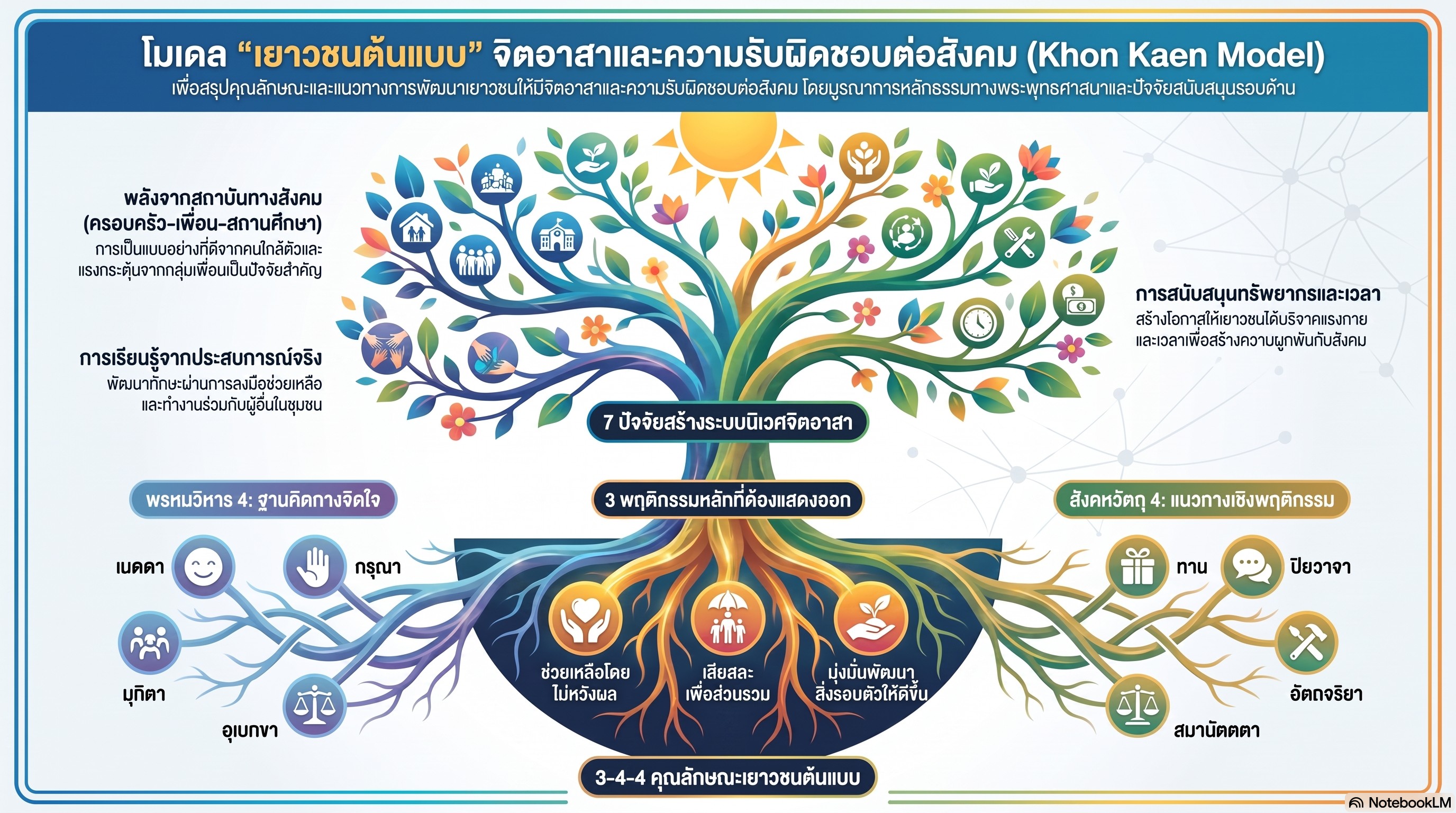
This research aimed to: 1) to synthesize the characteristics of volunteer spirit and social responsibility of youth in Khon Kaen Province, 2) to establish models of volunteer spirit and social responsibility of exemplary youth in Khon Kaen Province, and 3) to present models of volunteer spirit and social responsibility of exemplary youth in Khon Kaen Province. The study employed a Research and Development (R&D) methodology. Key informants consisted of representatives from temples, educational institutions, government agencies, and private organizations, with five participants from each sector, totaling 20 informants. In addition, a focus group discussion was conducted with 12 experts. Data were analyzed using descriptive content analysis, content analysis, inductive analysis, and were presented in the form of descriptive-analytical narratives. The findings revealed that: 1) The characteristics of volunteer spirit and social responsibility among exemplary youth comprised three major behavioral dimensions: (1) helping others without expecting rewards, (2) sacrificing personal interests for the common good, and (3) striving to improve the surrounding environment and society for positive change. Youth possessing volunteer spirit and social responsibility should demonstrate desirable qualities in both mental and behavioral aspects. Mentally, they should embody the principles of the Four Sublime States of Mind (Brahmavihāra IV), namely: (1) loving-kindness (Mettā), (2) compassion (Karuṇā), (3) sympathetic joy (Muditā), and (4) equanimity (Upekkhā). Behaviorally, they should practice the Four Bases of Social Solidarity (Saṅgahavatthu IV), namely: (1) generosity (Dāna), (2) kindly speech (Piyavācā), (3) beneficial conduct (Atthacariyā), and (4) impartial participation and consistency (Samānattatā). 2) The model of volunteer spirit and social responsibility for exemplary youth in Khon Kaen Province consisted of three dimensions: (1) helping others, (2) self-sacrifice, and (3) commitment to social development. Individuals should possess readiness in both mental and behavioral dimensions. The mental dimension should be guided by virtues based on the Four Sublime States of Mind (Brahmavihāra IV), while the behavioral dimension should reflect practices based on the Four Bases of Social Solidarity (Saṅgahavatthu IV). Furthermore, the development of volunteer spirit and social responsibility should be supported by seven key factors: (1) education and learning, (2) volunteer support systems, (3) the willingness to devote time and resources, (4) experiential learning, (5) support from family and society, (6) educational institutions, and (7) peer groups.
References
คณะกรรมการส่งเสริมคุณธรรมแห่งชาติ. (2566). แผนปฏิบัติการด้านการส่งเสริมคุณธรรมแห่งชาติ ระยะที่ 2 (พ.ศ. 2566–2570). กระทรวงวัฒนธรรม.
จังหวัดขอนแก่น. (ม.ป.ป.). แผนพัฒนาจังหวัดขอนแก่น (พ.ศ. 2566–2570) ฉบับทบทวน ประจำปีงบประมาณ พ.ศ. 2567.
ณัฐณิชากร ศรีบริบูรณ์. (2550). การพัฒนาโมเดลเชิงสาเหตุของจิตอาสาของนักเรียนมัธยมศึกษาตอนปลายในโรงเรียนสังกัดสำนักงานคณะกรรมการการศึกษาขั้นพื้นฐาน [วิทยานิพนธ์ปริญญามหาบัณฑิต, จุฬาลงกรณ์มหาวิทยาลัย].
พระพรหมคุณาภรณ์ (ป. อ. ปยุตฺโต). (2562). พจนานุกรมพุทธศาสตร์ ฉบับประมวลธรรม. โรงพิมพ์มหาจุฬาลงกรณราชวิทยาลัย.
พระราชบัญญัติการศึกษาแห่งชาติ พ.ศ. 2542. (2542, 19 สิงหาคม). ราชกิจจานุเบกษา, 116(74 ก), 1–23.
ศูนย์คุณธรรม (องค์การมหาชน). (2566). การส่งเสริมคุณธรรม พอเพียง วินัย สุจริต จิตอาสา. ศูนย์คุณธรรม (องค์การมหาชน).
แสงอาทิตย์ เจ้งวัฒนพงศ์, ประสิทธิ์ รัตนกลาง, & วลัยพร สิริภานุพงศ์. (2564). รูปแบบการพัฒนากิจกรรมที่ส่งเสริมลักษณะนิสัยด้านจิตอาสาของนักเรียนสังกัดสถาบันการอาชีวศึกษากรุงเทพมหานคร. วารสารบริหารธุรกิจศรีปทุม, 11(2). https://so04.tci-thaijo.org/index.php/JSBA/article/download/250058/170638
สำนักงานคณะกรรมการส่งเสริมการศึกษาเอกชน. (2564). แนวทางการพัฒนาผู้เรียนให้มีจิตอาสาและความรับผิดชอบต่อสังคม. กระทรวงศึกษาธิการ.
สำนักงานรับรองมาตรฐานและประเมินคุณภาพการศึกษา. (2549). มาตรฐานตัวบ่งชี้และเกณฑ์การพิจารณาเพื่อการประเมินคุณภาพภายนอก ระดับการศึกษาขั้นพื้นฐาน รอบที่ 2 (พ.ศ. 2549–2553) (พิมพ์ครั้งที่ 3). จุดทอง.
สำนักงานเลขาธิการสภาการศึกษา. (2561). จิตอาสาและการสร้างพลเมืองที่มีความรับผิดชอบต่อสังคม. สำนักงานเลขาธิการสภาการศึกษา.
Bacter, C., & Marc, C. (2016). Students’ involvement in social volunteering. Bulletin of the Transilvania University of Braşov. Series VII: Social Sciences. Law, 9(58), 69–78.
Downloads
Published
How to Cite
Issue
Section
License
Copyright (c) 2026 Author(s)

This work is licensed under a Creative Commons Attribution-NonCommercial-NoDerivatives 4.0 International License.