The Development of an Instructional Model Based on Constructivist Theory to Enhance Creativity in Musical Innovation Among Pre-Service Music Teachers
Keywords:
Musical Innovation Creativity Skills, Constructivist Theory, Instructional Model, Pre-service Music TeachersAbstract
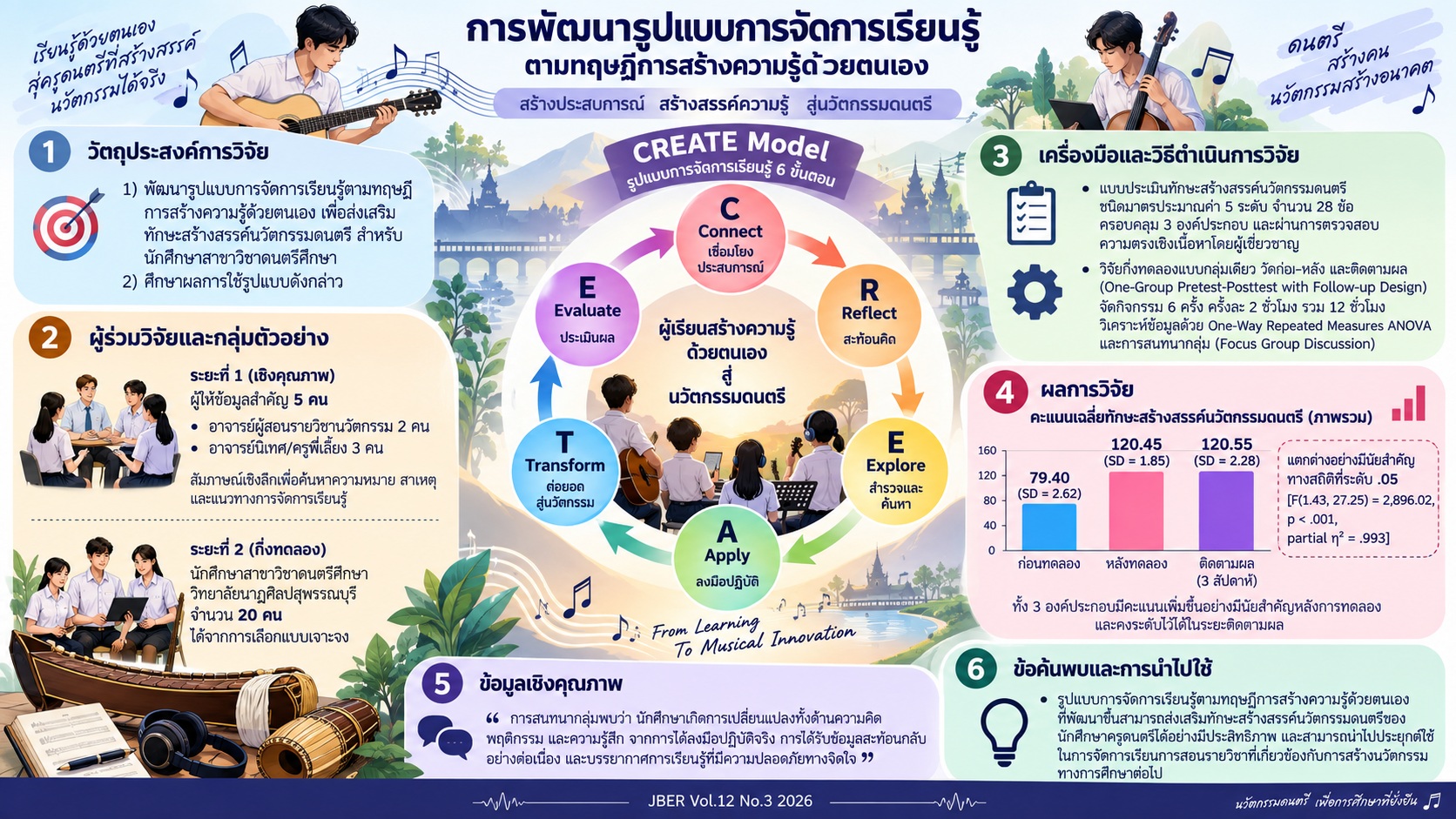
This study employed a mixed methods design with two purposes: 1) to develop an instructional model based on constructivist theory to enhance creativity in musical innovation among pre-service music teachers, and 2) to examine the effectiveness of the developed model. The research comprised two phases. Phase 1 was a qualitative pre-experimental study using in-depth interviews with five key informants — two instructors of innovation courses and three supervising/mentor teachers — to explore the meaning, causes, and instructional guidelines that promote musical innovation creativity skills. Findings were used to construct a six-step instructional model, the CREATE Model (Connect–Reflect–Explore–Apply–Transform–Evaluate), and a 28-item, five-point rating-scale assessment of musical innovation creativity skills covering three components: creative musical thinking, creative collaboration, and successful innovation implementation; both were validated for content validity by experts. Phase 2 was a one-group quasi-experimental study with pretest, posttest, and a three-week follow-up, conducted with a purposive sample of 20 pre-service music education students at Suphanburi College of Dramatic Arts. The instructional program consisted of six two-hour sessions (12 hours in total). Data were analyzed using one-way repeated-measures ANOVA, supplemented by a post-intervention focus group discussion. Results showed that students' overall musical innovation creativity scores were significantly higher at posttest (X ̅ = 120.45, SD = 1.85) and follow-up (X ̅ = 120.55, SD = 2.28) than at pretest (X ̅ = 79.40, SD = 2.62), F(1.43, 27.25) = 2,896.02, p < .001, partial η² = .993. All three components showed the same pattern of significant, sustained improvement. Qualitative findings corroborated the quantitative results, revealing cognitive, behavioral, and affective changes attributable to hands-on practice, continuous feedback, and a psychologically safe learning climate. The findings indicate that the constructivist-based instructional model effectively and sustainably enhances musical innovation creativity skills among pre-service music teachers and may be applied to courses related to educational innovation development.
Downloads
Published
How to Cite
Issue
Section
Categories
License
Copyright (c) 2026 Journal of Buddhist Education and Research (JBER)

This work is licensed under a Creative Commons Attribution-NonCommercial-NoDerivatives 4.0 International License.