A developmental model of Thai literature instruction integrating analytical thinking skills for Thai major students at Thaksin University
Keywords:
learning management model, Thai literature, analytical thinking skillsAbstract
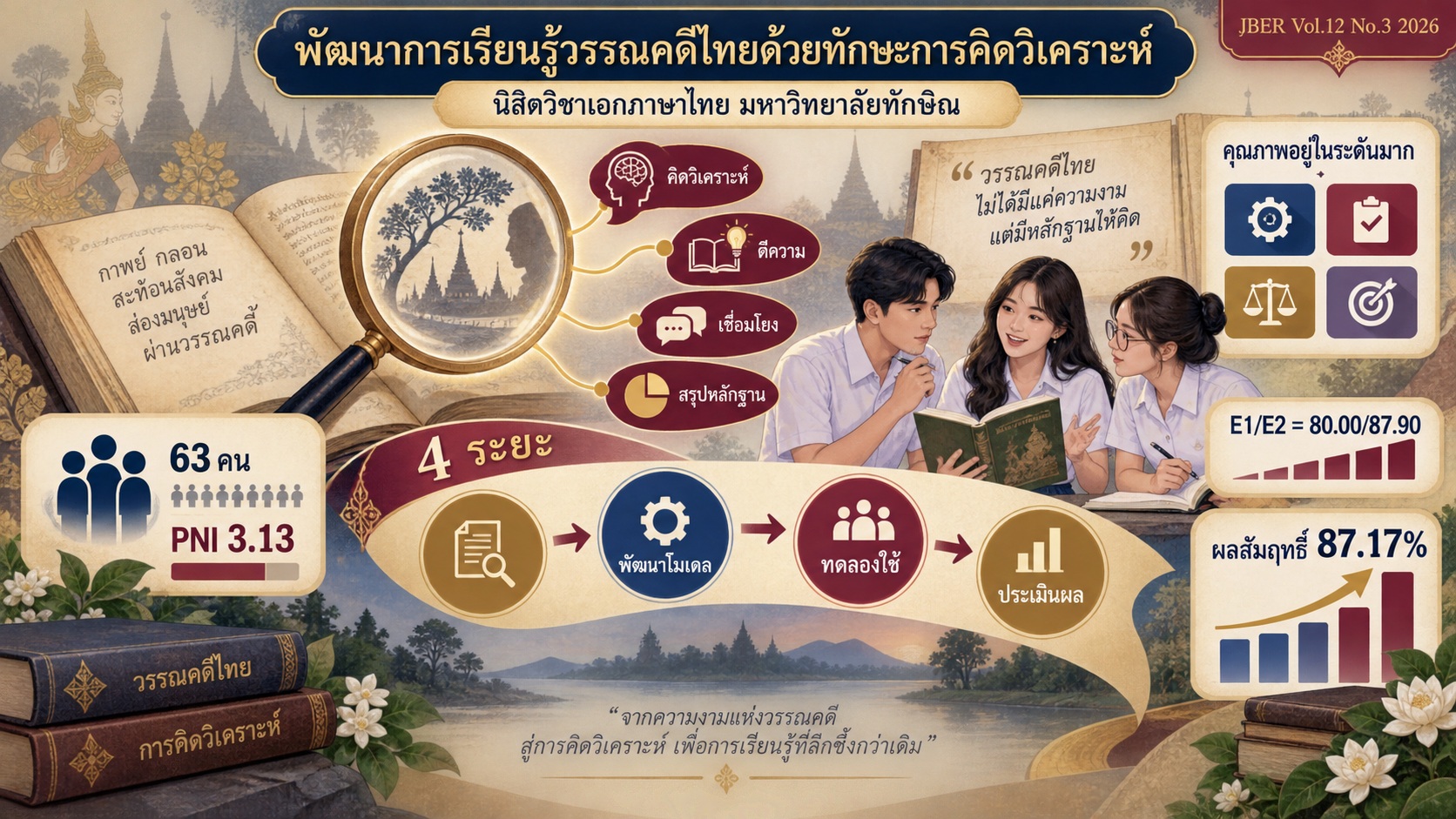
This research aimed: (1) to study the current conditions, problems, desired conditions, and priority needs for developing a model; (2) to develop the model; (3) to implement the model; and (4) to evaluate a developmental model of Thai literature instruction integrating analytical thinking skills for Thai major students at Thaksin University. The study employed a research and development (R&D) methodology and was conducted in four phases: Phase 1 involved investigating the current conditions, problems, desired conditions, and priority needs; Phase 2 focused on developing the model; Phase 3 involved implementing the model; and Phase 4 focused on evaluating the developmental model of Thai literature instruction integrating analytical thinking skills for Thai major students at Thaksin University. The findings of Phase 1 revealed that, based on the opinions of 63 participants, both the current conditions and the desired conditions were at a high level. The Priority Needs Index (PNI) was 3.13, indicating a moderate level of need. In Phase 2, concerning model development, the experts emphasized awareness of the learning activity management process, which comprised: (1) principles or concepts; (2) learning activity management processes; and (3) a variety of learning activity structures appropriate for students’ age levels. The results of the quality assessment of the model based on standard criteria indicated that the utility, feasibility, propriety, and accuracy standards were all at a high level. Similarly, the quality assessment of the model handbook showed that the utility, feasibility, propriety, and accuracy standards were also all at a high level. In Phase 3, the results of implementing the developmental model indicated that the efficiency of the model, based on the 80/80 criterion and calculated using the E₁/E₂ formula, was E₁ = 80.00, which exactly met the criterion, and E₂ = 87.90%. Analysis of learning achievement based on pretest and posttest scores revealed that the mean scores were equivalent to 87.17 percent, indicating that students’ learning achievement increased significantly at the .05 level. In Phase 4, the evaluation results of the developmental model, based on responses from 30 participants using a three-part questionnaire consisting of: (1) input factors, (2) learning management processes, and (3) outputs, revealed that all three aspects were at a high level.
References
จุฬาลักษณ์ คชาชัย. (2558). การศึกษาผลสัมฤทธิ์การเรียนวรรณคดีไทยของนักเรียนชั้นมัธยมศึกษาปีที่ 3 ที่ จัดการเรียนรู้ตามทฤษฎีการตอบสนองของผู้อ่าน.วารสารศิลปากร ฉบับภาษาไทย สาขา มนุษยศาสตร์ สังคมศาสตร์ และศิลปะ, 8(2), 62–75.
ชัยวัฒน์ สุทธิรัตน์. (2555). 80 นวัตกรรมการจัดการเรียนรู้ที่เน้นผู้เรียนเป็นสําคัญ.อินเตอร์คอร์ปอเรชัน.
ทิศนา แขมณี. (2566). ศาสตร์การสอน: องค์ความรู้เพื่อการจัดกระบวนการเรียนรู้ที่มีประสิทธิภาพ(พิมพ์ครั้ง ที่ 26). สํานักพิมพ์แห่งจุฬาลงกรณ์มหาวิทยาลัย.
พิชัย ศรีภูไพ. (2542). วรรณคดี สังคม และการเมือง.สถาบันราชภัฏอุบลราชธานี.
ไพรินทร์ พึ่งพงษ์, และคณะ. (2564). รูปแบบการสอนภาษาไทยตามแนวคิดการเรียนรู้เชิงรุกร่วมกับแนวคิด อภิปัญญา เพื่อส่งเสริมความสามารถด้านการอ่านอย่างมีวิจารณญาณของนักศึกษาระดับปริญญา บัณฑิต.วารสารศิลปากรศึกษาศาสตร์วิจัย, 13(2), 132–150.
ศราวุฒิ พรมชมพู, & อ้อมธจิต แป้นศรี. (2568). การพัฒนาความสามารถการอ่านเชิงวิเคราะห์ของนักเรียนชั้น มัธยมศึกษาปีที่ 2 โดยใช้แบบฝึกทักษะนิทานพื้นบ้านม้งร่วมกับกลวิธีการสอนอ่านแบบเมตาคอกนิ ชัน.วารสารมณีเชษฐาราม วัดจอมมณี, 8(3), 623–634.
สุวิทย์ มูลคํา. (2553). วิธีการจัดการเรียนรู้เพื่อพัฒนาความรู้และทักษะ(พิมพ์ครั้งที่ 9). ภาพพิมพ์.
เอมอร ชิตตะโสภณ. (2521). โลกแห่งวรรณคดี.ศูนย์หนังสือเชียงใหม่.
Bloom, B. S. (Ed.). (1956). Taxonomy of educational objectives: The classification of educational goals. Handbook I: Cognitive domain.Longmans, Green.
Kirkpatrick, D. L. (1998). Evaluating training programs: The four levels(2nd ed.). Berrett- Koehler Publishers.
Downloads
Published
How to Cite
Issue
Section
Categories
License
Copyright (c) 2026 Journal of Buddhist Education and Research (JBER)

This work is licensed under a Creative Commons Attribution-NonCommercial-NoDerivatives 4.0 International License.