Promoting Student Activities and Programs that Emphasize Morality, Ethics, Values, Discipline, and Desirable Characteristics in Thai Society
Keywords:
Morality, Experiential Learning, Student DevelopmentAbstract
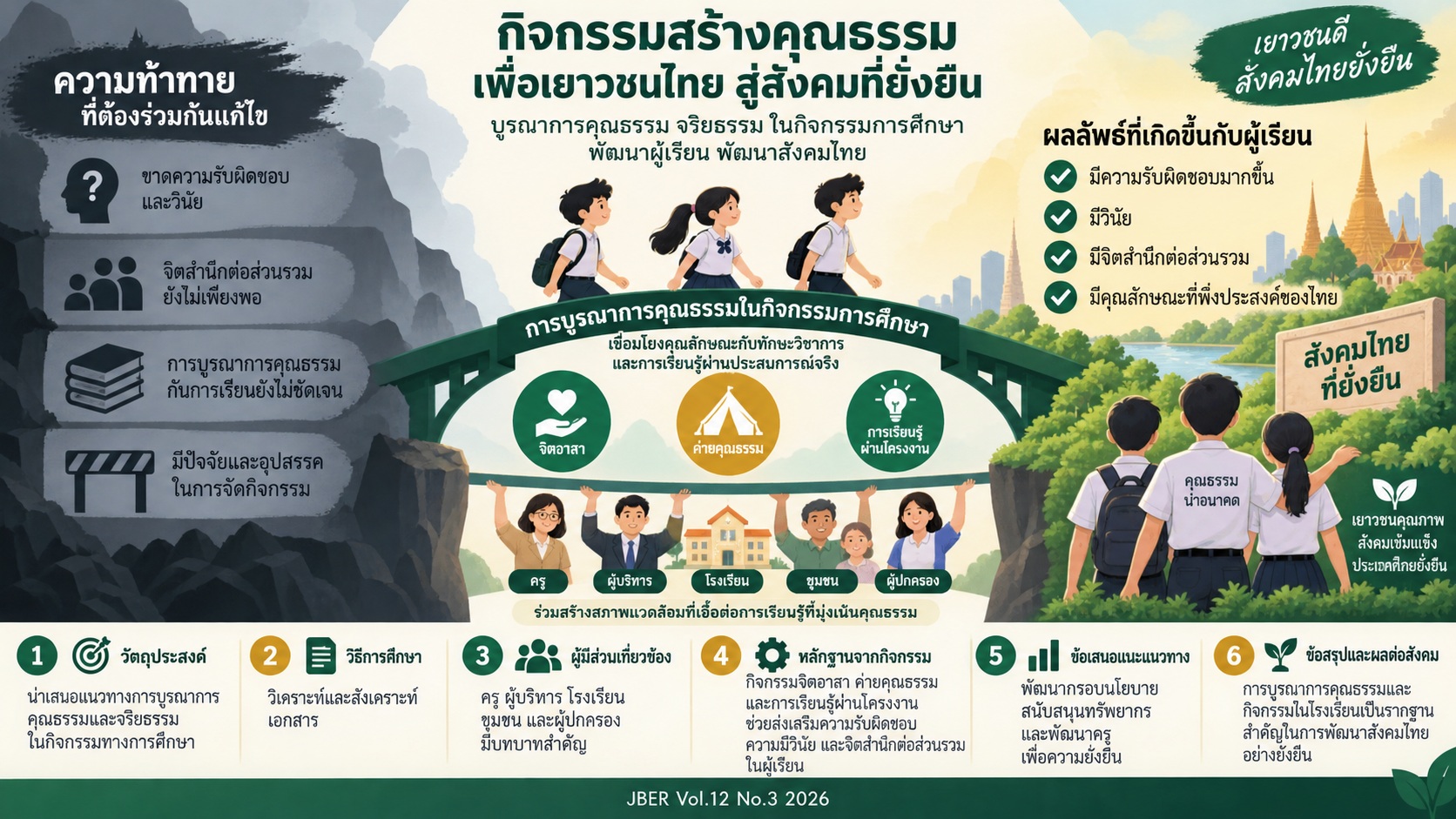
Promoting morality, ethics, values, discipline, and desirable characteristics among students is a crucial factor in enhancing the potential of Thai youth. This article aims to propose approaches for integrating morality and ethics into educational activities, emphasizing the connection between these attributes and the development of academic skills and experiential learning. Designed activities, such as volunteerism, moral camps, and project-based learning, have been proven effective in fostering responsibility, discipline, and a sense of community among students. Furthermore, the roles of teachers, administrators, schools, communities, and parents are vital in creating an environment conducive to moral-centered learning. The article also discusses enabling factors and obstacles affecting the promotion of such activities, along with proposed solutions such as policy framework development, resource support, and sustainable teacher training. This research highlights that integrating morality and school activities can serve as a fundamental basis for sustainable development in Thai society.
Keyword: Morality, Experiential Learning, Student Development
References
กรมวิชาการ. (2549). แนวทางการส่งเสริมคุณธรรมจริยธรรมในสถานศึกษา.กระทรวงศึกษาธิการ.
กระทรวงศึกษาธิการ. (2551). หลักสูตรแกนกลางการศึกษาขั้นพื้นฐาน.กระทรวงศึกษาธิการ.
กระทรวงศึกษาธิการ. (2564a). แนวทางการพัฒนาค่านิยม 12 ประการ.กระทรวงศึกษาธิการ.
กระทรวงศึกษาธิการ. (2564b). แนวทางการส่งเสริมคุณธรรมในสถานศึกษา.กระทรวงศึกษาธิการ.
กระทรวงศึกษาธิการ. (2565). แนวทางการพัฒนาการเรียนรู้แบบผู้เรียนเป็นศูนย์กลาง.กระทรวงศึกษาธิการ.
นิวัฒน์ สินไชย. (2560). การศึกษาคุณลักษณะอันพึงประสงค์ในเด็กและเยาวชนไทย.วารสารวิจัยทางการ ศึกษา, 12(1), 22–35.
สํานักงานกองทุนสนับสนุนการวิจัย. (2564). ปรัชญาเศรษฐกิจพอเพียงในระบบการศึกษาไทย.สํานักงาน กองทุนสนับสนุนการวิจัย.
สํานักงานพระพุทธศาสนาแห่งชาติ. (2565). บทบาทของศาสนาพุทธในสังคมไทย.สํานักงานพระพุทธศาสนา แห่งชาติ.
สํานักงานเลขาธิการสภาการศึกษา. (2565). รายงานการพัฒนาคุณธรรมในสถานศึกษา.กระทรวงศึกษาธิการ.
Bandura, A. (2018). Social learning theory.Prentice Hall.
Beard, R., & Thomson, P. (2021). Parent and community involvement in education: A key determinant of academic success. International Journal of Applied Research in Social Sciences, 6(3), 372–382.
Cefai, C., & Cavioni, V. (2021). The importance of a positive school climate for student well- being: Implications for educational practice. Journal of Educational Psychology, 113(2), 245–259.
Cordova, D., Jr., Chisom, E., & Adeniyi, P. (2024). Strengthening partnerships between schools and community organizations. International Journal of Applied Research in Social Sciences, 6(3), 374–382.
Khunanon, W. (2023). The factors hindering Thai education. Journal of Public Administration, 15(2), 45–60.
Kohlberg, L. (1981). Essays on moral development: Vol. 1. The philosophy of moral development.Harper & Row.
Lloyd, C. (2025). Exploring desirable student characteristics: Integrating academic and social- emotional learning. Journal of Educational Research, 118(1), 45–60.
Musling, M., Tenkorang, E., & Apatinga, A. (2021). The role of parents in moral development: A collaborative approach with schools. Journal of Moral Education, 50(2), 123–140.
Nattayan, S. (2023). Challenges in implementing educational activities in Thai schools. Thai Journal of Educational Research, 12(1), 23–34.
Organisation for Economic Co-operation and Development. (2022). Education for a changing world.OECD Publishing.
Rest, J. R., Narvaez, D., Bebeau, M. J., & Thoma, S. J. (2020). Postconventional moral thinking: A neo-Kohlbergian approach.Psychology Press.
Thitinun, T. (2023). Exploring desirable student characteristics: Integrating academic and social-emotional learning. Journal of Educational Research, 118(1), 45–60.
UNICEF. (2021). The state of the world's children 2021: On my mind.UNICEF.
Vygotsky, L. S. (1978). Mind in society: The development of higher psychological processes. Harvard University Press.
Wihakhaphirom, K. (2023). Factors promoting quality education in Thailand: A comprehensive analysis. International Journal of Education and Development, 8(4), 56–72.
World Economic Forum. (2023). Global risks report 2023.World Economic Forum.
Downloads
Published
How to Cite
Issue
Section
Categories
License
Copyright (c) 2026 Journal of Buddhist Education and Research (JBER)

This work is licensed under a Creative Commons Attribution-NonCommercial-NoDerivatives 4.0 International License.