The Development of a Communicative Thai Language Learning Model Based on Communicative Language Teaching (CLT) Using the Think-Pair- Share Technique for Undergraduate Students at the College of Fine Arts, Bunditpatanasilpa Institute
Keywords:
learning management model, Thai language communication, the Think-Pair-Share techniqueAbstract
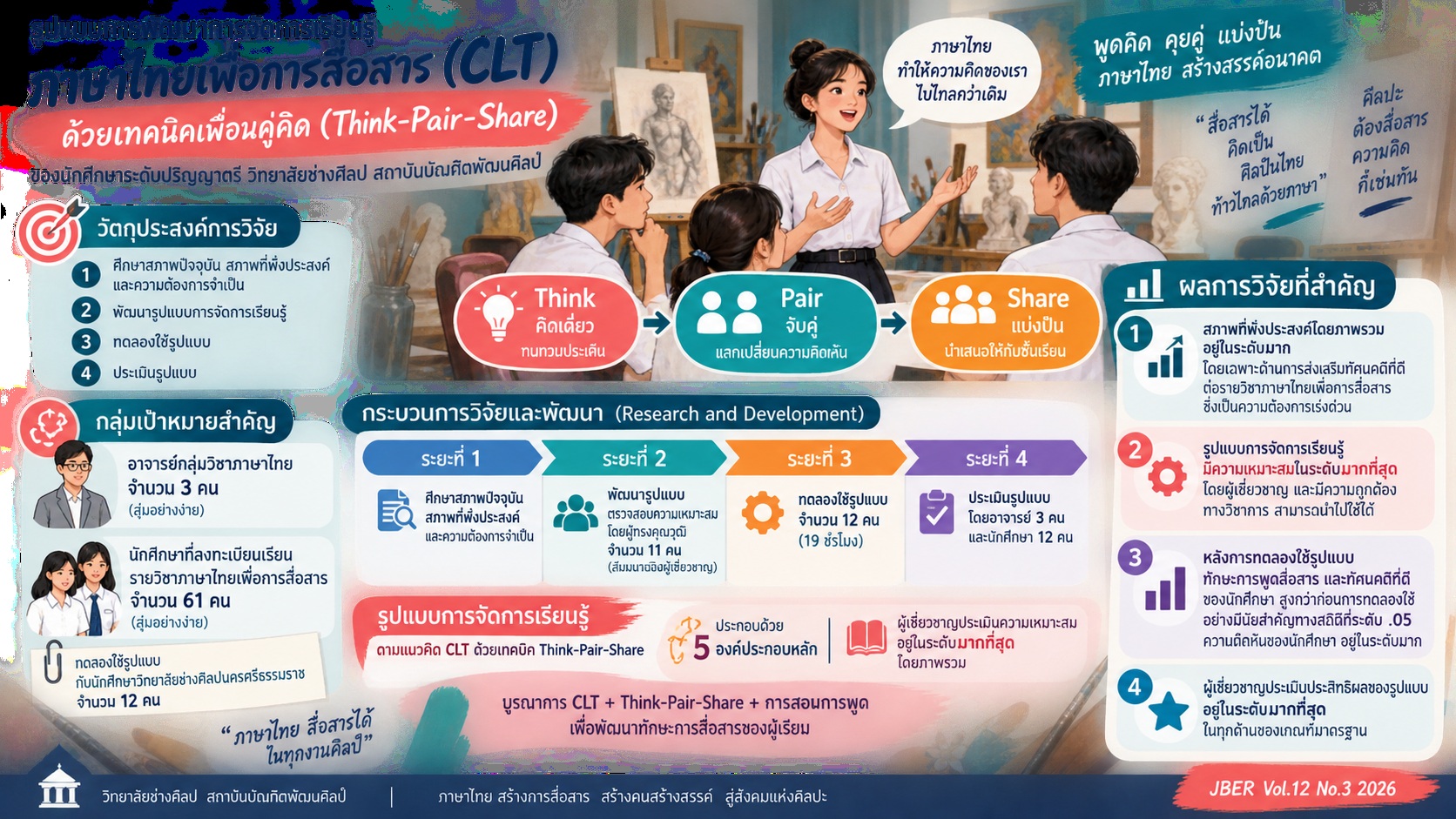
The purposes of this research were: (1) to investigate the current conditions, desired conditions, and essential needs for model development; (2) to develop the model; (3) to implement the model; and (4) to evaluate the model for developing Thai language instructional management for communication (CLT) using the Think-Pair-Share technique among undergraduate students at the College of Fine Arts, Bunditpatanasilpa Institute. The study employed a Research and Development (R&D) methodology consisting of four phases: (1) analysis of current conditions, desired conditions, and essential needs; (2) model development; (3) model implementation; and (4) model evaluation.
The target groups for Phase 1 were: (1) three Thai language instructors at the College of Fine Arts, Bunditpatanasilpa Institute, selected through simple random sampling; and (2) sixty-one students enrolled in Thai for Communication in the first semester of the 2025 academic year, also selected through simple random sampling. The target group for Phase 2 consisted of eleven experts who assessed the appropriateness of the model through a connoisseurship seminar. The target group for Phase 3 included twelve students enrolled in Thai for Communication in the first semester of the 2025 academic year at Nakhon Si Thammarat College of Fine Arts. The target group for Phase 4 included: (1) three Thai language instructors at the College of Fine Arts, Bunditpatanasilpa Institute; and (2) twelve students enrolled in Thai for Communication in the first semester of the 2025 academic year at Nakhon Si Thammarat College of Fine Arts.
The research instruments included a questionnaire on current conditions, desired conditions, and essential needs for model development; a focus group discussion record; a model evaluation form; a communicative speaking skills test; a behavioral assessment of attitudes toward the Thai for Communication course; and a questionnaire on opinions regarding the model. The instructional management model was implemented over 19 hours. The data were analyzed using mean, standard deviation, Priority Needs Index (PNI), t-test, and content analysis.
The research findings revealed the following:
- The desired conditions of instructional management to promote communicative speaking skills and positive attitudes toward the Thai Language for Communication course were at a high level overall, particularly in enhancing students’ attitudes toward the course. This indicates an urgent need to develop instructional management to strengthen students’ positive attitudes toward the Thai language.
- The instructional model based on the CLT approach using the Think-Pair-Share technique consisted of five key components. Expert evaluations indicated that the model’s overall appropriateness was at the highest level, confirming that integrating CLT with the Think-Pair-Share technique for teaching speaking to enhance communication skills is academically valid and feasible for practical implementation.
- After implementing the model, students’ communicative speaking skills and attitudes toward the Thai Language for Communication course were significantly higher than before implementation at the .05 level. This confirms the model’s effectiveness in developing both cognitive and affective aspects of learners. Students’ overall opinions toward the instructional model were at a high level.
- Expert evaluation indicated that the instructional model’s overall effectiveness met the highest level in all criteria, demonstrating its quality and completeness as an innovative instructional framework suitable for undergraduate students at the College of Fine Arts, Bunditpatanasilpa Institute.
References
ชัยวัฒน์ สุทธิรัตน์. (2555). 80 นวัตกรรมการจัดการเรียนรู้ที่เน้นผู้เรียนเป็นสําคัญ.อินเตอร์คอร์ปอเรชัน.
ณัฏฐ์วัฒน์ อนันตะสุข. (2565). การพัฒนารูปแบบการเรียนการสอนโดยใช้บริบทเป็นฐานร่วมกับระบบ สารสนเทศภูมิศาสตร์ เพื่อส่งเสริมความสามารถในการแก้ปัญหาอย่างสร้างสรรค์ สําหรับนักเรียน ระดับชั้นมัธยมศึกษาตอนปลาย[วิทยานิพนธ์การศึกษาดุษฎีบัณฑิต สาขาวิชาหลักสูตรและการสอน, มหาวิทยาลัยนเรศวร].
ทิศนา แขมณี. (2566). ศาสตร์การสอน: องค์ความรู้เพื่อการจัดกระบวนการเรียนรู้ที่มีประสิทธิภาพ(พิมพ์ครั้ง ที่ 26). สํานักพิมพ์แห่งจุฬาลงกรณ์มหาวิทยาลัย.
ธราธิคุณ ระหา. (2566). การพัฒนารูปแบบการจัดการเรียนรู้ที่ส่งเสริมสมรรถนะภาษาไทยของนักเรียนชั้น ประถมศึกษาปีที่ 6[วิทยานิพนธ์ปรัชญาดุษฎีบัณฑิต สาขาวิชาหลักสูตรและการสอน, มหาวิทยาลัย มหาสารคาม].
พิชัย ศรีภูไพ. (2542). วรรณคดี สังคม และการเมือง.สถาบันราชภัฏอุบลราชธานี.
วรัญญา เสนสม. (2563). การพัฒนารูปแบบการจัดการเรียนรู้เชิงรุกโดยใช้สื่อมัลติมีเดียเรื่องประโยคเพื่อการ สื่อสาร วิชาภาษาไทย สําหรับนักเรียนชั้นประถมศึกษาปีที่ 1[วิทยานิพนธ์การศึกษามหาบัณฑิต สาขาวิชาเทคโนโลยีการศึกษา, มหาวิทยาลัยนเรศวร].
สุวิทย์ มูลคํา. (2553). วิธีการจัดการเรียนรู้เพื่อพัฒนาความรู้และทักษะ(พิมพ์ครั้งที่ 9). ภาพพิมพ์.
Downloads
Published
How to Cite
Issue
Section
Categories
License
Copyright (c) 2026 Journal of Buddhist Education and Research (JBER)

This work is licensed under a Creative Commons Attribution-NonCommercial-NoDerivatives 4.0 International License.