Guidelines for Application Artificial Intelligence (AI) in Learning Management in Schools under the Sukhothai Primary Educational Service Area Office 2
Keywords:
Learning Management, Artificial Intelligence (AI), Educational AdministrationAbstract
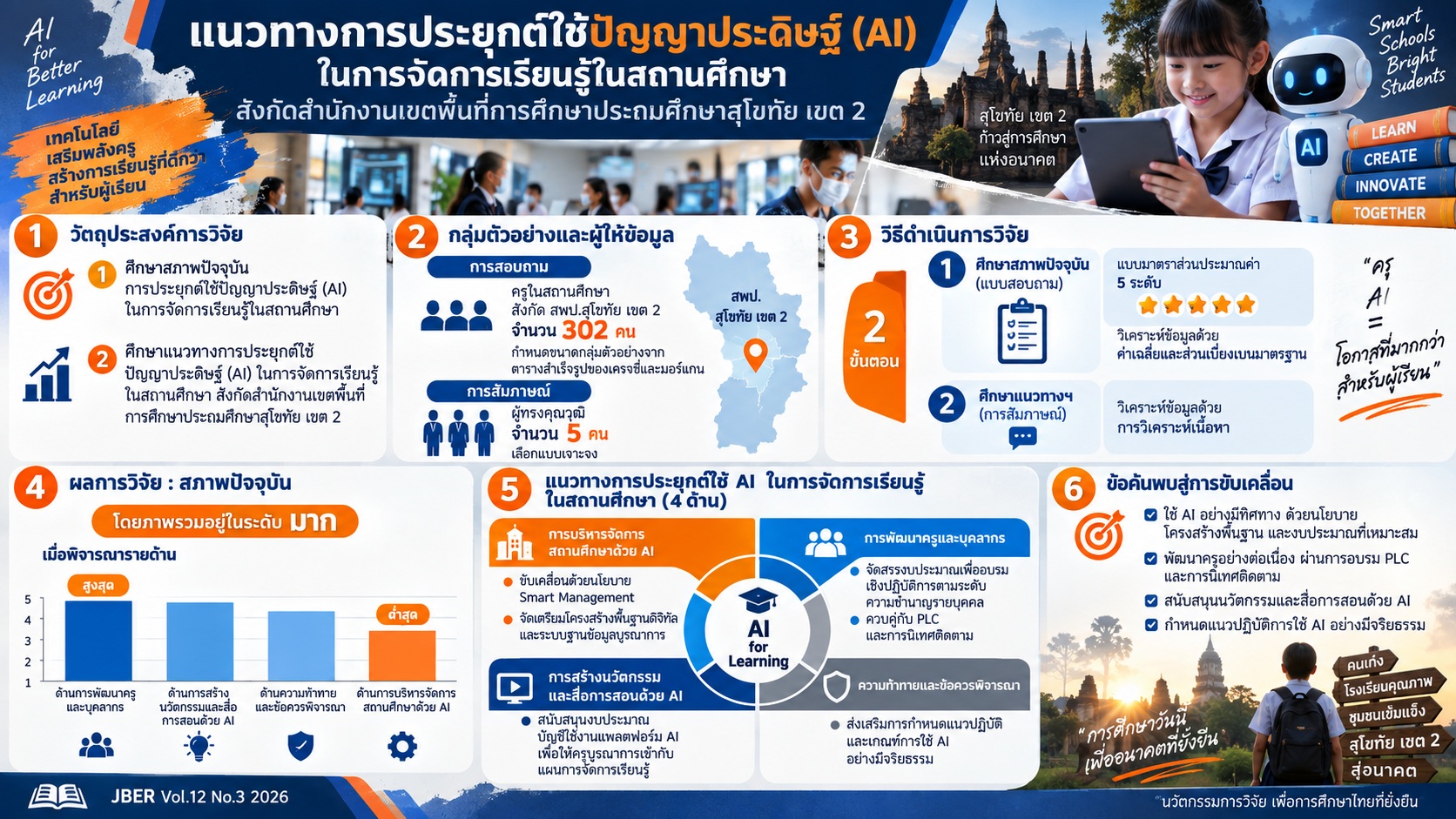
The purposes of this research were: 1) to study the current state of applying Artificial Intelligence (AI) in learning management, and 2) to establish guidelines for applying AI in learning management in schools under the Sukhothai Primary Educational Service Area Office 2. The research was conducted in two phases. Phase 1 involved studying the current state of AI application in schools. The sample consisted of 302 teachers under the Sukhothai Primary Educational Service Area Office 2, with the sample size determined by Krejcie & Morgan’s table. The research instrument was a 5-point Likert scale questionnaire, and data were analyzed using mean and standard deviation. Phase 2 focused on establishing guidelines for AI application through interviews with 5 experts selected via purposive sampling, and the data were analyzed using content analysis. The results revealed that: 1) The overall current state of applying AI in learning management in schools under the Sukhothai Primary Educational Service Area Office 2 was at a high level. When considering individual aspects, the highest mean was found in Teacher and Personnel Development, while the lowest mean was in School Management through AI. 2) The guidelines for applying AI in learning management across four aspects indicated that: School Management should be driven by "Smart Management" policies through the provision of digital infrastructure and integrated database systems to connect all data dimensions; Teacher and Personnel Development should focus on budget allocation for practical workshops tailored to individual skill levels, combined with Professional Learning Communities (PLC) and systematic supervision; Innovation and Instructional Media should be supported by providing budgets for AI platform accounts, enabling teachers to integrate AI into lesson plans; and Challenges and Considerations should be addressed by promoting correct understanding through established guidelines and ethical AI usage standards.
References
กระทรวงการอุดมศึกษา วิทยาศาสตร์ วิจัย และนวัตกรรม, และ กระทรวงดิจิทัลเพื่อเศรษฐกิจ และสังคม. (2566). รายงานประจำปี พ.ศ. 2566 แผนปฏิบัติการด้านปัญญาประดิษฐ์แห่งชาติเพื่อการพัฒนาประเทศไทย (พ.ศ. 2565 - 2570).
กฤษฎิ์พนธ์ พรรณรัตนชัย, วรชัย ศรีสมุดคำ, มงคล ศิริวงศ์ และ เทิดพงษ์ แดงสี. (2567). ประเด็นปัญหาการใช้ปัญญาประดิษฐ์ในภาคการศึกษา. วารสารวิทยาศาสตร์และเทคโนโลยี มหาวิทยาลัยเอเชียอาคเนย์, 4(2).
แคทรียา แสงใส. (2566). ปัญญาประดิษฐ์กับการพัฒนาทางการศึกษา. วารสารปัญญาพัฒน์, 1(3), 49-60.
จิรกร ฐาวิรัตน์. (2568). AI กับการศึกษา: ตัวช่วยสุดอัจฉริยะ เพื่อพัฒนาการเรียนรู้. วารสารสังคมศึกษาปริทรรศน์, 1(2), 98–108.
ทัตพงศ์ พานทองคำ และ ทิพรัตน์ สิทธิวงศ์. (2568). แนวทางการบริหารทรัพยากรทางการศึกษา เพื่อส่งเสริมระบบนิเวศการเรียนรู้ยุคปัญญาประดิษฐ์ของสถานศึกษา สังกัดสำนักงานเขตพื้นที่การศึกษามัธยมศึกษาเลย หนองบัวลำภู. วารสารสังคมศาสตร์ปัญญาพัฒน์, 7(2), 135-148.
นพฤทธิ์ ยิ้มนรินทร์. (2567). ระดับและแนวทางการส่งเสริมครูด้านปัญญาประดิษฐ์แบบรู้สร้างในการจัดการเรียนรู้ดิจิทัลของครูในสถานศึกษา สังกัดสำนักงานเขตพื้นที่การศึกษาประถมศึกษาสุโขทัย เขต 2 (วิทยานิพนธ์ปริญญามหาบัณฑิต). มหาวิทยาลัยนเรศวร.
นฤภัค สันป่าแก้ว. (2566). แนวทางการส่งเสริมครูในการจัดการเรียนรู้ในยุค AI. วารสารวิจัยนวัตกรรมการศึกษาและเทคโนโลยี, 1(2), 44–50. คณะครุศาสตร์ มหาวิทยาลัยมหาจุฬาลงกรณราชวิทยาลัย.
นำพล ม่วงอวยพร. (2566). บทบาทของครูในยุค AI. สืบค้นจาก https://shorturl.asia/JDG9X
บุญชม ศรีสะอาด. (2560). การวิจัยเบื้องต้น (พิมพ์ครั้งที่ 10). สุวีริยาสาส์น.
พิชญาภา ศิริรัตน์. (2566). เปิด 5 มิติ นวัตกรรมที่ใช้ AI ลดความเหลื่อมล้ำทางสังคม. สืบค้นจาก https://www.nia.or.th/5-dimensions-of-ai-innovation-reduce-social-inequality
รังสิยา นรินทร์. (2562). การพัฒนารูปแบบการจัดการเรียนรู้แบบห้องเรียนกลับด้านโดยการใช้ กิจกรรมเป็น ฐานในการเรียนรู้เพื่อเสริมสร้างความมุ่งมั่นแน่วแน่ของนักเรียน ระดับ มัธยมศึกษาตอนปลาย. วารสารศึกษาศาสตร์, 19(1), 57–79.
สว่างนภา ต่วนภูษา. (2567). ปัญญาประดิษฐ์เพื่อการบริหารการศึกษายุคดิจิทัล. วารสารการบริหาร การศึกษาและมนุษยสังคมศาสตร์, 2(3).
สำนักงานเลขาธิการสภาการศึกษา. (2563). AI เพื่อพัฒนาการเรียนรู้. กรุงเทพฯ: บริษัท พริกหวาน กราฟฟิค จำกัด.
สิริน ฉกามานนท์. (2568). แนวทางการยกระดับความฉลาดรู้ทางปัญญาประดิษฐ์ของครูไทยในยุค ดิจิทัล. Journal of Education and Innovation, 27(1), 184-199.
Ge, Z., & Hu, Y. (2020). Innovative Application of Artificial Intelligence (AI) in the Management of Higher Education and Teaching. Journal of Physics: Conference Series, 1533(3), 032089.
Karan, B., & Angadi, G. R. (2023). Artificial Intelligence Integration into School Education: A Review of Indian and Foreign Perspectives. Millennial Asia, 09763996231158229.
Ming Liu, Yiling Ren, Lucy Michael Nyagoga, Francis Stonier, Zhongming Wu, & Liang Yu. (2023). Future of education in the era of generative artificial intelligence: Consensus among Chinese scholars on applications of ChatGPT in schools. Future in Educational Research, 1(1), 72–101.
Sain, ZH, Sain, SH และ Serban, R. (2024). การนำปัญญาประดิษฐ์มาใช้ในระบบการจัดการ การศึกษา: การศึกษาโอกาสและความท้าทายอย่างครอบคลุม Asian Journal of Managerial Science ,13 (1), 23–31. https://doi.org/10.70112/ajms-2024.13.1.4235
Zheng, Y., Song, Y., Liu, X., & Wang, H. (2022). The six fundamental domains of AI applications. Retrieved from https://www.researchgate.net
Downloads
Published
How to Cite
Issue
Section
Categories
License
Copyright (c) 2026 Journal of Buddhist Education and Research (JBER)

This work is licensed under a Creative Commons Attribution-NonCommercial-NoDerivatives 4.0 International License.