Effectiveness of an E-Cigarette Prevention Program for University Students: A Protection Motivation Theory Approach
Keywords:
E-cigarette, Protection Motivation Theory, Prevention Behavior, Health Promotion Program, University StudentsAbstract
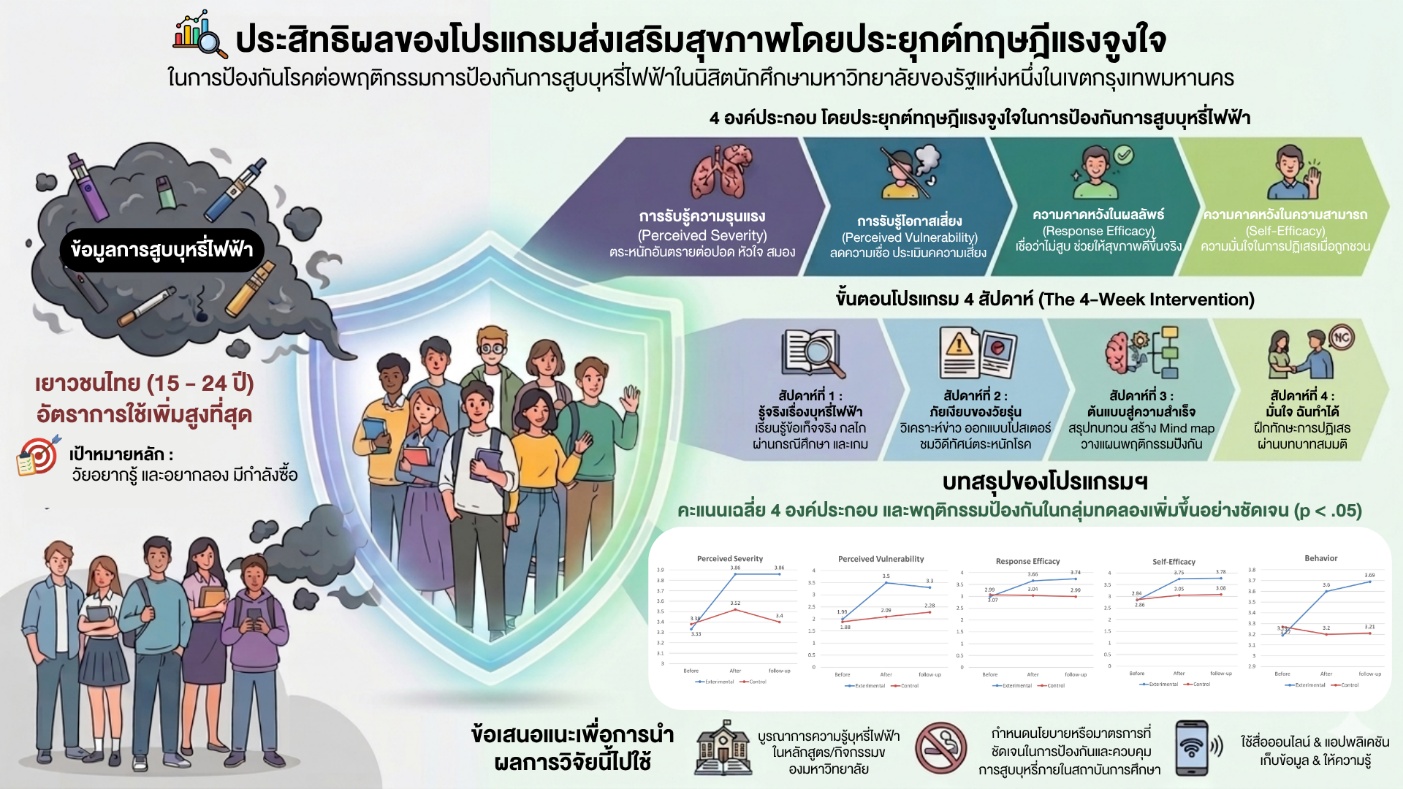
This experimental research aimed to examine the effectiveness of a health promotion program applying Protection Motivation Theory on e-cigarette smoking prevention behaviors among undergraduate students at a public university in Bangkok, Thailand. The participants were undergraduate students enrolled in the 2025 academic year, selected through a multistage probability sampling method. The sample was divided into an experimental group of 51 students from the Faculty of Education, Kasetsart University, Bangkhen Campus, and a control group of 51 students from the Faculty of Veterinary Technology. The experimental group participated in the health promotion program for four weeks, with one 60-minute session per week, followed by a follow-up assessment. The control group studied independently from an informational leaflet about e-cigarettes for four weeks with follow-up. Data collection instruments included a general information questionnaire, a perception questionnaire regarding e-cigarettes, and an e-cigarette prevention behavior assessment. Data were analyzed using percentage, mean, standard deviation, independent-samples t-test, repeated measures one-way ANOVA, and Bonferroni post hoc test. The results revealed that after participating in the program, the experimental group had significantly higher mean scores in all four components and in e-cigarette prevention behaviors compared with both their pre-intervention scores and the control group at a statistical significance level of .05. These findings indicate that the health promotion program based on Protection Motivation Theory was effective in enhancing e-cigarette smoking prevention behaviors among undergraduate students.
References
Al-Sawalha, N. A., Almomani, B. A., Mokhemer, E., Al-Shatnawi, S. F., & Bdeir, R. (2021). E-cigarettes use among university students in Jordan: Perception and related knowledge. PLOS ONE, 16(12), e0262090. https://doi.org/10.1371/journal.pone.0262090
Babjaková, J., Rimárová, K., Weitzman, M., Bušová, M., Jurkovičová, J., Dorko, E., & Argalášová, Ľ. (2022). E-cigarette use, opinion about harmfulness and addiction among university students in Bratislava, Slovakia [journal article]. Central European Journal of Public Health, 30(88), S50-S56. https://cejph.szu.cz/artkey/cjp-202288-0009.php http://dx.doi.org/10.21101/cejph.a7240
Chen, Y., Lin, S., Lin, H., Wang, Z., Zhao, X., Ao, P., Cai, Y., Xu, J., Yu, X., Yang, X., & Chan, K. S. (2025). Strengthening the cognition of university students to refuse e-cigarette use: A pilot randomized controlled trial of a peer-to-peer intervention. Tob Induc Dis, 23. https://doi.org/10.18332/tid/208715
Didarloo, A., Sharafkhani, N., Rezapour, B., & Moghaddam-Tabrizi, F. (2023). Predictors of Smoking Preventive Behavior Based on Empowerment Components among Male Students of High Schools: A Cross-Sectional Study in Iran. https://pubmed.ncbi.nlm.nih.gov/36761237/
Floyd, D. L., Prentice-Dunn, S., & Rogers, R. W. (2000). A meta-analysis of research on protection motivation theory. Journal of Applied Social Psychology, 30(2), 407–429. https://doi.org/10.1111/j.1559-1816.2000.tb02323.x
Ghanim, M., Rabayaa, M., Abuawad, M., Saeedi, M., & Amer, J. (2024). E-cigarette use among university students in Palestine: Prevalence, knowledge, and determinant factors. PLOS ONE, 19(5), e0302946. https://doi.org/10.1371/journal.pone.0302946
Hosseini, Z., Mouseli, A., Aghamolaei, T., Mohseni, S., Shahini, S., & Dadipoor, S. (2023). Predictors of adopting smoking preventive behaviors by university students: the extended parallel process model fitness test. Journal of Substance Use, 28(6), 968-975. https://doi.org/10.1080/14659891.2022.2120423
Kowitt, S. D., Osman, A., Ranney, L. M., Heck, C., & Goldstein, A. O. (2018). E-Cigarette Use Among Adolescents Not Susceptible to Using Cigarettes. Prev Chronic Dis, 15, E18. https://doi.org/10.5888/pcd15.170368
Kurdi, R., Al-Jayyousi, G. F., Yaseen, M., Ali, A., Mosleh, N., & Abdul Rahim, H. F. (2021). Prevalence, Risk Factors, Harm Perception, and Attitudes Toward E-cigarette Use Among University Students in Qatar: A Cross-Sectional Study [Original Research]. Frontiers in Public Health, Volume 9 - 2021. https://doi.org/10.3389/fpubh.2021.682355
Le, H. T. T., Tran, A. T. V., Nguyen, A. Q., & Tran, T. T. T. (2022). E-Cigarette Use among University Students from One University in Hanoi, Vietnam, and Associated Factors. Asian Pacific Journal of Cancer Prevention, 23(11), 3649-3655. https://doi.org/10.31557/apjcp.2022.23.11.3649
MILNE, S., SHEERAN, P., & ORBELL, S. (2000). Prediction and Intervention in Health-Related Behavior: A Meta-Analytic Review of Protection Motivation Theory. Journal of Applied Social Psychology, 30(1), 106-143. https://doi.org/https://doi.org/10.1111/j.1559-1816.2000.tb02308.x
Mowreader, A. (2023). How Colleges Are Discouraging Vaping Among Students. Retrieved from https://www.insidehighered.com/news/student-success/health-wellness/2023/07/28/e-cigarette-vaping-prevention-strategies-college
Nazzal, Z., Maraqa, B., Azizeh, R., Darawsha, B., AbuAlrub, I., Hmeidat, M., & Al-Jabari, F. (2024). Exploring the prevalence, knowledge, attitudes and influencing factors of e-cigarette use among university students in Palestine: a cross-sectional study. BMJ Open, 14(2), e080881. https://doi.org/10.1136/bmjopen-2023-080881
Panahi, R., Ramezankhani, A., Tavousi, M., Osmani, F., & Niknami, S. (2017). Predictors of Adoption of Smoking Preventive Behaviors among University Students: Application of Health Belief Model. Journal of Education and Community Health, 4(1), 35-42. https://doi.org/https://doi.org/10.18869/acadpub.jech.4.1.35
Patanavanich, R., Aekplakorn, W., Glantz, S. A., & Kalayasiri, R. (2021). Use of E-Cigarettes and Associated Factors among Youth in Thailand. Asian Pac J Cancer Prev, 22(7), 2199-2207. https://doi.org/10.31557/apjcp.2021.22.7.2199
Rogers, R. W. (1983). Cognitive and Physiological Processes in Fear Appeals and Attitude Change: A Revised Theory of Protection Motivation. In: Cacioppo, J. and Petty, R. Eds., Social Psychophysiology, Guilford Press, New York, 153-177.
Rogers, R. W., & Mewborn, C. R. (1976). Fear appeals and attitude change: Effects of a threat's noxiousness, probability of occurrence, and the efficacy of coping responses. Journal of Personality and Social Psychology, 34(1), 54-61. https://doi.org/https://doi.org/10.1037/0022-3514.34.1.54
Salmani, B., & Prapavessis, H. (2023). Using a protection motivation theory framework to reduce vaping intention and behaviour in Canadian university students who regularely vape: A randomized controlled trial. Journal of Health Psychology, 28(9), 832-845. https://doi.org/10.1177/13591053221144977
Song, H., Yang, X., Yang, W., Dai, Y., Duan, K., Jiang, X., Huang, G., Li, M., Zhong, G., Liu, P., & Chen, J. (2023). Cigarettes smoking and e-cigarettes using among university students: a cross-section survey in Guangzhou, China, 2021. BMC Public Health, 23(1), 438. https://doi.org/10.1186/s12889-023-15350-2
World Health Organization. (2019). Who Report on The Global Tobacco Epidemic 2021 : addressing new and emerging products. Retrieved from https://iris.who.int/server/api/core/bitstreams/d6747635-8c77-431e-9554-b3a2cd4d21a1/content
กมลภู ถนอมสัตย์, พนิตนันท์ แซ่ลิ้ม และพุทธพร อ่อนคำสี. (2567). ปัจจัยที่สัมพันธ์กับพฤติกรรมการใช้บุหรี่ไฟฟ้าของนักศึกษามหาวิทยาลัยราชภัฏนครปฐม. วารสารพยาบาลตำรวจและวิทยาศาสตร์สุขภาพ, 16(1), 81-90.
กองงานคณะกรรมการควบคุมผลิตภัณฑ์ยาสูบ กรมควบคุมโรค. (2567). ข้อมูลวิชาการเกี่ยวกับบุหรี่ไฟฟ้า. สืบค้นจาก https://ddc.moph.go.th/otpc/journal_detail.php?publish=15890&deptcode=otpc
กัญญภัค สุวรรณศรี. (2566). ผลโปรแกรมสุขศึกษา เพื่อปรับเปลี่ยนพฤติกรรมในการเลิกสูบบุหรี่ของผู้ที่สูบบุหรี่ เขตโรงพยาบาลส่งเสริมสุขภาพตำบลหนองบัว อำเภอเมือง จังหวัดอุดรธานี. วารสารสิ่งแวดล้อมศึกษาการแพทย์และสุขภาพ, 8(2), 89–100. https://so06.tci-thaijo.org/index.php/hej/article/view/264176
กิติพงษ์ เรือนเพ็ชร. (2564). ปัจจัยที่มีความสัมพันธ์กับการสูบบุหรี่ไฟฟ้าของนักเรียนชายอาชีวศึกษา จังหวัดบุรีรัมย์ [พยาบาลศาสตรมหาบัณฑิต, มหาวิทยาลัยบูรพา]. Burapha University Research Information. https://buuir.buu.ac.th/handle/1234567890/10092
จตุพร เฉลิมเรืองรอง. (2561). ผลของโปรแกรมการสร้างแรงจูงใจในการป้องกันโรคไม่ติดต่อ ต่อการเลิกบุหรี่ในข้าราชการทหารอากาศ. Chulalongkorn University Theses and Dissertations (Chula ETD). 3097. https://digital.car.chula.ac.th/chulaetd/3097
จินดาพร จันเทศ. (2565). ประสิทธิผลของโปรแกรมการประยุกต์ใช้ทฤษฎีแรงจูงใจเพื่อป้องกันโรค ต่อพฤติกรรมการป้องกันโรคไข้เลือดออกของนักเรียนชั้นประถมศึกษาตอนปลาย อำเภอเมือง จังหวัดพิจิตร [วิทยานิพนธ์ปริญญามหาบัณฑิต], มหาวิทยาลัยนเรศวร. NU Intellectual Repository
จีรภัทร์ รัตนชมภู. (2565). รูปแบบการป้องกันการใช้บุหรี่ไฟฟ้ารายใหม่ของนักศึกษาอาชีวศึกษาภาคเหนือตอนบนของประเทศไทย. [สาธารณสุขศาสตรดุษฎีบัณฑิต, มหาวิทยาลัยนเรศวร]. NU Intellectual Repository. http://nuir.lib.nu.ac.th/dspace/handle/123456789/5857
จุไรรัตน์ ช่วงไชยยะ. (2564). ผลของโปรแกรมป้องกันการสูบบุหรี่ร่วมกับการใช้ Facebook ในนักเรียนมัธยมศึกษาปีที่ 2 อำเภอเมือง จังหวัดประจวบคีรีขันธ์ [วิทยานิพนธ์ปริญญาโท,มหาวิทยาลัยมหิดล].
ฐิติภัทร จันเกษม และเกรียงกมล เหมือนกรุด. (2562). ปัจจัยทำนายพฤติกรรมการป้องกันการสูบบุหรี่ของนักเรียนระดับมัธยมศึกษา โรงเรียนบ้านไร่วิทยา จังหวัดอุทัยธานี. วารสารโรคและภัยสุขภาพ สำนักงานป้องกันควบคุมโรคที่ 3 จังหวัดนครสวรรค์, 13(2), 1-13.
ธนะวัฒน์ รวมสุก, สุรินธร กลัมพากร และทัศนีย์ รวิวรกุล. (2561). ผลของโปรแกรมเลิกบุหรี่โดยประยุกต์ใช้ทฤษฎีแรงจูงใจเพื่อป้องกันโรคในผู้ป่วยโรคความดันโลหิตสูง. วารสารพยาบาล, 67(1), 1-10.
ธิติรัตน์ ราศิริ. (2565). ปัจจัยทำนายพฤติกรรมการใช้บุหรี่ไฟฟ้าของนักศึกษาระดับอุดมศึกษาในเขตจังหวัดพิษณุโลก. วารสารควบคุมโรค, 48(1), 132-142.
ธีรพล ผังดี และอดิศร ปล้องใหม่. (2567). การพัฒนานวัตกรรมการเรียนรู้ผ่านเว็บไซต์ ร่วมกับการประยุกต์ใช้กลวิธีทางสุขศึกษาเพื่อส่งเสริมการป้องกัน การติดเชื้อโควิด 19 ของนิสิตมหาวิทยาลัย. สืบค้นจาก from https://he01.tci-thaijo.org/index.php/JHR/article/view/268470
บุญชรัสมิ์ ธันย์ธิติธนากุล, และชไมพร จั่นจุ้ย. (2568). ความเชื่อด้านสุขภาพและพฤติกรรมป้องกันการใช้บุหรี่ไฟฟ้า ของนักศึกษามหาวิทยาลัยเอกชนไทยในยุคดิจิทัล. วารสารพยาบาลทหารบก, 26(1), 421-429.
บุษกร วราอัศวปติ. (2565). ประสิทธิผลของโปรแกรมการประยุกต์ใช้ทฤษฎีแรงจูงใจเพื่อป้องกันโรคในการส่งเสริมพฤติกรรมการเข้ารับบริการทันตกรรมของหญิงตั้งครรภ์ชนเผ่าม้ง อำเภอเขาค้อ จังหวัดเพชรบูรณ์ [วิทยานิพนธ์ปริญญามหาบัณฑิต], มหาวิทยาลัยนเรศวร. NU Intellectual Repository
ปัญย์ณภัทร ศรีวิสรณ์. (2566). ปัจจัยที่มีอิทธิพลต่อพฤติกรรมการป้องกันการสูบบุหรี่ของนักเรียนชาย ระดับมัธยมศึกษาตอนปลายของจังหวัดหนึ่งในภาคเหนือตอนล่าตอนล่าง. [สาธารณสุขศาสตรมหาบัณฑิต, มหาวิทยาลัยนเรศวร]. NU Intellectual Repository. http://nuir.lib.nu.ac.th/dspace/handle/123456789/6135
ปิยะวดี พุฒไทย. (2566). ผลของโปรแกรมที่ประยุกต์ทฤษฎีพฤติกรรมตามแผนต่อการป้องกันการสูบบุหรี่ไฟฟ้าในนักเรียนชั้นประถมศึกษาตอนปลาย อำเภอโป่งน้ำร้อน จังหวัดจันทบุรี. วารสารพยาบาล, 74(1), 20-30.
ปิยวรรณ บุญเพ็ญ, ภาวนา เมนทะระ และปิยชาติ บุญเพ็ญ. (2562). พฤติกรรมการสูบบุหรี่ไฟฟ้าและพฤติกรรมต้องการเลิกบุหรี่ของนักศึกษาระดับอุดมศึกษาในเขตกรุงเทพมหานคร. วารสารศรีนครินทรวิโรฒวิจัยและพัฒนา (สาขามนุษยศาสตร์และสังคมศาสตร์), 11(22), 111-127.
ประภาพร ไวยวงษ์. (2567). ปัจจัยพยากรณ์พฤติกรรมการป้องกันการสูบบุหรี่ของนักเรียนระดับมัธยมศึกษา จังหวัดกำแพงเพชร. สืบค้นจาก https://mis.kpo.go.th/tobekpp/index.php?goto=innovation
ภัทรินทร์ ศิริทรากุล. (2567). ปัจจัยที่ส่งผลต่อพฤติกรรมการป้องกันการสูบบุหรี่ของนักเรียนมัธยมศึกษาตอนปลาย จังหวัดพิษณุโลก. วารสารวิชาการป้องกันควบคุมโรค สคร.2 พิษณุโลก, 11(1), 89-106.
วิกานต์ดา โหม่งมาตย์. (2561). ปัจจัยที่ส่งผลต่อพฤติกรรมการป้องกันการสูบบุหรี่ของนักเรียนชาย ชั้นประถมศึกษาตอนปลาย อำเภอเมือง จังหวัดนครปฐม. [ศิลปศาสตรมหาบัณฑิต, มหาวิทยาลัยศิลปากร]. DSpace JSPUI. http://ithesis-ir.su.ac.th/dspace/handle/123456789/2253
พัชรินทร์ ยุพา, ธวัชชัย เอกสันติ, ศิริลักษณ์ เพียรธัญญะ, ศุภรัตน์ คงรอด, สิริยากร พันจันทึก และสุกัญญา ผลพิมาย. (2567). ปัจจัยที่มีความสัมพันธ์กับการสูบบุหรี่ไฟฟ้าของนักศึกษาระดับมหาวิทยาลัย จังหวัดนครราชสีมา. วารสารสหเวชศาสตร์ มหาวิทยาลัยราชภัฏสวนสุนันทา, 9(2), 51-69.
วนิดา ลาภโชค, นภาเพ็ญ จันทขัมมา และองค์อร ประจันเขตต์. (2567). ผลของโปรแกรมเสริมสร้างแรงจูงใจต่อการเลิกบุหรี่ของทหารกองประจำการ ค่ายศรีพัชรินทร จังหวัดขอนแก่น. วารสารสำนักงานป้องกันควบคุมโรคที่ 7 ขอนแก่น, 3(2), 45-56.
วลัยพร สิงห์จุ้ย, วันเพ็ญ แก้วปาน และอาภาพร เผ่าวัฒนา. (2556). ประสิทธิผลของโปรแกรมการประยุกต์ทฤษฎีแรงจูงใจในการป้องกันโรค ต่อพฤติกรรมการป้องกันวัณโรคปอดของผู้ดูแล. วารสารพยาบาลสาธารณสุข, 27(3), 14-26.
สำนักงานสถิติ. (2567). การสำรวจสถานการณ์การสูบบุหรี่ และการดื่มเครื่องดื่มที่มีแอลกอฮอล์ของประชากร พ.ศ. 2567. https://share.google/aC18BEaJZ95gQI7PT
อุทัยวรรณ พงษ์บริบูรณ์, พัชรินทร์ อัจนากิตติ และรัชยา รัตนะถาวร. (2566). การพัฒนาและประเมินผลโปรแกรมการป้องกันการใช้ผลิตภัณฑ์บุหรี่ไฟฟ้าในสังคมออนไลน์ของนักศึกษามหาวิทยาลัยเอกชนในจังหวัดปทุมธานี. วารสารพยาบาลทหารบก, 24(2), 269-278.
Downloads
Published
How to Cite
Issue
Section
Categories
License
Copyright (c) 2026 Journal of Buddhist Education and Research (JBER)

This work is licensed under a Creative Commons Attribution-NonCommercial-NoDerivatives 4.0 International License.