A Promotion Model for Thai Traditional Medicine Practice among People with Visual Impairment
Keywords:
Thai Traditional Medicine, Visually Impaired Persons, Professional Advancement, The UBEST Approach, Social Enterprise, Universal Design for Learning (UDL)Abstract
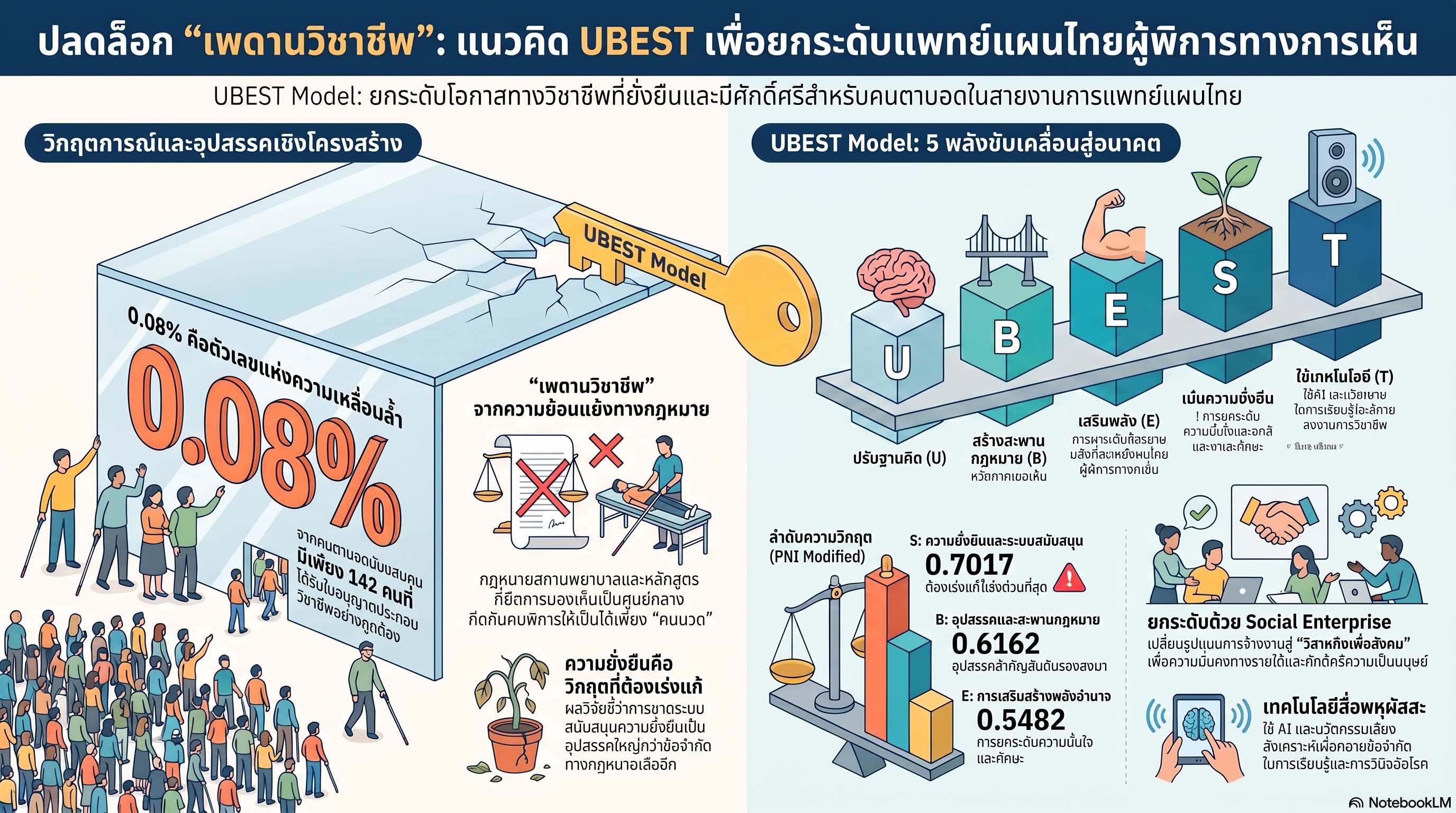
This research and development (R&D) study aimed to: 1) investigate structural and systemic impediments within legal frameworks and curricula; 2) assess priority needs for professional advancement; and 3) develop and validate the UBEST Approach as a strategic framework to elevate Thai Traditional Medicine (TTM) professionalism among visually impaired persons. The study employed an exploratory sequential mixed-methods design, integrated with the Design Thinking process. The research was conducted in three phases: Phase I involved qualitative inquiries with 20 key informants; Phase II consisted of a quantitative survey with 322 working-age visually impaired individuals, analyzed using the Modified Priority Needs Index (PNI modified}); and Phase III involved validation of the approach by 15 senior experts. The findings revealed that: 1) structural barriers are rooted in the legal incongruity between the Sanatorium Act and the Professional Acts, compounded by vision-centric TTM curricula; 2) the needs assessment indicated that Sustainability and Systemic Support (S) represented the highest priority gap (PNI modified = 0.7017), followed by Legal Barriers (B) (PNI modified = 0.6162), refuting the conventional premise that legal constraints are the sole primary obstacle; 3) the UBEST Approach integrates five critical dimensions: Understanding, Barriers & Bridges, Empowerment, Sustainability, and Technology. The approach was validated with the highest level of appropriateness and feasibility (\bar{X} = 4.64). The UBEST Approach serves as a transformative policy innovation, facilitating a transition for visually impaired persons toward substantive freedom, professional dignity, and sustainable autonomy.
References
กรมส่งเสริมและพัฒนาคุณภาพชีวิตคนพิการ. (2569). ระบบสารสนเทศสถานการณ์คนพิการ ณ 28 กุมภาพันธ์ 2569. https://www.dep.go.th/
ขวัญชัย อัตโณ. (2563). การประกอบอาชีพนวดไทยของผู้พิการทางการเห็น: กรณีศึกษากฎกระทรวงการขึ้นทะเบียนเป็นผู้ให้บริการในสถานประกอบการเพื่อสุขภาพ พ.ศ. 2560. วารสารการบริหารปกครอง, 9(2), 212–243.
สโรชา กิตติสิริพันธุ์. (2563). ประสบการณ์ภายในจิตใจของพนักงานตาบอดที่ทำงานในองค์กร [วิทยานิพนธ์มหาบัณฑิต, จุฬาลงกรณ์มหาวิทยาลัย].
Oliver, M. (1990). The politics of disablement. Macmillan.
Sen, A. (1999). Development as freedom. Oxford University Press.
Downloads
Published
How to Cite
Issue
Section
Categories
License
Copyright (c) 2026 Journal of Buddhist Education and Research (JBER)

This work is licensed under a Creative Commons Attribution-NonCommercial-NoDerivatives 4.0 International License.